This is a special post for quick takes by Lucius Bushnaq. Only they can create top-level comments. Comments here also appear on the Quick Takes page and All Posts page.
Comment Permalink
254
I want to point out that there are many interesting symmetries that are non-global or data-dependent. These "non-generic" symmetries can change throughout training. Let me provide a few examples.
ReLU networks. Consider the computation involved in a single layer of a ReLU network:
or, equivalently,
(Maybe we're looking at a two-layer network where are the inputs and are the outputs, or maybe we're at some intermediate layer where these variables represent internal activations before and after a given layer.)
Dead neuron . If one of the biases is always larger than the associated preactivation , then the ReLU will always spit out a zero at that index. This "dead" neuron introduces a new continuous symmetry, where you can set the entries of column of to an arbitrary value, without affecting the network's computation ().
Bypassed neuron . Consider the opposite: if for all possible inputs , then neuron will always activate, and the ReLU's nonlinearity effectively vanishes at that index. This introduces a new continuous symmetry, where you can insert an arbitrary invertible transformation to the subspace of bypassed neurons between the activations and the final transformation. For the sake of clarity, assume all neurons are bypassed, then:
Hidden polytopes. A ReLU network learns a piecewise linear approximation to a function. For ease, consider the case of learning a 1-dimensional mapping. It might look something like this:
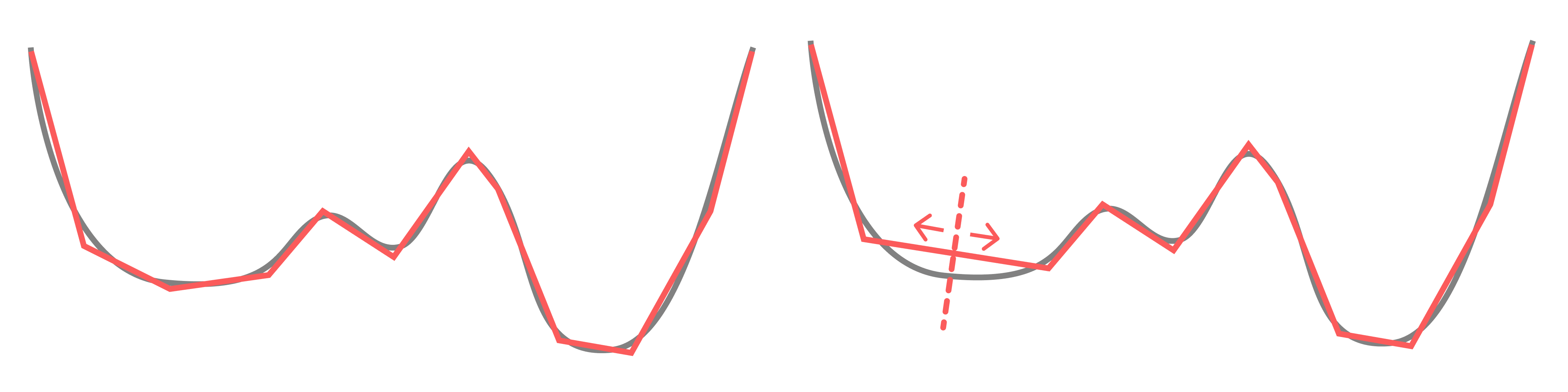
The vertices between polytopes correspond to a set of constraints on the weights. Consider what happens when two neighboring linear pieces line up (left to right). One vertex becomes redundant (dotted lined). You can now move the vertex along the shared polytope without changing the function implemented. This corresponds to a continuous transformation of your weights in some direction of weight space. Importantly this is only true locally— as soon as the vertex reaches the next edge of the shared polytope, pushing it any further will change the function. Moving the vertex in any direction orthogonal to the polytope will also change the function.