Bayes' rule: Proportional form
If and are hypotheses and is a piece of evidence, Bayes's Rule states:
We can see this as justifying a rule about odds ratios, like, in the Diseasitis example,
But if we read off the three quantities in the equation directly, we get or
If we try to directly interpret this, it says, "If a patient starts out 0.25 times as likely to be sick as healthy, and we see a test result that is 3 times as likely to occur if the patient is sick as if the patient is healthy, we conclude the patient is 0.75 times as likely to be sick as healthy."
This is perfectly valid reasoning, and we could call it the proportional form of Bayes's Theorem. To get the probability back out, we reason that if there's 0.75 sick patients and 1 healthy patient in a bag, the bag is 0.75/(0.75 + 1) = 3/7 = 43% full of sick patients.
Spotlight visualization
One way of looking at this result is that, since odds ratios are isomorphic up to multiplication by a positive constant, we can fix the right side of the odds ratio as equaling 1 and ask about what's on the left side. This is what we do when seeing the calculation as the form suggested by the theorem proved above.
We could visualize Bayes's Theorem as a pair of spotlights with different starting intensities, that go through lenses that amplify or reduce each incoming unit of light by a fixed multiplier. In the Diseasitis case, if we fix the right-side blue beam as having a starting intensity of 1 and a multiplying lens of 1, the result visualizes the calculation 0.25 * 3 = 0.75:
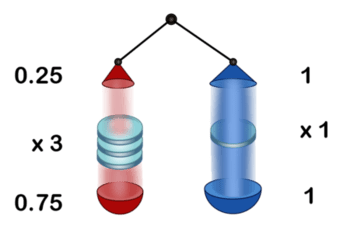
Note the similarity to the waterfall visualization. The main thing the spotlight visualization adds is that we can imagine varying the absolute intensities of the lights and lenses, while preserving their relative intensities, in such a way as to make the right-side beams and lenses equal 1.
Usefulness in informal argument
Arguably, the proportional form of Bayes's Rule is the fastest way of describing a Bayesian argument, without using any special notation like odds ratios, which at least sounds like it maybe ought to be true. If you were having a fictional character suddenly give a Bayesian argument in the middle of a story being read by many people who'd never heard of Bayes, you might have them say:
"Suppose the Dark Mark is certain to continue while the Dark Lord's sentience lives on, but a priori we'd only have guessed a twenty percent chance of the Dark Mark continuing to exist after the Dark Lord dies. Then the observation, 'The Dark Mark has not faded' is five times as likely to occur in worlds where the Dark Lord is alive as in worlds where the Dark Lord is dead. Is that really commensurate with the prior improbability of immortality? Let's say the prior odds were a hundred-to-one against the Dark Lord surviving. If a hypothesis is a hundred times as likely to be false versus true, and then you see evidence five times more likely if the hypothesis is true versus false, you should update to believing the hypothesis is twenty times as likely to be false as true."
Similarly, if you were trying to explain the meaning of a positive test result to a patient, you might say: "If we haven't seen any test results, patients like you are a thousand times as likely to be healthy as sick. This test is only a hundred times as likely to be positive for sick as for healthy patients. So now we think you're ten times as likely to be healthy as sick, which is still a pretty good chance!"
Diagrams might be better, but this is probably the most valid-sounding thing that is quantitatively valid that you can say in three sentences.