A bit disappointed that the story didn't involve terrorists mass duplicating a gram of uranium-235 and blowing up a bunch of places.
Suitcase nukes are already a thing. My model for why terrorists haven't already done this is that it's kinda hard to get enough highly enriched nuclear material. But it is probably much easier to get a teensy bit!
Equivalence classes of sets under directions is the standard way of defining "size" (cardinality), so unless you are talking about some more specific idea this is not just something in some circles of math.
There are also ordinals, which are ordered sets under order isomorphism. You use cardinals when you only care about size (meaning each element doesn't have an individual identity), and ordinals when you also care about order (so each apple still doesn't have an individual identity, but the way they are lined up on the plate matters)
Honestly neither are useful to most mathematicians, beyond distinguishing countably infinite from uncountably infinite.
I am struggling to find good studies on typical migraine pain levels. Informal sampling (reddit + vibes + friends) suggests mine are abnormally mild, so "debilitating" is fine. I just wanted to add my anecdata as an existence proof.
Light, sound, and motion sensitivity alone make me not want to go anywhere, likewise nausea. For myself, I remember having occasional random non-migraine headaches that were more painful (but shorter) than the migraines I've had.
Nitpick: shouldn't the observation that you didn't observe a proof of negation be a "codisproof" (that is, nonobservation of disproof)? Now, disproof is a type of proof (namely a proof of the negation), so you can validly say that codisproof is a type of coproof (namely, a coproof of negation). This does mean that proof and codisproof are the two that are evidence for H, while disproof and coproof are evidence for -H.
The link is about social contagion[1] type induction of mental illnesses like anorexia. I'm uncertain how true they are for stuff like anorexia, but think that they are much more unlikely to hold for cluster headaches:
I expect it's harder to social-contagion into severe headache pain. Counter-evidence: I've heard some people say that chronic back pain can sometimes be fixed using some psychological techniques that cause you to then do some things that fix it or something? However I think there's a scale difference here, along with suddenness without inciting incidents.
I can see how you end up becoming that way, have analogies to draw with my own experiences, see the wisdom that "a part
Migraines are much worse — there is debilitating pain that lasts for hours, often with extreme light sensitivity and vomiting on top of it. I’ve never had one, but I’ve watched someone close to me get them regularly — and I’d personally pause before wishing a migraine on my worst enemy. Our old good friends, ibuprofen and aspirin, are at least somewhat helpful for a majority of patients
This is not always true about migraines. I rarely (~3ish/year) get migraines, and mine are mild. I am technically "debilitated" for hours, but the pain intensity wasn't much worse than a tension headache for me. The light sensitivity and nausea suck, but mostly I was... (read more)
I personally use only one fist. I go from left to right on my left hand, using my right pointer finger to touch the successive knuckles and valleys. After reaching July for my pointer finger's knuckle, I double back (doing that knuckle again for August). I like the visual compactness, and having separate hands for the pointer and the reference.
For me, a critical step was using shaving cream. Yes, I was not doing that. I think what happened is I once tried shaving cream as a kid, didn't seem to think it did anything, and then for the next few years would spend an hour on an inferior and painful shave. Additionally, using new blades - I think a few weeks to a month is about my razor frequency if it's just used for my face?
I think I'd prefer the header-thing to take up half the vertical width that it does. But I have weaker feelings there and probably others like it more than I dislike it.
"whispy" certainly captures part of my aesthetic discontent. I think it is literally just going from (on my end in dark mode) the previous dark green text on black background to white and grey text on weaker grey background.
Edit: I just looked at the wayback machine, the profile page did not look like what my memories thought it did - I must've been thinking of design features elsewhere on LW, like profile mouseovers and green links in post bodies. The "wispy"... (read more)
This was a prose piece I performed for the 2024 KC Winter Solstice celebration, written by me
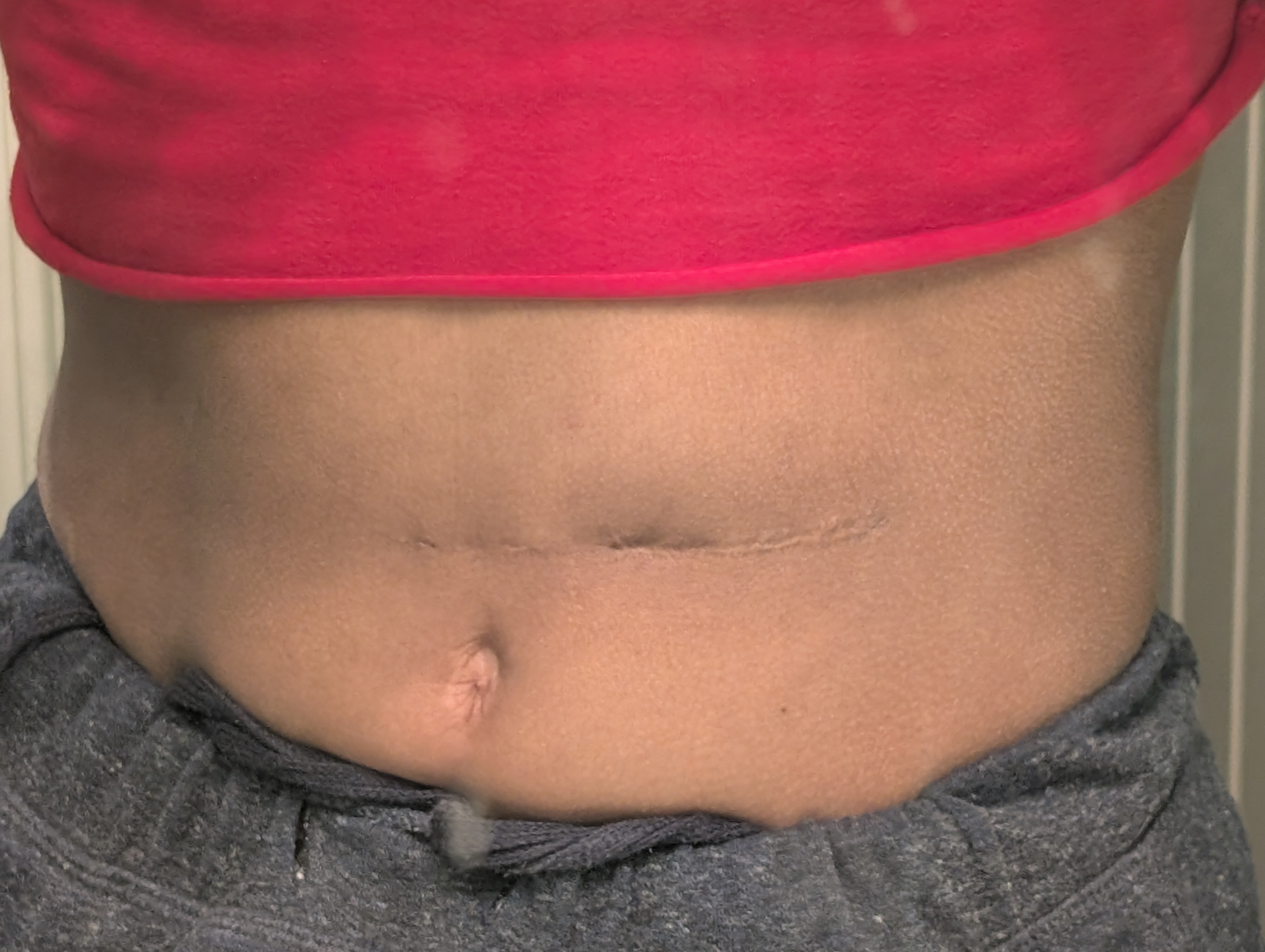
I have a scar running from right above my navel to the right end of my abdomen. You see, I was born premature, with a volvulus, which means that my intestines were tangled and blue. I spent the first months of my life in the NICU in New York, my dad trying to get what time he could from a job that required travel to spend with me. The scar is from surgery to untangle my intestines - which is a thing we can do now!
All that has happened since then. Every laugh, every smile, every... (read more)
The Neuralink YouTube channel (which is apparently a thing that exists) released a demo of their technology using Pager, a nine year old Macaque monkey.
WHO'S A GOOD MONKEY! YES YOU ARE!
Video Overview
In the video, Pager plays two games using a joystick. For the first, he moves a cursor to an orange square in a grey grid, then moves it to the next square to pop up. For the second, he plays his favorite game, Pong.
While he plays, the Neuralink team have been analyzing the neural activity in his brain using a Neuralink implanted in his brain. They are able to receive data in realtime, and figure out which patterns of activity correspond... (read more)

A bit disappointed that the story didn't involve terrorists mass duplicating a gram of uranium-235 and blowing up a bunch of places.
Suitcase nukes are already a thing. My model for why terrorists haven't already done this is that it's kinda hard to get enough highly enriched nuclear material. But it is probably much easier to get a teensy bit!