Here are some clearer evidence that broader usages of "AI alignment" were common from the beginning:
The “alignment problem for advanced agents” or “AI alignment” is the overarching research topic of how to develop sufficiently advanced machine intelligences such that running them produces good outcomes in the real world.
(I couldn't find a easy way to view the original 2015 version, but do have a screenshot that I can produce upon request showing a Jan 2017 edit on Arbital that already had this broad definition.)
By “AI alignment” I mean building AI systems which robustly advance human interests.
AI Alignment focuses on ways to ensure that future smarter than human intelligence will have goals aligned with the goals of humanity. Many approaches to AI Alignment deserve attention. This includes technical and philosophical topics, as well as strategic research about related social, economic or political issues.
I feel like to the extent there is confusion/conflation over the terminology, it was mainly due to Paul's (probably unintentional) overloading of "AI alignment" with the new and narrower meaning (in Clarifying “AI Alignment”)
I don't think this is the main or only source of confusion:
I think the terms "AI Alignment" and "AI existential safety" are often used interchangeably, leading the ideas to be conflated.
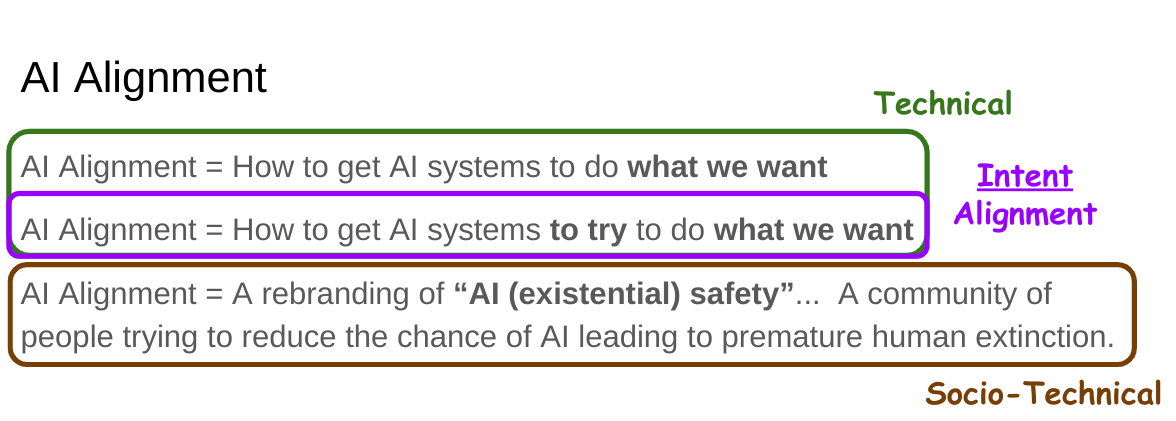
In practice, I think "AI Alignment" is mostly used in one of the following three ways, and should be used exclusively for Intent Alignment (with some vagueness about whose intent, e.g. designer vs. user):
1) AI Alignment = How to get AI systems to do what we want
2) AI Alignment = How to get AI systems to try to do what we want
3) AI Alignment = A rebranding of “AI (existential) safety”... A community of people trying to reduce the chance of AI leading to premature human extinction.
The problem with (1) is that it is too broad, and invites the response: "Isn't that what most/all AI research is about?"
The problem with (3) is that it suggests that (Intent) Alignment is the one-and-only way to increase AI existential safety.
Some reasons not to conflate (2) and (3):
In my experience, this sloppy use of terminology is common in this community, and leads to incorrect reasoning (if not in those using it than certainly at least sometimes in those hearing/reading it).
EtA: This Tweet and associated paper make a similar point: https://twitter.com/HeidyKhlaaf/status/1634173714055979010