Thank you so much for your detailed and insightful response, Esben! It is extremely informative and helpful.
So as far as I understand your text, you argue that fine-grained interpretability loses out against "empiricism" (running the model) because of computational intractability.
I generally disagree with this. beren points out many of the same critiques of this piece as I would come forth with. Additionally, the arguments seem too undefined, like there is not in-depth argumentation enough to support the points you make. Strong upvote for writing them out, though!
The main benefit of interpretability, if it can succeed, is that one can predict harmful future behavior (that would have occurred when deployed out-of-distribution) by probing internal data. This allows the researchers to preemptively prevent the harmful behavior: for example, by retraining after detecting deceptive intent. If this is scientifically possible, it would be a substantial benefit, especially since it is generally difficult to obtain out-of-distribution predictions from atheoretical empiricism.
However, I am skeptical that interpretability can achieve nontrivial success in out-of-distribution predictions, especially in the amount of time alignment researchers will realistically have. The reason is that deceptive intent is likely a fine-grained trait at the internal-data level (rather than at the behavioral level). Consequently, computational irreducibility is likely to impose a hard bound on predicting deceptive intent out-of-distribution, at least when assuming realistic amounts of time and resources.
My guess is that detecting deceptive intent solely from a neural net's internal data is probably at least as fine-grained as behavioral genetics or neuroscience. These fields have made some progress, but preemptively predicting behavioral traits from internal data remains mostly unsolved.
For example, consider a question analogous to that of deceptive misalignment: 'Is the given genome optimized for inclusive fitness, or is it optimized for a proxy goal that deviates from inclusive fitness in certain historically unprecedented environments?' We know that evolutionary pressures select for maximizing inclusive fitness. However, the genome is optimized not for inclusive fitness, but for a proxy goal (survive and engage in sexual intercourse) that deviates from inclusive fitness in environments that are sufficiently distinct from ancestral environments.
How did scientists find out that the genome is optimized for a proxy goal? Almost entirely from behavior. We have a coarse-grained behavioral model that is quite good and generalizable. Evolution shaped animals' behavior towards a drive for sexual intercourse, but historically unprecedented environmental changes (e.g., widespread availability of birth control) has made this proxy goal distinct from inclusive fitness. Parsimonious models based on first principles that are likely to be correct, like the above one, have a realistic chance of achieving situation-specific predictability that generalizes out-of-distribution.
In contrast, there is still very little understanding of which genes interact to cause animals' sex drive. Which genes affect sex drive? Probably a substantial proportion of them, and they probably interact in interconnected and nonlinear ways (including with the extremely complex, multidimensionally varying environment) to produce behavioral traits in an unpredictable manner. Moreover, a lot of the information needed to predict behavioral traits like sex drive will lie in the specific environment and how it interacts with the genome. Only the most coarse-grained of these interaction dynamics will be predictable via bypassing empiricism with a statistical-mechanics-like model, due to computational irreducibility. And such a coarse-grained model will likely be rooted in behavior-based abstractions.
Deep-learning neural nets do come with an advantage lacked by behavioral genetics and neuroscience: a potentially complete knowledge of the internal data, the environmental data, and the data of their interaction throughout the whole training process.
But there is a missing piece: complete knowledge of the deployment environment. Any internals-based model of deceptive intent that alignment researchers can come up with is only guaranteed to hold in the subset of environments that the researchers have empirically tested. In the subset of environments that the polycausal model has not been tested in, there is no a priori reason that the model will generalize correctly. A barrier to generalizability is posed by the nonlinear and interconnected interactions between the neural net's internals and the unprecedented environment, which can and likely will manifest differently depending on the environment. Relaxed adversarial training can help test a wider variety of environments, but this is still hampered by the blind spot of being unable to test the subset of environments that cannot be instantiated at human-level capabilities (e.g., the environment in which RSA encryption is broken). Thus, my guess is that the intrinsic out-of-distribution predictability of the AGI neural net's behavior would be low, just like that of behavioral genetics or neuroscience.
For a conceptual example, consider the fact that the dynamics of cellular automata can change drastically with just one cell’s change in the initial conditions. See Figure 1 of Beckage et al. (Code 1599 in Wolfram's A New Kind of Science), reproduced below:
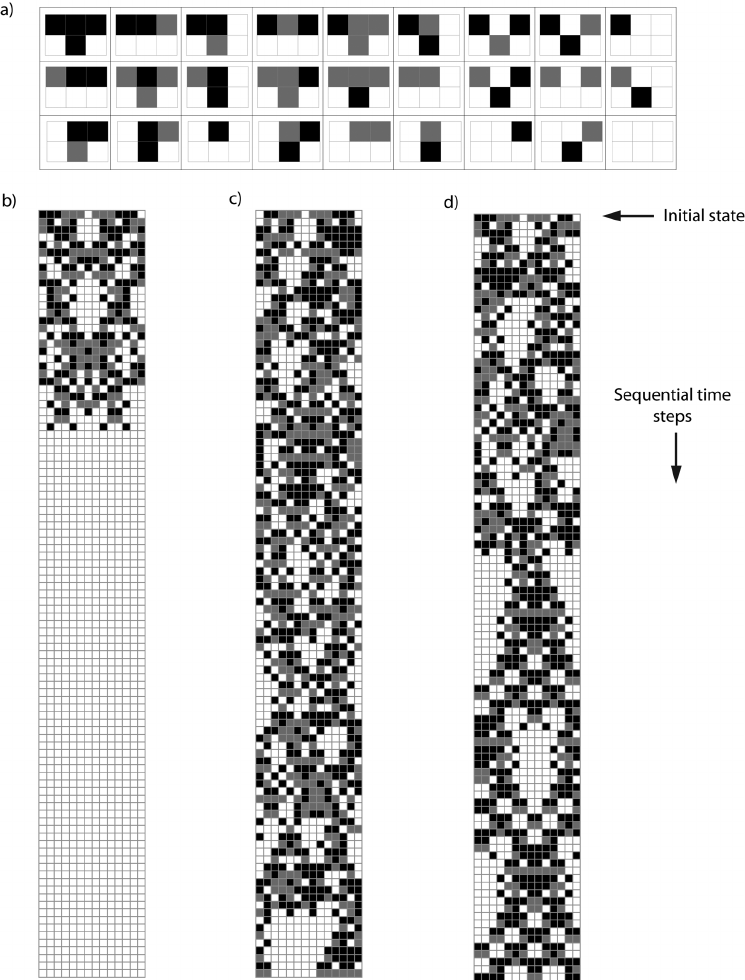
In general, the only way to accurately ascertain how a computationally irreducible agent will behave in a complex environment is to run it in that environment. Even with complete knowledge of the agent's internals, incomplete knowledge of the environment is sufficient to constrain a priori predictability. I expect that many predictions yielded by interpretability tools in the pre-deployment environment will fail to generalize to the post-deployment environment, unless the two are equal.
It seems premature to disregard the plausibility of the agenda itself, just as it is premature to disregard the project of neuroscience based on HBP. Now, arguing that it's a matter of speed seems completely fine but this is another argument and isn't emphasized in the text.
Sorry for the miscommunication! I meant to say that the rate at which mechanistic interpretability will yield useful, generalizable information is slow, not zero.
But this is sufficient for concern because informational channels are dual-use; the AGI can use it for sandbox escape. We should only open an interpretability channel if the rate of scientific benefit exceeds the rate of cost (risk of premature sandbox escape by a misaligned AGI).
My opinion is that while mechanistic interpretability has made some progress, the rate at which this progress is happening is not fast enough to solve alignment in a short amount of time and computational resources. So far, the rate of progress in interpretability research has been substantially outpaced by that in AI capabilities research. I think this was predictable, due to what we know about computational irreducibility.
Maybe it's just my misunderstanding of what you mean by fine-grained interpretability, but we don't need to figure out what neurons do, we literally design them. So the inspections happen at feature level, which is much more high-level than investigating individual neurons (sometimes these features seem represented in singular neurons of course). The circuits paradigm also generally looks at neural networks like systems neuroscience does, interpreting causal pathways in the models (of course with radical methodological differences because of the architectures and computation medium). The mechanistic interpretability project does not seem misguided by an idealization of neuron-level analysis and will probably adopt any new strategy that seems promising.
Roughly speaking, there is a spectrum between high-complexity paradigms of design (e.g., deep learning) and low-complexity, modular paradigms of design (e.g., software design by a human software engineer). My guess is that for many complex tasks, the optimal equilibrium strategy can be achieved only by the former, and attempting to meaningfully move towards the latter end of the spectum will result in sacrificing performance. For example, I expect that we won't be able to build AGI via modular software design by a human software engineer, but that we will be able to build it by deep learning.
Again, thank you for the post and I always like when people cite McElreath, though I don't see his arguments apply as well to interpretability since we don't model neural networks with linear regression at all. Not even scaling laws use such simplistic modeling, e.g. see Ethan's work.
In Ethan's scaling law, extrapolatory generalization is only guaranteed to be valid locally ("perfectly extrapolate until the next break"), and not globally. This is completely consistent with my prior. My assertion was that in order to globally extrapolate empirical findings to an unknown deployment environment, only simple models have a nontrivial chance of working (assuming realistic amounts of time and computational resources). These simple models will likely be based on parsimonious first principles that we have strong reason to be valid even in the unknown environment. And consequently, they will likely be largely based on behavioral data rather than the internal data of the agent-environment interaction dynamics.
TL;DR: A strategy aiming to elicit latent knowledge (or to make any hopefully robust, hopefully generalizable prediction) from interpreting an AGI’s fine-grained internal data may be unlikely to succeed, given that the complex system of an AGI’s agent-environment interaction dynamics will plausibly turn out to be computationally irreducible. In general, the most efficient way to predict the behavior of a complex agent in an environment is to run it in that exact environment. Mechanistic interpretability is unlikely to provide a reliable safety plan that magically improves on the default strategy of empiricism. Coarse-grained models of the complex system have a realistic chance of making robust predictions out-of-distribution, although such predictions would then necessarily be limited in scope.
The paradigm of deep learning, potentially with a small extra step, seems likely sufficient for creating AGI. This is because AI capabilities seem likely to continue increasing, given empirical scaling laws, the decreasing cost of compute, and AI corporations’ unabating desire to build increasingly powerful AI. The most recent findings from neuroscience also suggest that across different species, scale is the causal factor behind most general capabilities.
Biological systems like those of evolutionary biology and neuroscience are plausibly the best reference class for large-scale deep-learning models we have. To quote arguably the world’s leading expert in interpreting neural nets, Chris Olah:
For a more detailed case, see (1) Olah’s excellent writeup "Analogies between biology and deep learning" as well as (2) the review paper by Saxe et al. about the analogy between deep learning and systems neuroscience.
Computational irreducibility
Predicting the dynamics of biological systems is often computationally intractable. To quote "The limits to prediction in ecological systems" by Beckage et al.:
Unlike astronomical systems, however, ecological systems often have computationally irreducible dynamics.
The computational irreducibility of ecological systems is due to “(1) the difficulty of pre-stating the relevant features of the niche, (2) the complexity of ecological communities, and (3) their potential to enable novel system states (e.g., niche creation).” As a result, the inherent predictability of ecological systems out-of-distribution is generally low. Some compelling examples of this phenomenon include the inherent unpredictability of how ecological systems will respond to future climate change and the inherent unpredictability of invasive species impact. An analogous argument correctly deduces that epigenetic systems (of genome-environment interactions) and neurocognitive systems (of brain-environment interactions) have computationally irreducible dynamics.
The three factors causing computational irreducibility in biological systems (comprised of biological agents and their environments) also seem likely to apply to AGI-scale deep-learning systems (comprised of AI agents and their training or deployment environments).
Implications for predictability of agent-environment interactions
What are the implications of computational irreducibility for high-complexity systems like biological systems and future AGI systems? To again quote Beckage et al.:
A coarse-grained model—if decently correct—can make robust predictions about a computationally irreducible system, although such predictions would necessarily be informationally incomplete. This is consistent with my research background in high-complexity systems like those of biological science and social science. For such a high-complexity system, the only general hope for predictability out-of-distribution (in the absence of unrealistically large amounts of time and computational resources) is to deduce theorems from a coarse-grained model of the system based on decently correct first principles. And due to information loss, the types of predictions this method can yield are generally quite limited in scope.
In the more optimistic case where one can fully specify a computationally irreducible agent’s environment a priori, the most efficient way to predict the agent’s behavior in that environment is to run it in that exact environment. There is no shortcut, such as one based on the agent's internal data.
What does this mean for current AI safety research directions?
Given that future AGI systems will plausibly be computationally irreducible, I think the following implications of computational irreducibility deserve consideration.
1. Fine-grained interpretability of an AGI-scale model (e.g., interpreting circuits) may be intractable if researchers only have a short amount of time.
Many AI safety researchers consider fine-grained interpretability to be a promising research direction for reducing AGI x-risks. For example, Eliezer Yudkowsky—one of the founders of the AI safety field—has remarked that the interpretability agenda is "exceptional in the field," because he thinks it is one of the few research directions in the field that is "on a pathway to anything important at all."
But this may be false. Due to computational irreducibility, achieving fine-grained interpretability of AGI-scale models may be intractable in the absence of an unrealistically large amount of time and of computational resources.
A cautionary tale is provided by the Human Brain Project, which aimed to achieve a causally accurate predictive model of a brain. Why did the Human Brain Project crash and burn? Because computational irreducibility imposed a hard limit to the scientific upside of the project.
This was predictable, to the point where a year into the $1.6 billion project, almost a thousand neuroscientists—who could have gotten salaries for long periods of time by participating in the project—instead selflessly boycotted it as a waste of scarce scientific resources. That year, the Guardian reported:
And the project did in fact crash and burn. To this day, progress on achieving a causally accurate model of the brain remains marginal at best.
Anthropic plans to rely on interpreting large-scale models at the circuit level. Given the hard bounds on predictability imposed by the phenomenon of computational irreducibility, the Human Brain Project’s waste of $1.6 billion and years of researchers’ time provides a cautionary tale for Anthropic on its strategy for how to use its $580 million funding. This is because the complexity and computational irreducibility of AGI-scale models likely imply that achieving a fine-grained causal understanding of AGI-scale models will require an extremely large amount of time and computational resources, just like for neuroscience.
To be clear, a fine-grained causal understanding may be theoretically achievable given enough time and computational resources. A more optimistic reference case is provided by gene-editing, where scientists—through immense trial and error—have obtained a nontrivial ability to make a priori predictions based entirely on genomic code data. But even this scientific problem is largely unsolved. Because the inherent predictability of the genome-environment system may be low, even gene-editing strategies that scientists are comparatively confident in today will almost certainly come with unforeseen side effects arising from extremely complex and unpredictable epigenetic dynamics.
A counterargument is that researchers have more ready access to internal data for neural nets than they do for neuroscience, and that this advantage can be a game-changer. However, this advantage does not seem to address the core issue of computational irreducibility, which seems likely to be an inevitable consequence of using deep learning rather than lower-complexity paradigms (like software design by a human software engineer). Given that the core issue of computational irreducibility exists, it seems plausible that easier access to internal data will only result in a moderate increase in the rate of solving neural-net interpretability compared to the rate of solving neuroscience interpretability. This would imply that the challenges of solving neuroscience, and the prematureness and resource waste of the Human Brain Project, are apt cautionary tales for a safety plan based on fine-grained interpretability of AGI-scale neural nets, even if Anthropic’s brilliant, well-meaning, and well-funded researchers are the ones carrying out this safety plan.
Computational irreducibility implies that achieving a fine-grained causal understanding of a large-scale model will realistically require patient trial-and-error, in the precise environment in which the model is set to run. Mechanistically interpreting large-scale models is unlikely to provide a reliable safety plan, since it probably cannot efficiently yield the necessary predictions.
And since it is likely easy to make a large-scale model accidentally dangerous, an unprecedented security mindset is probably needed, both from a moral perspective and from the perspective of avoiding a movement-wide credibility risk for EA. This is especially true for Anthropic, a for-profit corporation whose credibility is intertwined with that of the EA movement, and whose $580 million Series B funding was famously raised by lead investor Sam Bankman-Fried (another movement-wide credibility risk that has recently blown up, even likely rising to the point of fraud).
If Anthropic is publicly blamed (fairly or not) for causing a future AGI disaster, then this may cause a substantial credibility loss for the EA movement as a whole. Combined with the one caused by Sam Bankman-Fried, the credibility of the EA movement—on AI safety matters and in general—may not be able to recover.
2. Eliciting Latent Knowledge from fine-grained internal data may be intractable if researchers only have a short amount of time.
See Point 1.
3. Coarse-grained models of AGI systems (e.g., game theory) have a realistic chance of efficiently making robust predictions out-of-distribution, but these predictions will be limited in scope.
The theory of computational irreducibility can explain why success cases in out-of-distribution predictions of complex systems—in biology, economics, and neuroscience—have generally arisen from coarse-grained information. Of course, a necessary condition for a coarse-grained model of a system to yield robust predictions is that the model is based on decently correct first principles.
Even when coarse-grained models based on decently correct first principles can yield robust predictions, however, these predictions then necessarily turn out to be quite limited in scope. To quote Mathematical Models of Social Evolution by McElreath and Boyd:
The tone of the last sentence is arguably too optimistic. The cases in which coarse-grained models can correctly make precise quantitative predictions, like Fisher’s principle of sex allocation, are extremely rare. Fisher’s principle that most sexually reproducing species produce 50% male and 50% female offspring has been called “probably the most celebrated argument in evolutionary biology” because it makes such a precise quantitative prediction, which tends to be the exception in the field, not the norm. And even when such precise predictions are possible, they are likely to then necessarily be quite limited in scope: sex allocation strategy is one of countless many phenotypic dimensions that are relevant for a given biological agent. Most aspects of phenotype are probably subject to a high level of inherent unpredictability due to computational irreducibility. This is why the best we biologists and economists can do for robust prediction usually just consists of comparative-statics predictions or functional-form predictions that are subject to significant information loss.
The above lesson has the following implication. When developing safety plans for AGI-scale models, complexity is likely to be the enemy of security. Assuming a realistic amount of time and computational resources, simple plans for AI safety based on coarse-grained models (e.g., limiting the action space of the AGI, based on game theory/mechanism design) are the ones that have a realistic chance of working in a robust, generalizable manner. And the fact that simple safety plans are insufficient to quickly provide for-profit AGI corporations with everything they want—an AGI that is simultaneously safe and economically useful—should not be used as a source of motivated reasoning that these plans can be magically improved on by a strategy of interpreting fine-grained internal data.
Acknowledgements: I am grateful to Spencer Becker-Kahn, Michael Chen, Johannes Gasteiger, Harrison Gietz, Gwern, Adam Jermyn, Arun Jose, Jonathan Mann, Xavier Roberts-Gaal, and Luke Stebbing for providing very valuable feedback on this draft.