The performance of o1 in the first linked paper is indeed impressive, especially on what they call mystery blocksworld. Would not have expected this level of improvement. Do you know of any material that goes into more detail on the RL pre-training of o1?
I do take issue with the conclusion that reasoning in the confines of toy problems is sufficient to scale directly to AGI, though. The disagreement might stem from differing definitions of AGI. LLMs (or LRMs) exist in an environment provided by humans, including the means to translate LLM output into "action". LLMs continue to be very sensitive to the properties of this environment. Humans created the languages that LLMs use to reason, as abstraction layers on top of our perception of reality, to help us communicate, reason and to control machines we build, under the constraint of a limited bandwidth. Everything LLMs do is routed through human understanding of reality. And is for the most part still limited by what we care to make accessible via language. Humans routinely deal with a degree of complexity in our environment which isn't even on the map we provided LLMs with. There is no conveniently pre-processed corpus of data to allow for LLM architecture to bridge this gap. Synthetic data only gets you so far.
You acknowledge the importance of scaffolding, but I think the term understates just how much of the actual intelligence of AGI could end up "in there". It might well turn out to be a far harder problem than language-bound reasoning. You seem to have a different view and I'd be very interested in what underpins your conclusions. If you have written more on the topic or could point me in the direction of what most strongly influenced your world model in this regard, I'd love to read it.
 1
In the past couple of weeks lots of people have been saying the scaling labs have hit the data wall, because of rumors of slowdowns in capabilities improvements. But before that, I was hearing at least some people in those labs saying that they expected to wring another 0.5 - 1 order of magnitude of human-generated training data out of what they had access to, and that still seems very plausible to me
Epoch's analysis from June supports this view, and suggests it may even be a bit too conservative:
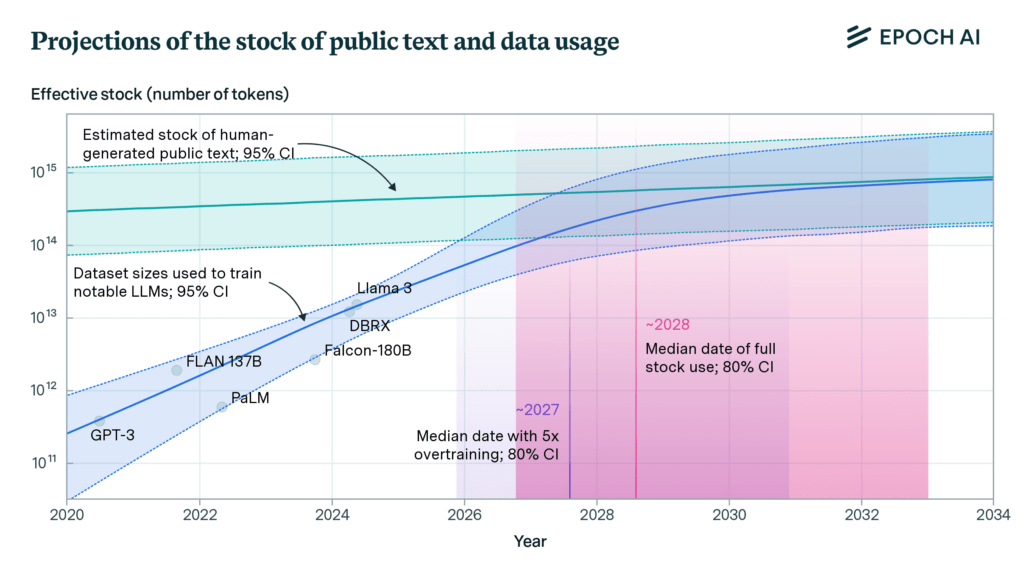
(and that's just for text -- there are also other significan...
Summary
Four months after my post 'LLM Generality is a Timeline Crux', new research on o1-preview should update us significantly toward LLMs being capable of general reasoning, and hence of scaling straight to AGI, and shorten our timeline estimates.
Update
Since writing this post, my continuing interest in this question has led to empirical research on the topic: this post describes both a completed pilot project and the plan for a now-underway larger project, expected to finish in mid-2025.
Summary of previous post
In June of 2024, I wrote a post, 'LLM Generality is a Timeline Crux', in which I argue that
Reasons to update
In the original post, I gave the three main pieces of evidence against LLMs doing general reasoning that I found most compelling: blocksworld, planning/scheduling, and ARC-AGI (see original for details). All three of those seem importantly weakened in light of recent research.
Most dramatically, a new paper on blocksworld has recently been published by some of the same highly LLM-skeptical researchers (Valmeekam et al, led by Subbarao Kambhampati[1]: 'LLMs Still Can’t Plan; Can LRMs? A Preliminary Evaluation of OpenAI’s o1 on Planbench'. Where the best previous success rate on non-obfuscated blocksworld was 57.6%, o1-preview essentially saturates the benchmark with 97.8%. On obfuscated blocksworld, where previous LLMs had proved almost entirely incapable (0.8% zero-shot, 4.3% one-shot), o1-preview jumps all the way to a 52.8% success rate. In my view, this jump in particular should update us significantly toward the LLM architecture being capable of general reasoning[2].
o1-preview also does much better on ARC-AGI than gpt-4o, jumping from 9% to 21.2% on the public eval ('OpenAI o1 Results on ARC-AGI-Pub'). Note that since my original post, Claude-3.5-Sonnet also reached 21% on the public eval.
The planning/scheduling evidence, on the other hand, seemed weaker almost immediately after the post; a commenter quickly pointed out that the paper was full of errors. Nonetheless, note that another recent paper looks at a broader range of planning problems and also finds substantial improvements from o1-preview, although arguably not the same level of 0-to-1 improvement that Valmeekam et al find with obfuscated blocksworld ('On The Planning Abilities of OpenAI’s o1 Models: Feasibility, Optimality, and Generalizability').
I would be grateful to hear about other recent research that helps answer these questions (and thanks to @Archimedes for calling my attention to these papers).
Discussion
My overall conclusion, and the reason I think it's worth posting this follow-up, is that I believe the new evidence should update all of us toward LLMs scaling straight to AGI, and therefore toward timelines being relatively short. Time will continue to tell, of course, and I have a research project planned for early spring that aims to more rigorously investigate whether LLMs are capable of the particular sorts of general reasoning that will allow them to perform novel scientific research end-to-end.
My own numeric updates follow.
Updated probability estimates
(text copied from my previous post is italicized for clarity on what changed)
Citations
'LLMs Still Can’t Plan; Can LRMs? A Preliminary Evaluation of Openai’S O1 on Planbench', Valmeekam et al (includes Kambhampati) 09/24
'OpenAI o1 Results on ARC-AGI-Pub', Mike Knoop 09/24
'On The Planning Abilities of OpenAI’s o1 Models: Feasibility, Optimality, and Generalizability', Wang et al 09/24.
I am restraining myself with some difficulty from jumping up and down and yelling about the level of goalpost-moving in this new paper.
There's a sense in which comparing results from previous LLMs with o1-preview isn't entirely an apples-to-apples comparison, since o1-preview is throwing a lot more inference-time compute at the problem. In that way it's similar to Ryan's hybrid approach to ARC-AGI, as discussed in the original post. But since the key question here is whether LLMs are capable of general reasoning at all, that doesn't really change my thinking here; certainly there are many problems (like capabilities research) where companies will be perfectly happy to spend a lot on compute to get a better answer.