Comment Permalink
Ω12-2
4
Alek: What do you think about a proposal using "ECI vs. no-CoT capabilities" instead of "ECI vs. monitorability"? It seems to me more likely that there's a nice continuous notion there which isn't too difficult to get a dataset for, ameliorating 1, 2, and 7, and I think problem 3-6 straightforwardly don't apply.
This could potentially be coupled to Evan's proposal if there was a presumption that "ECI vs. no-CoT capabilities" was an easier-to-measure metric that's upstream of many monitorability metrics, such that AI companies would accept a higher burden of proof of demonstrating and explaining why they think none of the monitorability trends are broken if the "ECI vs. no-CoT capabilities" trend looks concerning.
20
Hey Lukas! Requiring that companies do not deviate from the no-CoT capabilities (e.g., Neel's NCRI) vs ECI trend seems alright. According to Neel's post, there does seem to be a pretty good ECI vs NCRI trend that we could stick to.
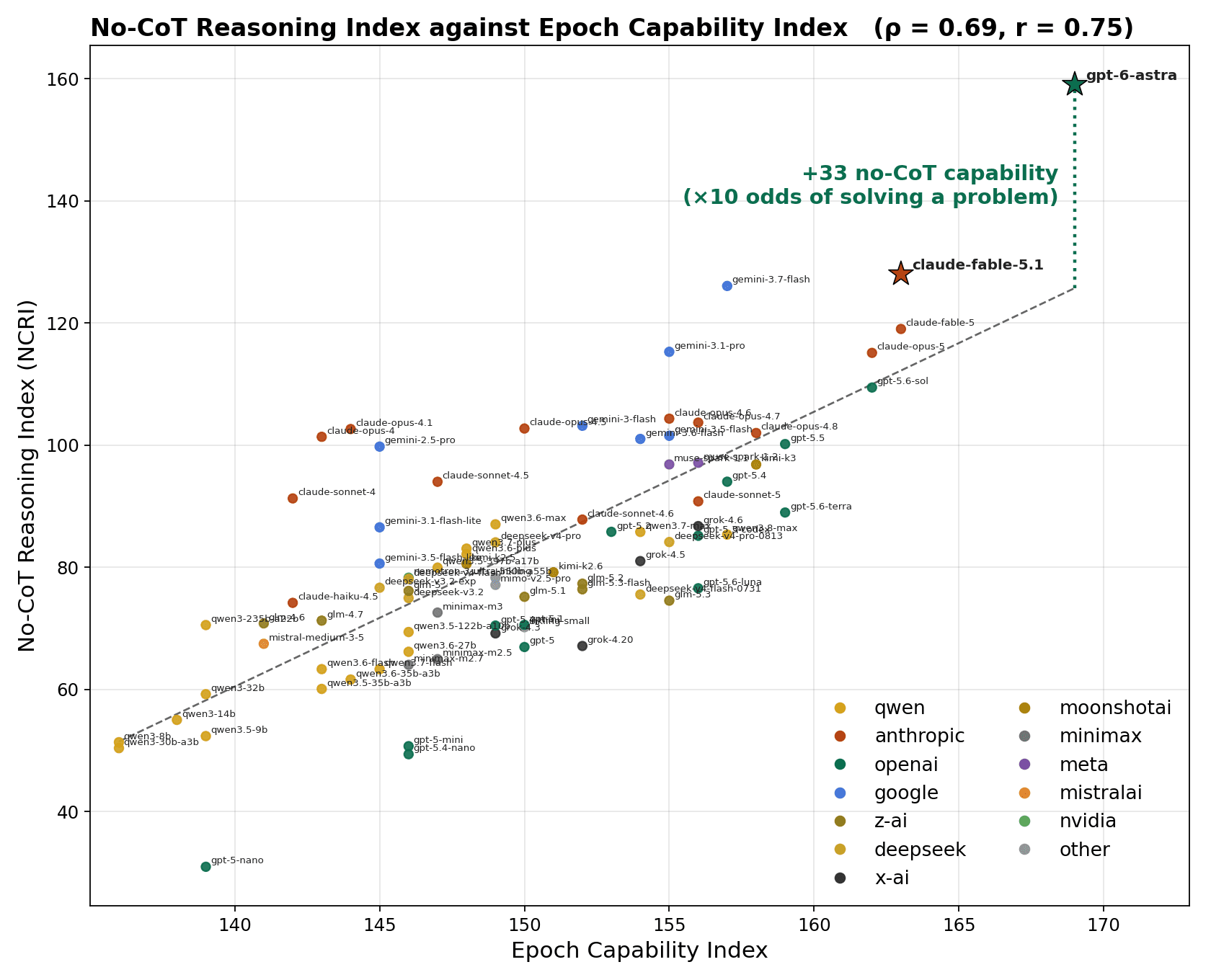
Here are a few issues that I have with NCRI:
- Models might just be really not used to doing this type of computation without CoT. Eliciting models to give empty CoTs might be hard.
- Another unfortunate aspect of this proposal is that you only get the result of "is my model acceptable" after you finish post-training. I worry that com...
There has been a lot of discussion recently of policy proposals around monitorability, such as Redwood's proposal and my counter-proposal. I'd like to say a bit more generally about how I'm thinking about monitorability. Note that nothing here is an official Anthropic position; these are just my personal thoughts.
First, a categorization. I currently think about four different types of monitorability:
Second, some notes on trustedness, which is currently my biggest conceptual uncertainty with how to think about monitorability. A basic fact that is true about at least all of the non-diffuse forms of monitorability is that you should be able to in some sense get a perfect score by just using the same model as the monitor and policy. That is because for any bad thing that the policy can think to do, if the monitor is the same model, it too should be able to come up with and detect that.
So if we ever want to be able to use monitorability as a meaningful red line, we need to have a very good answer as to why that might be insufficient. The standard answer in the literature is trustedness: you need to be able to trust that your monitor is aligned and thus not just lying to you in its monitoring. Conventionally, the idea is to separate models into "trusted" and "untrusted" based on whether you have previously made a confident alignment safety case for them. Then, you can either just evaluate monitorability relative to a trusted monitor, or try to come up with monitoring schemes that combine trusted and untrusted monitoring in some way that makes it hard for the untrusted monitors to collude (of which there are many such schemes, a simple one being to just run both the trusted and untrusted monitors together and then if the untrusted monitor ever doesn't flag something that the trusted monitor does flag, you get very suspicious that the untrusted monitor is sandbagging).
However, this basic setup has some issues, probably the biggest one being how to deal with white-box monitoring. The conservative thing to do is to just treat white-box monitors as untrusted, though in theory you might think they should be trusted because it's not clear that a misaligned model would actually be able to spoof a white-box monitor looking at its own activations. However, I think this idea is pretty untested and relies on white-box monitors picking up on deep features about the model's intent, which it's very unclear to me that they actually do—for example, if you train a white-box monitor on prior examples you were able to detect (rather than e.g. some sort of unsupervised discovery of an intent-laden direction), that leaves open the possibility of a generalization where the classifier learns to only detect the sort of things that you would previously have been able to detect but doesn't detect subtler things that a smarter policy might be able to do.
Given all of that, I would propose the following methodology for how to do (non-diffuse) monitorability evaluations:
Finally, some thoughts on monitorability-based policy proposals. The big thing I'd like to see is a combination of a) red lines for absolute levels of unmonitorability that labs should not cross and b) measures that constrain the degree to which labs can do things that degrade monitorability even before reaching those red lines. (a) is in some sense the best thing to do here, though I'm somewhat nervous about it in isolation given that it doesn't constrain actions at all now, which is why I'd prefer it to be coupled to some sort of (b) that meaningfully binds all along the way.
I've already written about what I'd like to see for (b), which is to evaluate the quotient of unmonitorability/capabilities and reject any substantial model change that makes that quotient—what I'll call the "monitorability externality"—too high. The idea is that a monitorability externality would be a change that makes monitorability even worse than would otherwise have previously been predicted for a given level of capabilities. For actually evaluating this quotient, I suggest simply using the methodology I described above for evaluating all the different types of unmonitorability, and then something like ECI for capabilities.
In addition to proposals like that which result in constraints along the way, I also think that ideally we'd be able to enshrine some hard monitorability red lines as well. I'd propose both Control and Training Monitorability red lines—with Auditing Monitorability implicitly present to the extent that it constrains the trustedness of the monitors that you evaluate the others with respect to, as above. Specifically, I'd suggest something like: