We have been hunter gatherer for a couple of hundred thousands years, and farmers for a couple of thousands.
I'd be wary of leaning too hard into this kind of argument, because our evolutionary history goes back more than a hundred thousand years.
Homo Habilis are currently believed to have been opportunistic scavengers at best, given that they weren't adapted well enough to running to do persistence hunting.
> [...they were capable of eating a broad range of foods, including some tougher foods like leaves, woody plants, and some animal tissues...](https:/... (read more)
A reasonable estimate for a sedentary person is https://www.omnicalculator.com/health/bmr-harris-benedict-equation multiplied by 1.2. Plus any activity on top. Worth calculating - you might be at a much bigger calorie deficit than you think.
When I'm at a 200-400 calorie deficit for a while I can still be very active, but my mood feels flat and I have a hard time getting excited about anything.
You can get pretty similar graphs by just assuming that hiring slowly increased up to 2021 and then slowly decreased. The demographic bulge from the hiring spike moves up in age over time, and normalizing to 2022 hides the fact the overall ratio of hires at different ages hasn't changed at all.
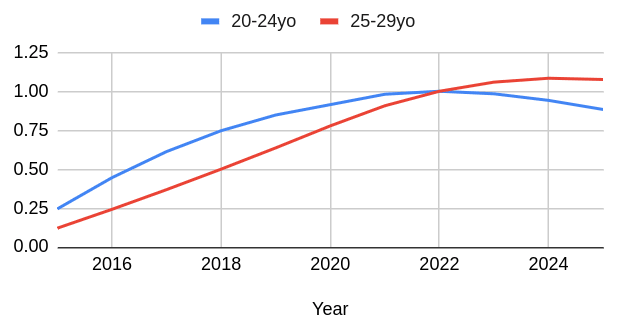
https://docs.google.com/spreadsheets/d/1z0l0rNebCTVWLk77_7HAwVzL7QtTjlrllAMH2lxhnes/edit?usp=sharing

There have been massive improvements in productivity in infrastructure from cloud services, especially object storage. See eg https://materializedview.io/p/infrastructure-vendors-are-in-a-tough for many examples of small teams out-competing established vendors.
But I didn't notice that until it was pointed out to me by several sources. So should I expect to notice large productivity improvements from LLMs? How huge would they have to be to show up in the sparse signal that I'm getting? What data would I even have to be looking at to see a 5x improvement in productivity?
A friend from Singapore did Express Entry and only took three months. Mine appears to have been longer because the London embassy was in the middle of moving buildings. When I went in for my biometrics it was total chaos - they didn't even have a regular camera setup yet so they tried taking pictures in three different rooms. Then after they approved it they kept failing to actually send the approval paperwork. But it seems like normally the process is pretty fast.
I hear that if you live in, say, India then getting things like police certificates is a lot more expensive and can take a long time.
I wrote about my experience with Canada (instant permanent residency) - https://scattered-thoughts.net/writing/canadas-express-entry-program/. Worth noting that so far this year they haven't offered any places in the regular program - https://www.canada.ca/en/immigration-refugees-citizenship/corporate/mandate/policies-operational-instructions-agreements/ministerial-instructions/express-entry-rounds.html.
Wesley Aptekar-Cassel wrote about his experience with Taiwan (very quick renenewable work visa) - https://notebook.wesleyac.com/taiwan-gold-card/
You can use leechblock to add time restrictions for any site.
It also has the option to add loading delays to sites, which I find useful for sites which I can't afford to block outright.
I've seen some authors use 'subjective experience' for the former and reserve consciousness for the latter. Unfortunately consciousness is one of those words, like 'intelligence', that everyone wants a piece of, so maybe it would be useful to have a specific term for the latter too. 'Reflective awareness' sounds about right, but after some quick googling it looks like that term has already been claimed for something else.
Uncontrolled argues along similar lines - that the physics/chemistry model of science, where we get to generalize a compact universal theory from a number of small experiments, is simply not applicable to biology/psychology/sociology/economics and that policy-makers should instead rely more on widespread, continuous experiments in real environments to generate many localized partial theories.
A prototypical argument is the paradox-of-choice jam experiment, which has since become solidified in pop psychology. But actual supermarkets run many 1000s of in-situ... (read more)
life is sufficiently hard as it is. We don't need to make it any harder than it has to be.
It seems like Kierkegaard could distinguish between kinds of difficulties. It feels good to deliberately challenge yourself. It doesn't feel good to fight to avoid snapping at your partner because you're hangry because you forgot to go shopping.
Maybe some difficulties are challenges to overcome and some are just friction to avoid.
TAPs seem to last about a week for me without some other regular reinforcement mechanism.
For a few weeks I've been writing them down in a text file. I read and rehearse them every morning over coffee, and just before I go to bed I look through them and reflect on whether I missed any triggers. It fits into journal habits that I already had so the inconvenience is quite low. So far I've been noticing triggers at a higher rate, but it's still in the novelty phase.
My mind is already spinning excuses on overdrive.
As a teenager I spent 7 years in military school. They adopted the army ethos that if something under your responsibility goes wrong, you get punished. Regardless of whether you could have done anything about it. Trying to produce excuses usually led to being cut off with "I don't care" followed by increasing the punishment.
This had an interesting effect - if you know you are going to be punished regardless of excuses, you stop thinking about excuses and start trying to head off problems. It's ... (read more)
This post is rekindling my urge to run away and live on a boat :)
I'd propose that another aspect of the steampunk aesthetic is uniqueness - a rebellion against the era of mass production. You don't live in a standard Mark II Apple iBoat, you live in a constantly changing hand-built ship-of-Theseus that only you could ever understand or operate.
In that aspect at least, Linux has steampunkish tendencies. You may start with a standard distro, but over time it becomes a web of shell scripts and homebuilt jury-rigged tools, until you reach the point ... (read more)
Agreed. 'Rest in bed as much as possible but grudgingly take the actions needed to stay alive' sounds a lot like depression, but there exist non-depressed people who need explaining.
I wonder if the conversion from mathematics to language is causing problems somewhere. The prose description you are working with is 'take actions that minimize prediction error' but the actual model is 'take actions that minimize a complicated construct called free energy'. Sitting in a dark room certainly works for the former but I don't kno... (read more)
(Posting here rather than SSC because I wrote the whole comment in markdown before remembering that SSC doesn't support it).
We had a guest lecture from Friston last year and I cornered him afterwards to try to get some enlightenment (notes here). I also spent the next few days working through the literature, using a multi-armed bandit bandit as a concrete problem (notes here ).
Very few of the papers have concrete examples. Those that do often skip important parts of the math and use inconsistent/ambiguous notation. He doesn't seem to have releas... (read more)
I didn't see the post itself, but it sounds like Unconscious Thought Theory. The experimental evidence is pretty weak, and imo the theory as it stands is just too poorly specified to really test experimentally.
There is some evidence that offline processing matters for eg motor learning or statistical learning. I haven't looked in enough detail to know whether to trust it or not.
My wife coaches teen athletes and the signs she's taught to look out for are not weight loss but withdrawal, depression, poor digestion, feeling cold etc. Not to say that you're doing something unhealthy, just that low mood is a known effect of being in an extended calorie deficit and not necessarily an effect of the semaglutide.
As you go further into deficit you tend to downregulate other stuff (eg bone and tissue maintenance) before losing weight faster, so the amount of weight loss only gives you an lower bound on your deficit. It might be worth tr... (read more)