Lake
Message
44
29
Lanier struck me as a sort of latterday Rorty: broadly a pragmatist; suspicious about the rigidity of linguistic meaning; unwilling to try to refute big visions but rather inclined to imply that he finds them silly and that perhaps any decently civilized person should do too.
The trouble with this outlook is, if your sense of what's silly is itself miscalibrated, there's not much anyone can do to help you. Moreover if meaning really is too slippery and amorphous to make debating big visions worthwhile, presumably the bright thing to do would be to avoid tho... (read more)
For what it's worth, I still find the mock-mysticism stuff fairly entertaining. Hard to think of another running joke that would stay good over the same duration.
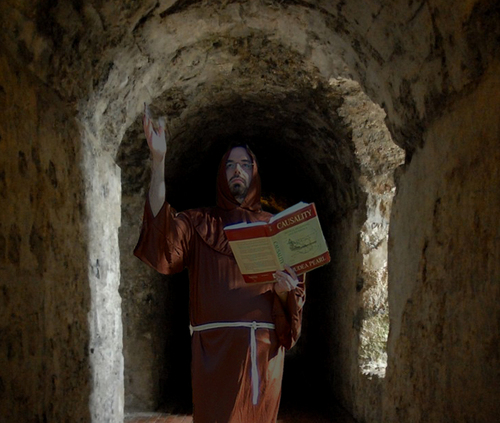
Lest we forget: http://lesswrong.com/static/imported/2008/03/27/elimonk2darker.jpg
@ Caroline: the effect on overall human fitness is neither here nor there, surely. The revolutionary power cycle would be adaptive because of its effect on the reproductive success of those who play the game versus those who don't. That is, the adaptation would only have to benefit specific lineages, not the whole species. Or have I missed your point?
No, I suppose you're right, insofar as there's no fixed initial quantity to be divided. But both involve an equal apportioning of something: money to workers in the one case, and money to man-hours in the other. The parable doesn't undermine the notion that equality is essential to all concepts of fairness, even where different versions license different outcomes.
While it seems intuitively pretty clear that fairness involves an equal division of something - be it pie, meta-pie or whatever - there seems to be an embarrassment of plausible candidates for the quantity to be divided. Which is fairer: an equal distribution of goods, of opportunities or of utility? If I read him right, Eliezer would recommend deciding this question by first doling out an equal distribution of votes. But that just palms the dilemma off onto the voters.
@ Ian C. Couldn't Subhan claim that as a restatement of his own position? His notion of wanting clearly encompasses more than mere whims. Perhaps he would say that a certain subset of desires, objectively grounded in the constitution of the mind, count as moral impulses.
Actually, is Subhan meant to be male? Apologies if not.
There's at least one other intuition about the nature of morality to distinguish from the as-preference and as-given ideas. It's the view that there are only moral emotions - guilt, anger and so on - plus the situations that cause those emotions in different people. That's it. Morality on this view might profitably be compared with something like humour. Certain things cause amusement in certain people, and it's an objective fact that they do. At the same time, if two people fail to find the same thing funny, there wouldn't normally be any question of one ... (read more)
I suppose that's just to second Paul Gowder's point that the political problem is insurmountable. But I imagine few things would resolve a political problem faster then the backing of an all-powerful supermind.
@Paul: You seem to suggest that we all take the same things to be reasons, perhaps even the same reasons. Is this warranted?
Eliezer: Are you looking for a new definition of "fairness" which would reconcile the partisans of existing definitions? Or are you just pointing out that this is a sort of damned-if-you-do, damned if-you-don't problem, and that any rule for establishing fairness will piss somebody or other off? If the latter, from the point of view of your larger project, why not just insert a dummy answer for this question - pick any definition that grabs you - and see how it fits with the rest of what you need to work out. Or work through several different obv... (read more)
@ frelkins:
Eliezer's brand of humanism seems to consist in endorsing many of the values of traditional humanism while ditching the metaphysics. Jaron seemed to think the metaphysical stuff - specifically, psychological dualism of some sort - is indispensible. I'm not sure who should have proprietory rights over the word, but that argument is surely more about brand ownership rather than anything deep. And surely there's little enough to recommend dualism in itself.
Jaron's epistemic caution also struck me as being slightly odd. It's one thing to beware delu... (read more)