You can disable the silent nerfing when using the api, so it's not really about preventing fooling the classifier.
 1
1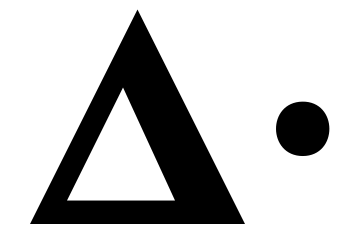 1
1such a model would probably take less than $100 million to train and so this law wouldn't apply.
I think the parent meant an ideal form of price discrimination where the entire consumer surplus is instead claimed by the company.
I recently saw a Hank Green video (https://youtu.be/DpGU8NARX-s?t=558) where he gives a definition of pseudoscience that I thought was pretty good.
The basic idea is that science is the process by which we create evidence for something, and then have that evidence be challenged. Doing this repeatedly helps us notice that some structures are pretty good for creating good evidence (ie statistics, double blind trials, falsifiability, etc.). Pseudoscience is using these same structures to make what you're doing look like science, without actually interacting with the "being challenged" part.
This post answers the question: Is AI smart enough to largely independently, and without any special structure find vulnerabilities?
Personally I think the following question is more important (and interesting): Can we use AI to find vulnerabilities autonomously?
This seems to be something AIxCC tries to answer.
Why are you donating these credits?
I thought it would be helpful to include the statistics from said report here (non-broken link to the report at time of posting). The values sum to 120.7%
Current or Former Intimate Partner: 51.1%
Family member: 12.5%
Person of Authority: 2.5%
Acquaintance: 40.8%
Stranger: 13.8%
I read the reasoning more as:
A: "It's ok to offer victims advice on how to reduce their risk."
B: "This statement is universal, but in general it's wrong to give victims advice (as just receiving this advice is hurtful), so this is a wrong statement to make."
B: "But the advice tends to be given at inappropriate times and with what appears to be insufficient compassion"
I read the root comment as the statement "it is almost universally inappropriate to give victims advice" because of [all these interconnected societal things].
If such claims were instead sometimes true, then they would sometimes be made.
I don't see how this is relevant? No matter if these claims are sometimes true, rape victims know these claims are made, and this knowledge will impact how they experience receiving "wisdom".
Offering advice after the assault has already happened can come across as scary because of the fear that you'll follow up with "well it's your fault for wearing that" or "well if you were drunk then I don't believe you because you might have misremembered something".
Presumably the existence of such claims would make this more scary?
C2PA isn't a watermark, as it's tacked on to the end of the file. I wouldn't call the camera meta info attached to pictures I take with my phone a watermark, and C2PA is basically just that. I believe that "invisible provenance signals" is referring to something like Google's https://deepmind.google/models/synthid/
What would be your ideal law if not bill 469? Should AI agents be able to form legal personhood?
Seems like this competitor is just fraud, as reported here: I Think Substrate is Fraudulent: Part 1
The problem with gerrymandering is that it makes elections less representative. It seems to me that (section 2 of) the Voting Rights Act makes elections more representative, so that's good. It seems reasonable to be mad at republicans when they implement measures that make elections less representative that benefit them, but not when you want elections to stay less fair.
Did this prediction end up being true? We'll charitably interpret the prediction as being about Anthropic itself
I'd expect if you have a simpler project, more of the code can be written by AI. Creating AI seems like it's on the more complex side of projects, so if 90% of all code is written by AI, I'd expect less than 90% at Anthropic.
Missing "is". (Also I couldn't find the pls fix input on your site)
Edit: also