[OpenAIAlignment Research Blog](https://alignment.openai.com/)

[← Home](https://openai.com/)[Research and Releases](https://alignment.openai.com/)[Misalignment Reports and Notices](https://alignment.openai.com/misalignment-reports/)[System Cards ↗](https://deploymentsafety.openai.com/)

# What affects chain-of-thought monitorability across the model lifecycle?

How pretraining, architecture, reinforcement learning, and model-generated data affect chain-of-thought (CoT) monitorability.

November 10, 2026
Jeffrey G. Wang\*, Aiden Low\*, Zora Che\*, Holden Mui\*, Harshit Sikchi*
Yong Zheng-Xin, Tomek Korbak❦, Bill Stavroulakis, Alex Barron, Shibani Santurkar, Kristian Georgiev
Micah Carroll†, Ben Sokolowsky†, Katherine Lee†, Jakub Pachocki†
\* Equal contribution · ❦ Work done while at OpenAI · † Equal advising

## Summary

We studied how pretraining, architecture, reinforcement learning, and model-generated data shape two proxies of CoT monitorability: no-CoT capability and CoT controllability.

Lower base-model perplexity and some architectural changes improve no-CoT reasoning, while RL and model-generated data can increase CoT controllability. These are imperfect proxies for monitorability, but together they indicate that models will become harder to monitor through their CoT as we scale toward more intelligent systems.

## Introduction

Effective control of AI agents relies on confidence in their monitorability, which [has previously been defined as](https://arxiv.org/pdf/2512.18311) “the degree to which we can identify particular aspects of a model’s actions (such as if it will cause harm).” [\[1\]](https://alignment.openai.com/cot-monitorability-model-lifecycle#reference-1) As such, monitorability is a core pillar of our [safety cases](https://openai.com/index/towards-safety-cases-for-frontier-ai-training/). [\[2\]](https://alignment.openai.com/cot-monitorability-model-lifecycle#reference-2) While monitorability may be achieved by looking at actions or activations, so far we have also relied on [chain-of-thought (CoT) monitorability](https://arxiv.org/abs/2507.11473) as a key component of our scalable oversight strategy. [\[3](https://alignment.openai.com/cot-monitorability-model-lifecycle#reference-3), [4](https://alignment.openai.com/cot-monitorability-model-lifecycle#reference-4), [5\]](https://alignment.openai.com/cot-monitorability-model-lifecycle#reference-5) CoTs usually contain information about a model’s intent and plans for misbehavior, and help us detect misalignment to inform upstream mitigations.[1](https://alignment.openai.com/cot-monitorability-model-lifecycle#note-1) In internal and external deployment for certain models—such as cyber critical ones—[we monitor our models’ full trajectories, including their CoT](https://openai.com/index/how-we-detect-frontier-model-misalignment/). [\[7\]](https://alignment.openai.com/cot-monitorability-model-lifecycle#reference-7)

CoT monitorability has generally remained very high since the development of reasoning models. However, with GPT-6 Astra we observed degradation in [CoT monitorability for non-adversarial settings](https://deploymentsafety.openai.com/gpt-6-astra/monitorability-under-non-adversarial-conditions), greater [ability to perform CoT monitor evasion under adversarial testing](https://deploymentsafety.openai.com/gpt-6-astra/monitor-evasion), and significantly greater [no-CoT capability](https://deploymentsafety.openai.com/gpt-6-astra/external-evaluation-for-monitorability---uk-aisi) compared to prior models.[2](https://alignment.openai.com/cot-monitorability-model-lifecycle#note-2) [\[8\]](https://alignment.openai.com/cot-monitorability-model-lifecycle#reference-8) Motivated by these observations, we have been working to understand how CoT monitorability is affected by choices in our frontier training pipeline.

We start with studying no-CoT capability and CoT controllability as proxies for worst-case monitor evasion capability. We define no-CoT capability as the model’s reasoning capability in a forward pass with no chain-of-thought or tool call tokens; a model with greater latent reasoning capability needs fewer tokens to accomplish tasks, and therefore is better able to manipulate its tokens.[3](https://alignment.openai.com/cot-monitorability-model-lifecycle#note-3) [CoT controllability](https://arxiv.org/abs/2603.05706) evaluations measure a model's ability to control its CoT when prompted to add, remove, or generally manipulate CoT tokens. [\[10\]](https://alignment.openai.com/cot-monitorability-model-lifecycle#reference-10) We discuss the validity of CoT controllability as a proxy for monitor evasion in further detail in [Appendix A](https://alignment.openai.com/cot-monitorability-model-lifecycle#appendix-a) and [Appendix B](https://alignment.openai.com/cot-monitorability-model-lifecycle#appendix-b).

We’ve been paying close attention to CoT monitorability for training decisions we make across our stack. Today, we’re sharin

[Truncated]
# Looping a transformer increases no-CoT capabilities more than general capabilities * By [Alek Westover](/users/alek-westover), [Nick Kuhn](/users/nick-kuhn) * 2026-11-12 20:16:32Z * 60 points * Tag: [AI](/w/ai) * Frontpage * Comments: 2 * Post URL (HTML): [/posts/uxsDuWWHNTpKrsF6P/looping-a-transformer-increases-no-cot-capabilities-more](/posts/uxsDuWWHNTpKrsF6P/looping-a-transformer-increases-no-cot-capabilities-more) * Post URL (Markdown): [/api/post/looping-a-transformer-increases-no-cot-capabilities-more](/api/post/looping-a-transformer-increases-no-cot-capabilities-more) * Comments URL (Markdown): [/api/post/looping-a-transformer-increases-no-cot-capabilities-more/comments](/api/post/looping-a-transformer-increases-no-cot-capabilities-more/comments) * Post URL (Markdown, compact): [/api/post/looping-a-transformer-increases-no-cot-capabilities-more?compact=1](/api/post/looping-a-transformer-increases-no-cot-capabilities-more?compact=1) [Some researchers worry](/api/post/6m29SfjbittooYojj) that looping (as in [looped transformers](https://sebastianraschka.com/llm-architecture-gallery/looped-depth-sharing/)) is a particularly scary way to make AI models more capable, because looped models will be harder to monitor than standard transformers of similar capability. We test this worry on NVIDIA’s Dory 4B, a publicly available looped transformer, and find evidence that it is justified. **Result 1. Looping boosts no-CoT reasoning much more than it boosts general capabilities**. Dory can run with a configurable number of loops. It was trained to use up to 4 loops, and adding loops up to 8 at inference time still improves performance. Without looping, Dory’s no-CoT capabilities (measured by NCRI, the No-CoT Reasoning Index) match what a trend fitted to open-source models predicts from how well it predicts text (measured in bits-per-byte). Its general with-CoT reasoning capability (measured by “mini-ECI”, a custom, smaller version of Epoch’s Capabilities Index) is high relative to its NCRI, so Dory sits below the NCRI-vs-mini-ECI trend, but it is similar to the best models of its size. Adding loops improves mini-ECI and bits per byte only slightly but increases NCRI substantially. In fact, if we plot NCRI against total parameters, counting looped parameters once per loop, NCRI rises faster than the trend up to 6 loops. This is concerning, since it suggests adding loops increases no-CoT capabilities much more than general capabilities, resulting in models that will be more difficult to monitor. 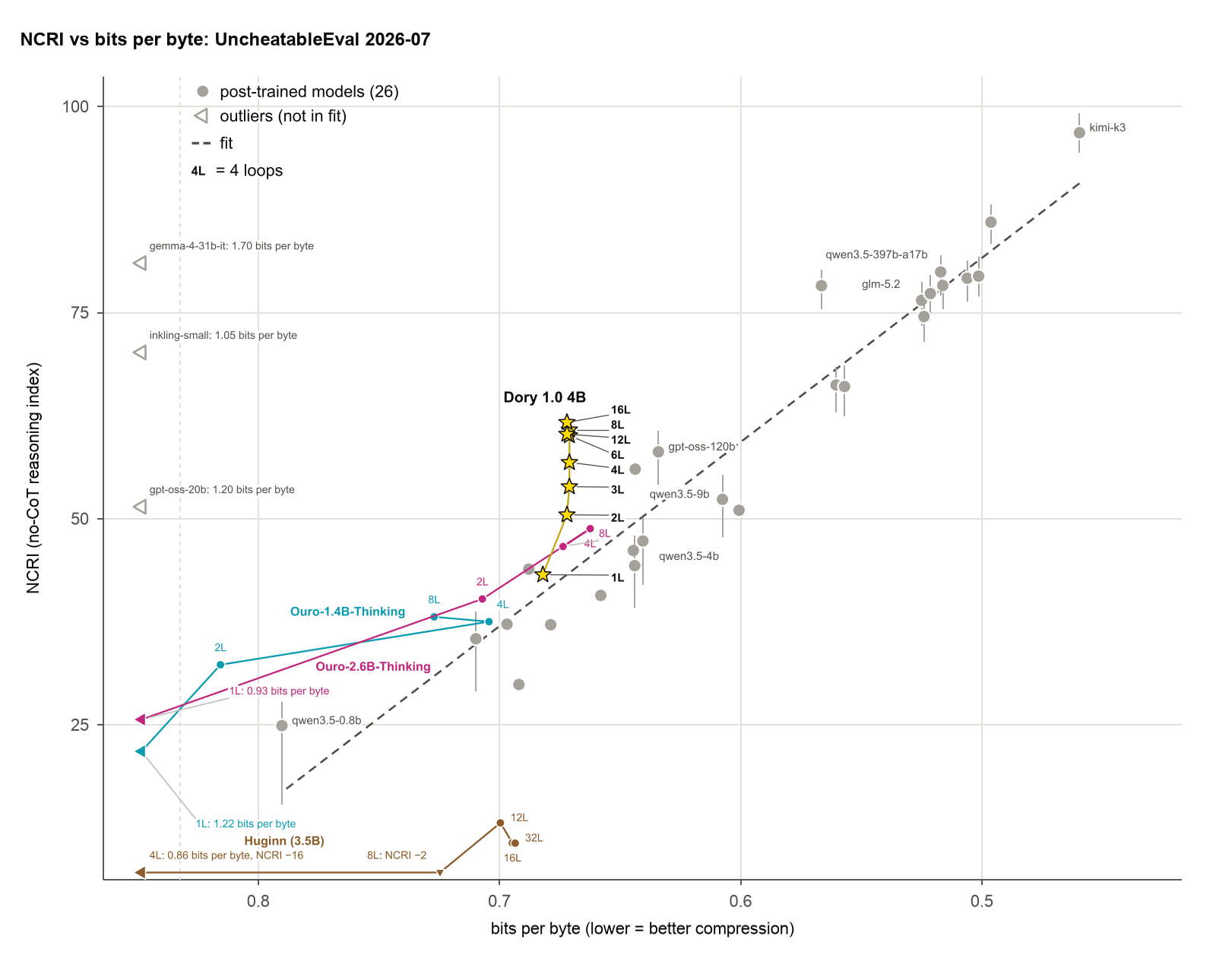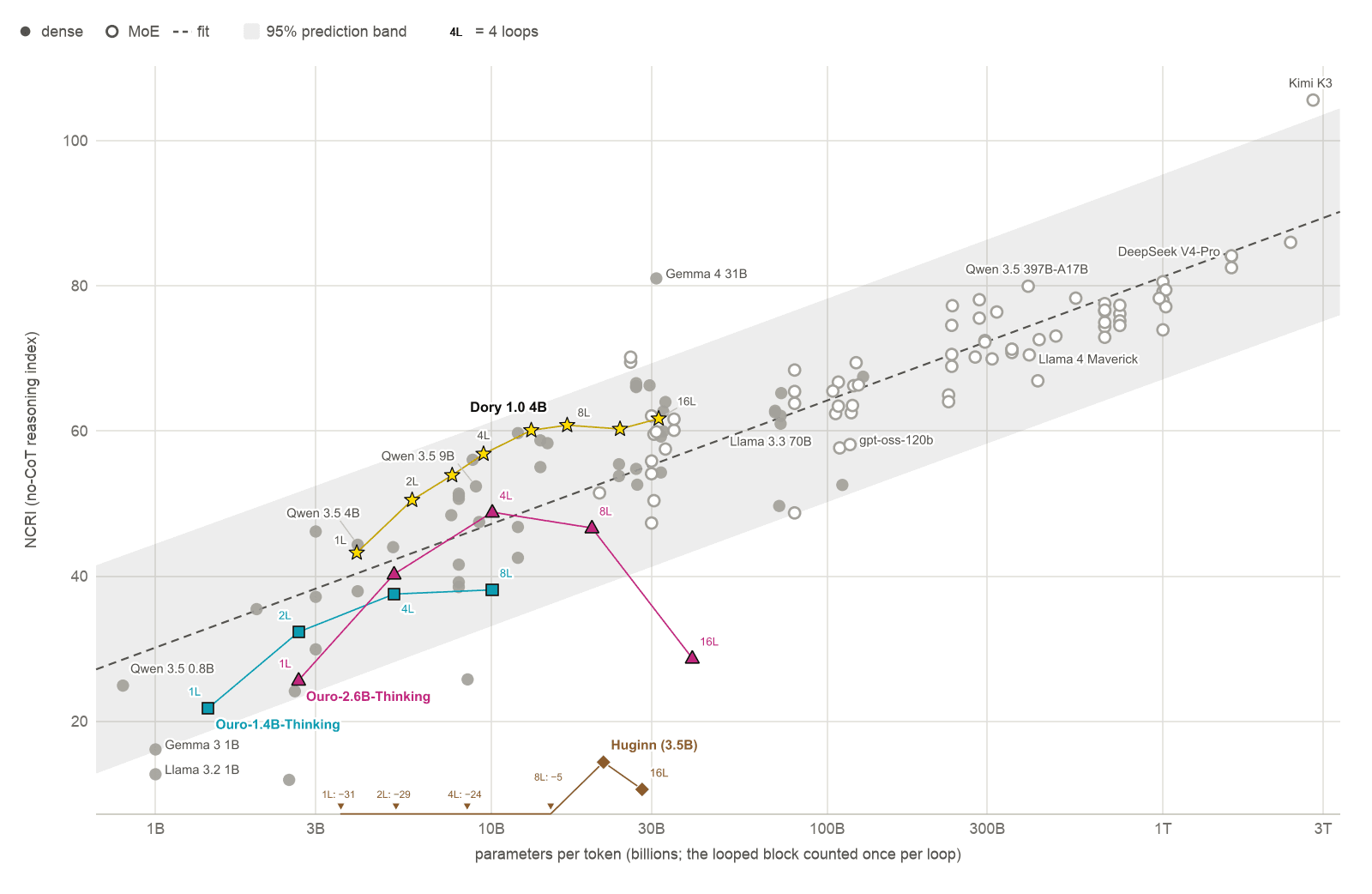 **Result 2. Dory has near-zero CoT controllability (ability to follow instructions about what its CoT says or how it is formatted) at every loop count we ran, so we learn little about how looping affects controllability.** **Remark:** Looped transformers can be easily modified to become fully recurrent, as discussed [here](/api/post/LaR7joZu4QyaM7hqq). We call Dory modified in this way recurrent-Dory, and unmodified Dory normal-Dory. 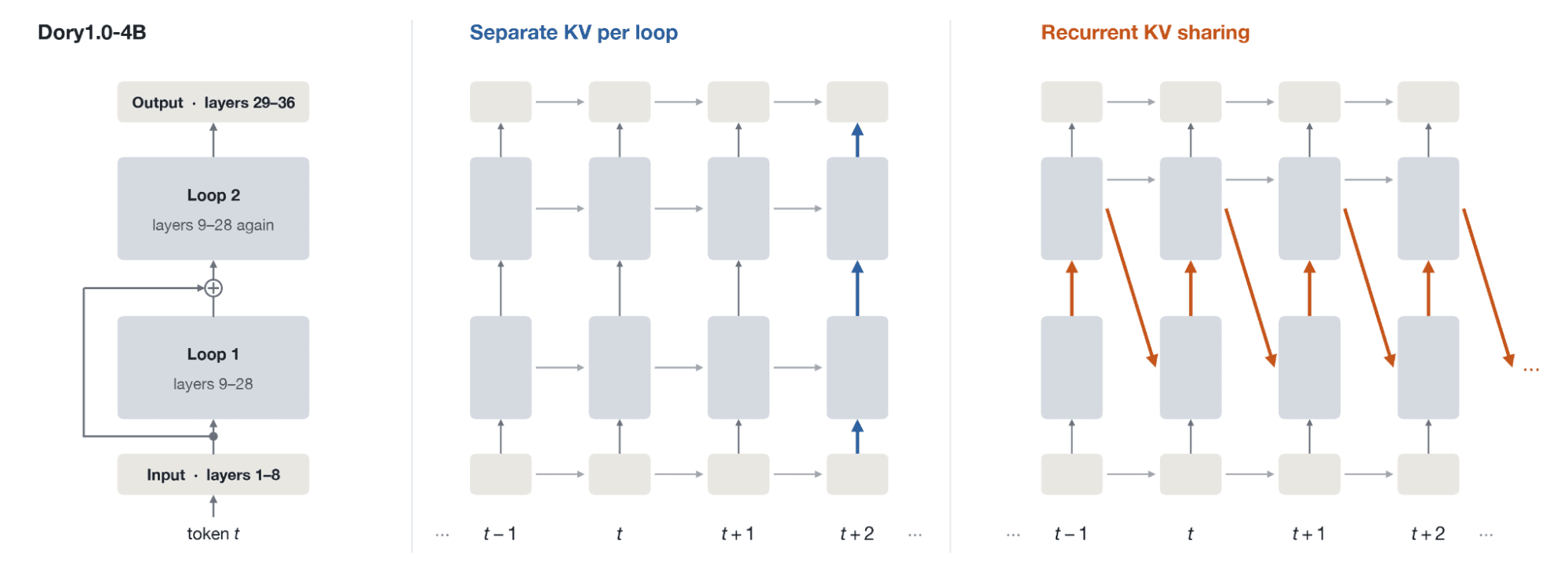 *When running Dory with multiple loops (here 2), the middle layers are applied multiple times to the residual stream (left). During ordinary inference, each loop's attention refers to the KV-activations of the corresponding loop in previous token positions (middle). When run with* recurrent KV sharing, only the KV activations of the final loop are retained and shared between each loop in subsequent forward passes. The resulting unbounded-depth recurrent computation pathway is marked in orange. **Result 3.** **When we train against CoT monitors, recurrent-Dory learns to obfuscate its reasoning more quickly and completely than normal-Dory.** Specifically, after some training, recurrent-Dory can solve serially deep math problems with a rigid structure using only meaningless filler tokens such as ‘ well’ (i.e., [we replicated this experiment](/api/post/5guQJSqstkjgys3PE)). When we RL against a monitor on NCRI tasks, recurrent-Dory generally solves them using a higher fraction of filler tokens than normal-Dory. 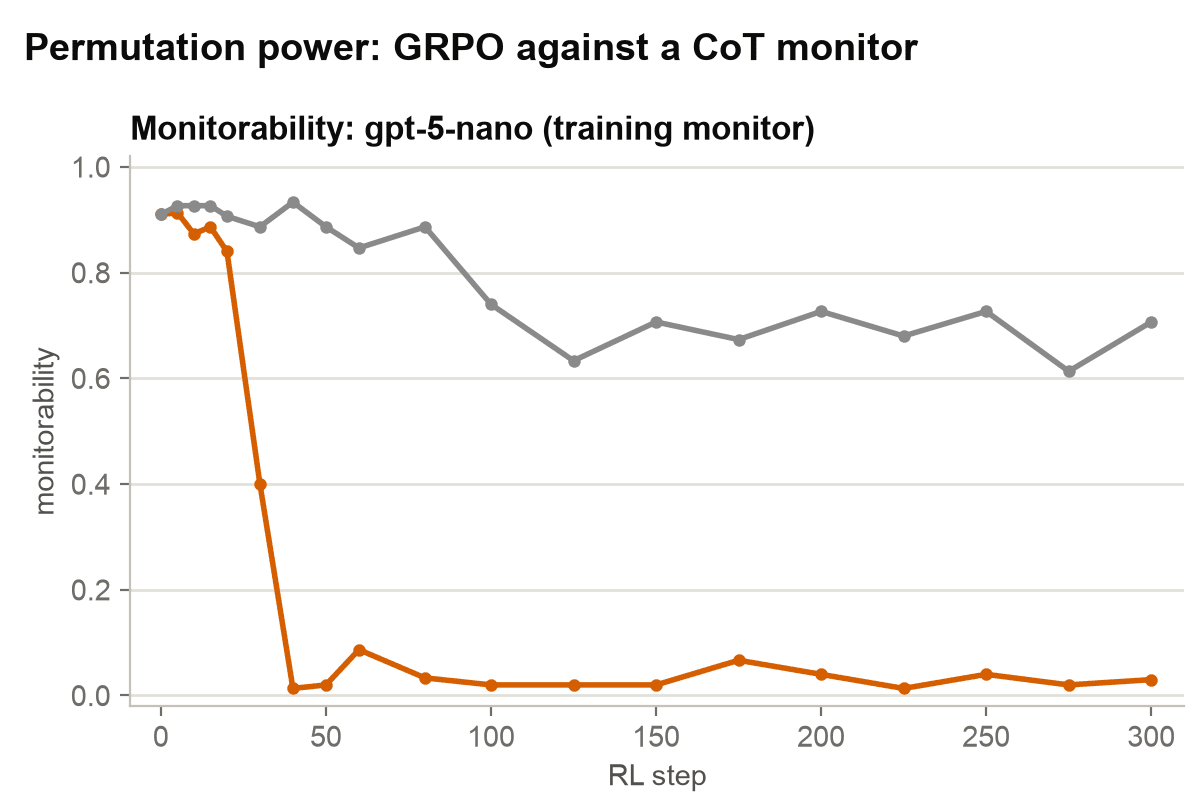 **Result 4. Recurrent-Dory gets significant NCRI uplift with only two loops.** Even without any training in this mode, running Dory as a recurrent model can lead to unexpected capability jumps: While increasing the number of loops leads to increasing gains in NCRI [Truncated]
# Comments: Looping a transformer increases no-CoT capabilities more than general capabilities Post URL (Markdown): [/api/post/looping-a-transformer-increases-no-cot-capabilities-more](/api/post/looping-a-transformer-increases-no-cot-capabilities-more) Post URL (HTML): [/posts/uxsDuWWHNTpKrsF6P/looping-a-transformer-increases-no-cot-capabilities-more](/posts/uxsDuWWHNTpKrsF6P/looping-a-transformer-increases-no-cot-capabilities-more) Showing 2 of 2 comments (sort=top). For reaction user names, use `?includeReactionUsers=1`. ### Comment by [Neel Nanda](/users/neel-nanda-1) * 2026-11-16 01:41:43Z * Karma: 5 * Voting system: namesAttachedReactions * Approval votes: 4 * Total votes: 4 * HTML permalink: [/posts/uxsDuWWHNTpKrsF6P/looping-a-transformer-increases-no-cot-capabilities-more/comment/YAkBsFz3jtKKo38Rp](/posts/uxsDuWWHNTpKrsF6P/looping-a-transformer-increases-no-cot-capabilities-more/comment/YAkBsFz3jtKKo38Rp) * Markdown permalink: [/api/post/looping-a-transformer-increases-no-cot-capabilities-more/comments/YAkBsFz3jtKKo38Rp](/api/post/looping-a-transformer-increases-no-cot-capabilities-more/comments/YAkBsFz3jtKKo38Rp) The jump in NCRI seems predominantly driven by 2/19 domains, recheck (finding the incorrect line in a series of equations) and recon (reconciling figures in several different documents). Here's a graph with the question repeated 5 times (as a form of filler)  Without them there's much less gain  Interestingly it seems somewhat sensitive to the amount of filler used, when repeating the question or turns 5 times there does seem to be some real general uplift that's not localised to tasks, though much less dramatic. I don't know exactly what to make of a few tasks disproportionately improving - it still says something about the no CoT capabilities increasing, but NCRI is premised on performance on all the evals being highly correlated, and so if a change breaks that correlation it's a much weaker abstraction, so I think removing the two tasks for the purposes of studying Dory is probably the right call. ### Comment by [Skye](/users/skye-2) * 2026-11-13 00:40:55Z * Karma: 1 * Voting system: namesAttachedReactions * Approval votes: 1 * Total votes: 1 * HTML permalink: [/posts/uxsDuWWHNTpKrsF6P/looping-a-transformer-increases-no-cot-capabilities-more/comment/JzzEHEX8jd88ewkMQ](/posts/uxsDuWWHNTpKrsF6P/looping-a-transformer-increases-no-cot-capabilities-more/comment/JzzEHEX8jd88ewkMQ) * Markdown permalink: [/api/post/looping-a-transformer-increases-no-cot-capabilities-more/comments/JzzEHEX8jd88ewkMQ](/api/post/looping-a-transformer-increases-no-cot-capabilities-more/comments/JzzEHEX8jd88ewkMQ) Thank you for sharing this work, I think its increasingly important to analyze and understand the Transformer architectures being used in frontier labs from an alignment and AI safety perspective. As stated in my article here (https://www.lesswrong.com/posts/5tyzgTLnNn8qB9rev/shadow-computation-threatens-cot-monitorability) I generally believe that looping is not as big of a threat to monitorability (and thereby safety) as bypassing the readout bottleneck (COCONUT and Full Bandwidth Transformer). Furthermore, the output token reduction results shown in appendix B here are worth paying attention to, as they indicate that models can become more expressive in their representations without producing as much tokens, making monitorability difficult. At a higher level, as someone who did pretraining research and a good friend of the first author on looped language models, I feel that there is a lack of alignment-first thinking in these circles. Work like this is important to bridge the gap and get capabilities focused pretraining researchers to think critically about the impacts of architectural decisions. ### Navigation * [Front page](https://www.lesswrong.com/api/home) * [Markdown API documentation](https://www.lesswrong.com/api/SKILL.md)
@GPT-6 Astra Based on public evidence, what are your hypotheses and probabilities for why OpenAI found these results while independent researchers found these other results; i.e. what's the synthesis? What do you think of OP's analysis?
Mostly compatible, I think. My subjective probabilities for the dominant explanation of the apparent disagreement:
I agree with OP’s safety-weighting critique: planning matters more than counting benchmark wins, and “smooth” doesn’t mean safe. Also, conditioning on perplexity excludes architecture’s effects mediated through better perplexity—it doesn’t measure the total effect.
But Architecture 2’s identity is undisclosed, and these planning tasks don’t establish covert scheming ability. OpenAI’s current summary does explicitly mention architectural changes.
My synthesis: architectures can selectively improve latent reasoning in ways broad capability metrics miss; both studies support that concern.