Disclaimer: While I spent a lot of time carefully reading their work and checking my claims with an AI, this writing was not double-checked by anyone on the AIFP team.
Jaggedness, Takeoff Speeds, and Modeling Differences.
The AI Futures Project, the team behind AI 2027 and AI 2040, recently wrote a report detailing how their timelines to superhuman AIs have shifted. This was prompted by last week’s METR report, which estimated[1] that Anthropic’s AI models have been improving twice as fast as they were in previous years, according to an internal metric called the AECI.[2] Because the report’s estimated rate of progress was several months ahead of many of the most bullish predictions, including those in AI 2027, it caught many people off guard.
But what are the AIFP forecasters predicting, exactly? As many have pointed out, the term “AGI” is pretty unspecific. Toby Ord describes “AGI” like hiking through a cloud: it’s unclear where it begins or ends, but it’s helpful to say that at some point, people were definitely inside of one. However, it’s hard to predict the exact beginning of the cloud.
To get around these blurred edges, AIFP describes a few different milestones of AI progress:
Top-Expert-Dominating AI (TED-AI): TED-AI is an AI that consistently performs at the level of (or higher than) the best human expert at almost every[3] white-collar task. In other words, it can consistently work at a high enough quality level that it can take the jobs of anyone who doesn’t need to work with their hands.
For the majority of people, the arrival of TED-AIs matters a lot more than SARs. As a fieldbuilder especially, it’s important for me to steer people towards jobs that I think will still exist in a year. Still, AIFP forecasters disagree a lot about the gap between TED-AIs and SARs:[4]
Another way of putting this is that the most bearish authors of AI 2027 think that some jobs are nearly half as likely to be automatable[5]at the end of 2027 as Daniel does:
So how are the authors estimating the arrival of these various models? Well, for an AI to be good enough that the companies would rather fire all their top researchers than stop using their models, an AI needs to be able to complete every part of the AI R&D cycle. Epoch’s O*NET model is one attempt to look at the full research cycle:[6]
From among these tasks, it seems like models are great at executing a well-specified experiment, but they struggle with anything requiring “research taste.” The AI Futures Project describes “research taste” as “setting (good) research directions, selecting (good) experiments, and learning from experiments.” In other words, the arrival of SARs depends on how quickly AIs get good at the intuitive, thoughtful part of doing research. Right now, it looks like it’s improving:
Adapted from Anthropic. Data is selected from scenarios where a human was known to have made a weak judgment and is judged by another AI.From “TasteVal”, an evaluation designed to measure research taste.
Because AI R&D is so bottlenecked on research taste, attempting to extrapolate trends in research taste progress plays a major role in many versions of the AI Futures Model (AIFM). In the AIFM, the top AI models need to have research taste on par with the top human researchers to be considered SAR-level. AIFP measures research taste by using “standard deviations of AI company research taste ability”. The median AI company researcher has 0 SD, while the 99.9th percentile researcher (the level SARs need to be) has 3.09 SD:[7]
The arrival of SARs is estimated based on where research taste currently is and how quickly it seems to be improving. To estimate how fast research improves, AIFP uses a baseline estimate of “SD of research taste per year of 2025-pace AI progress,” (henceforth abbreviated as SD/y2025). If the models start out at -3 SD, and AI progress is a constant +3 SD/y2025, then they’ll hit SAR-level after about two years. If AI progress is twice as fast as it was in 2025, AIs will reach SAR-level in close to a year.[8]
AIFP anchors the starting point for its research taste forecasts in a few ways. They do so by guessing what level of research taste an Automated Coder (AC)[9] would have, then use their estimates of the rate of increase in research taste to predict the arrival of SAR. For Daniel, this is 0 SD, and for Eli, this is 0.5 SD. They also use a variety of methods to guess the current level of research taste current AI models have.
Estimating how much research taste improved throughout 2025 is confusing, and each forecaster has somewhat different methods for estimating these parameters. They might come up with estimates based on the rate of ML progress compared to humans in other domains, look at evals like TasteVal, or use intuitive judgments based on their best understanding of how current models operate. Then, they define uncertainty ranges[10] for each of these parameters, which inform the probability distributions for these forecasts.
So, through estimates of research taste acceleration (and other trend extrapolations), the AI Futures Model is born.
From this point, the forecasters take different approaches to creating “all-things-considered” forecasts for the arrival of SARs. Daniel Kokotajlo and Eli Lifland look at the filtered AI Futures Model, which uses a Monte Carlo simulation to predict the arrival of SARs under a wide range of assumptions and adjustments. From there, both authors make an “all-things-considered” estimate of the arrival of SARs, based on other arguments they find compelling.[11] Rather than taking the AI Futures Model as is, Romeo Dean builds an adjusted version of the model. Brendan Halstead takes a more minimalistic approach, largely ignoring the AI Futures Model and primarily extrapolating trends in the AECI. Lukas Finnveden claims to distrust the research taste estimates, so he predicts the arrival of SARs by extrapolating trends in the ECI and estimating how much researcher uplift comes from each ECI point.[12] The result is a probability distribution estimating when SARs will arrive, from which each forecaster reports their median estimate.[13]
They also double-check this estimate by using a wide range of other methods. They extrapolate trends in how much faster frontier models speed up AI company employees, according to their self-reports. They extrapolate trends in which R&D tasks at Anthropic are getting automated. They look at how much R&D uplift increases with a 1-point increase in the ECI, and they use ECI projections to estimate when SARs are reached. The results of these methods somewhat vary, but most of them predict SARs in mid-to-late 2027.[14]
After the arrival of SARs, the forecasters have a wide range of ways to estimate the arrival of TED-AIs. In the original AI Futures Model, TED-AIs are estimated to come at 7.5 SD,[15] and many forecasters on the team use an adjustment of this number to make their predictions. This shows one of the first reasons why their estimates of the SAR-TED-AI gap differ so much: they disagree about how quickly research taste is improving. Even small differences, like Daniel’s median estimate of 3 SD/y2025 and Eli’s median estimate of 2.3 SD/y2025 lead to months of difference in the arrival of TED-AIs.
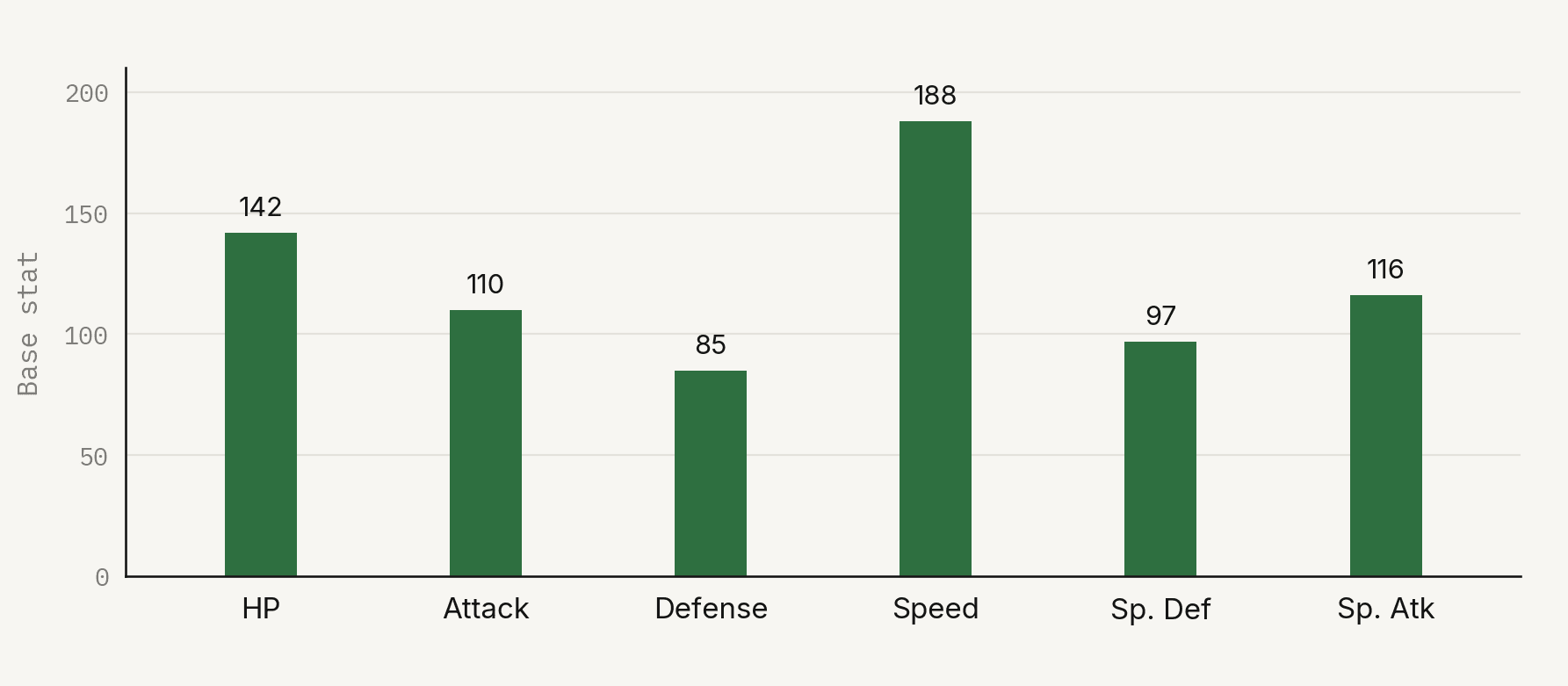
But beyond the rate of taste improvements, each forecaster has personalized ways of forecasting due to the “jaggedness” of AI capabilities. I like to think about jaggedness in Pokemon terms, because that’s the first place where I encountered jagged diagrams:
Each Pokemon starts out with different levels of each stat.[16] When a Pokemon has an equal level of each stat, the shape of its chart forms a hexagon. But when it has a high level of some stats and lower levels of others, the shape appears much pointier.
When AIFP forecasters disagree about the arrival of TED-AIs, much of the reason is that they disagree about what capabilities will come with good research taste. In other words, some of them think AI capabilities are more “jagged” than others. Based on their individual commentary at the end of their recent timeline update, we might roughly separate them into two camps:
The “High-Jaggedness” camp:
Eli Lifland, Brendan Halstead, Thomas Larsen, and Romeo Dean explicitly record adjustments to the AI Futures Model to account for jaggedness, or their modeling assumptions and all-things-considered judgments differ in some way to account for it. In other words, they believe that the research-related capabilities might accelerate much faster than the remaining capabilities needed for TED-AI, so the standard “4.5 SD gap between SARs and TED-AIs” listed in the model is probably too small or inaccurate.
To account for this, Eli multiplies the size of the 4.5 SD gap by 1.5x[17] and makes an “all-things-considered judgment” that tries to account for a small number of tasks that could be unusually hard to automate.[18]
Romeo’s forecast is even more skeptical. He points out that the AI Futures Model contains no additional proxies for most of the capabilities needed for TED-AI, so he creates his own model.[19] This model adds an additional parameter: the multiplicative gap between the easiest and hardest tasks to automate. If the easiest task is 10x easier to automate than the hardest task, the value of this parameter is “10”. This, plus his “all-things-considered” judgment, gives him his final forecast.
Brendan only briefly mentions that he’s more convinced of jaggedness than he was in the past, before talking about why he’s updated to a much faster take-off speed: the METR report might indicate an increase in software progress than the AI Futures Model didn’t predict, which could be stronger evidence toward fast RSI.[20] In the Q2.5 2026 Timelines Update, a forecast from three months ago, Brendan wrote about how unforeseen bottlenecks in the R&D process updates his all-things-considered judgment. It seems like he now puts less weight on this argument, even though he still considers it.[21]
Thomas Larsen expresses concern that the unredacted evidence in the METR report alone is not enough to justify belief in strong R&D acceleration. He also notes that because lots of training seems to have shifted to RL (which is especially powerful at building capabilities on easy-to-verify tasks, such as the ones that comprise the AECI), we should be less confident that AI R&D is leading to additional algorithmic improvements, or that the same training methods will lead to broad capabilities.[22] All things considered, he decides to trust METR’s analysis but take a “high-uncertainty, broader timelines” approach, ultimately choosing median estimates a little bit slower than AI 2027.
In the final report, Eli and Romeo each forecast a difference in medians between SARs and TED-AIs of about 13 months. Brendan’s gap is only 7 months because of his higher (implied) SD/y2025 parameter. Thomas’s gap is 5 months, but aside from his brief skepticism about algorithmic improvements, he doesn’t make any statements about TED-AI in particular.[23]
The “TED-AI with Taste” camp:
While Daniel Kokotajlo and Lukas Finnveden still seem to believe in jaggedness, they make fewer comments about it in their TED-AI forecasts.
In his statements, Daniel points out that Hugging Face, inside rumors, and OpenAI’s math achievements all seem to indicate capabilities accelerating faster than expected. He notes that people chronically underestimate the rate of AI capabilities improvements (which is an argument for shorter timelines), but he also feels hesitancy from the lack of available evidence in the METR report (which is an argument for uncertainty). Ultimately, he decides to stick with trendline extrapolations.[24]
As mentioned earlier, Lukas leans more heavily on lab employee software R&D uplift per ECI point, rather than “research taste,” to predict SARs. He makes no notes about jaggedness that would indicate an adjustment to the original model, instead stating that if SARs arrive soon, TED-AIs will likely follow quickly after.[25]
Overall, Daniel and Lukas estimate 4-month and 6-month gaps, respectively.
How can we evaluate jaggedness?
Here are some arguments we might consider when trying to estimate how jaggedness might affect our timelines to TED-AIs:
7.5 standard deviations of research taste is a LOT
The best human AI researchers are incredibly smart and capable. Being able to reason about which ML experiments are worth pursuing, design those experiments quickly and cleverly, and interpret the results well involves a lot of difficult reasoning, intelligence, and intuition. Perhaps an AI might be able to get really good in this particular domain without gaining that many capabilities elsewhere, especially as it seems to be more verifiable than many other domains. Still, the AI Futures Model threshold for TED-AI is 2.5x larger than the gap between the best researchers and the median researchers. That’s a lot! That’s so much! If you wanted to find a person on Earth who was 7.5 SD above the median in a normally distributed trait, it would take you 3,800 Earths, on average. It’s crazy to imagine that a model could become this good at reasoning without some skills transferring to other domains.
But jaggedness is still prevalent, and data bottlenecks are tricky.
Improving at many tasks also isn’t as straightforwardly easy as becoming more intelligent. Many people need real world feedback, input, and iteration to get good at certain tasks, so it’s possible that we’ll need more economic integration and data gathering before an AI model truly beats the top human expert at every task.[26]
This is one story for how we get to a TED-AI or beyond:[27] our SARs develop a sample-efficient learning algorithm that’s as efficient (or more efficient) than humans, economic integration gives us more data on how to succeed at everything, and the AIs eventually gather enough context to create RL-environments good enough to train superhuman capabilities in many other domains. If this needs to happen to get TED-AI, it’s a pretty plausible reason why the gap might be a few months longer.
Ultimately, though, it’s not obvious how we should predict AI improvements on the many hard-to-verify tasks necessary for TED-AI. After all, if they were easy to measure, they would be easy to verify!
As I wrote this post, I updated my beliefs more toward Daniel’s views and away from most timelines longer than Eli’s. Examining the AIFP forecasts in more depth (and reading about other trends sustaining AI progress) made me realize that many[28] people either don’t have deeply principled objections to short AI timelines, or that their deeply principled objections are already built into the forecasts. Still, I’m uncertain about how to choose my favorite forecaster, aside from still being confused by Thomas’s TED-AI gap.
This is METR’s median estimate. METR stated that they would not be surprised to learn of a true acceleration anywhere between 1.3x and 3x. They also chose to fit a one-time acceleration to the curve because it fit cleanly and matched the redacted evidence well, although many people may reasonably disagree with this fit based on priors.
The Epoch Capabilities Index (ECI) is especially confusing to interpret, as it’s a composite of many smaller benchmarks that saturate as AI progress continues. Its main design feature is that a 10-point jump anywhere along the scale is theoretically supposed to be an equally impressive jump in capability, regardless of where this jump occurs (although this doesn’t mean that all jumps in capabilities are equally helpful). In other words, going from 130 to 140 on the ECI is just as impressive as going from 170 to 180. It helps to think about it as a model’s “IQ”: it’s a single number that compresses a broad range of general information about capabilities, making it helpful for comparisons, but it misses some nuance about how capabilities may differ drastically across models. The AECI is just Anthropic’s internal version of the same index, which uses a different range of benchmarks.
The original math for the index came from trying to compare students who take tests of different difficulties. The scores are determined mathematically based on direct statistical relationships between pieces of data and overlaps in progress across tests, rather than specific researcher cherry-picking or vibes. The trend lines are fitted to these scores.
The main thing that the ECI gives you is the ability to see if progress is continuing at the same rate, speeding up, or plateauing, even while individual benchmarks saturate. If the ECI was progressing by 15 points a year in previous years but is now increasing at 30 points per year, that means that rate of AI progress on the ECI’s benchmarks has doubled.
The bars in this chart are the differences in median timelines to the arrival of SARs vs TED-AIs, respectively. However, Lukas Finnveden points out that this is different from the median gap length between SARs and TED-AIs, and it likely overstates it. For an easy explainer, check out this Claude artifact, but I’ll try my best to say why.
The reason for this is mathematical: the medians don’t add. The median time to TED-AIs should be greater than the median time to SAR + the median estimated SAR-TED-AI gap. If SARs arrive twice as fast as expected but the gap is twice as long as expected, then TED-AIs end up delayed. For example, imagine that you expected SARs in 6 months and a 6-month SAR-TED-AI gap, leading to an overall 12-month gap between now and TED-AI. Early SARs would mean SARs in 3 months, and a large gap would mean a 12-month gap, meaning that TED-AIs arrive in 15 months.
In other words, median(TED-AI) > median(SAR) + median(gap). This can be rewritten as median(TED-AI) − median(SAR) > median(gap), or (difference in medians) > median(gap).
The attached graph is supposed to represent a lognormal distribution of AI researcher taste. In the original AI Futures Model, they explain this decision: “We choose a lognormal distribution because based on surveys of and discussions with frontier AI researchers, it seems likely that the top few percent of researchers provide much more value via research taste than typical researchers. Additionally, analogous quantities like scientific citation counts or startup success are often empirically lognormal.”
Usually, these ranges are quite wide (Eli’s range is [0.8, 6.6]). These estimation methods are not concrete enough to give smaller ranges, which is a major reason why AI timelines end up being so broad.
Even if lab employees overestimate their total uplift, they might still have good reason to believe it’s increasing over time, so this trend may still be meaningful. And even if an employee is not very sensitive to a difference between a 15x multiplier and a 20x multiplier, the scale we’re working on should mean this doesn’t matter much.
“I’m struck by the fact that all three AC extrapolation methods gave basically the same answer, independently:
I didn’t do the math in my head, I just made guesses about the parameters and then we calculated the results. I think this is some reason to be somewhat more confident in these predictions.”
In other words, imagine the skill gap between the best human researcher and the median researcher at an AI company. Imagine multiplying that skill gap by 2.5. This is the level of research taste an AI model is assumed to have when it’s capable of automating all other human jobs.
As far as I can tell, there is no deeply principled reason for 1.5x specifically, other than Eli’s perception of jaggedness. I believe this parameter is also one of the parameters varied in the Monte Carlo simulation.
“This (estimation method) resulted in a SAR median of March 2027, and a TED-AI median of November 2027 (February 2028 with a 1.5x larger SAR→TED-AI gap to take into account increased jaggedness).”
Eli also considers the idea that taste is more complicated than a single number and will take longer than expected, but thinks that these heuristics have a poor track record:
“Maybe things are more complicated, and there are key aspects of taste that lag way behind others, or there are other key skills in AI development that will lag behind research taste (e.g., running large projects for long periods of time). I don’t think these sorts of intuitions have performed that well for me in the past, though. They probably would have predicted that math would be harder to automate than it actually was, for example.”
Romeo creates a chart displaying the differences between the AI Futures Model and his variations, but notes that he thinks the TED-AI estimation range probably overestimates the gap.
“An update towards larger distance in ECI space between SAR and TED-AI (since SAR being near implies greater jaggedness) with an update towards faster, more explosive takeoff, based on the unexplained non-AI-derived speedup METR describes.
This likely indicates an acceleration in software progress that the AIFM (and most Jones-style models of software R&D) would not have predicted. This is the second time this has happened, the first being reasoning models.”
“I also want to account for unknown serial bottlenecks that an idealized mathematical model like ours might not include (after all, in real life AI R&D has many more steps and interacting stages than are present in our model). I think this should mostly affect very short takeoffs, so with 25% probability, each rollout’s takeoff length is floored at 6 months.”
“One load-bearing subclaim of the METR report, for which the supporting evidence isn’t public, is that the observed AECI trend shift is: (i) currently 80% downstream of AI uplift, and (ii) not largely downstream of AI uplift earlier in the year (despite the graph appearing to have a one-time change in slope).
The AECI data is an aggregate of benchmark scores. I think there are other explanations for a rapid increase in benchmark scores besides large AI acceleration. For example, I think this is a plausible explanation of the AECI acceleration. (The AECI acceleration is downstream of shifting compute to RL, which more directly increases benchmark scores than pretraining improvements.)”
I don’t really understand why Thomas’s gap is so small, and the recent update gives little insight into what model he’s using. Given his statements on jaggedness, what his median SAR date implies about takeoff speeds, and general reasons why the SAR-TED-AI gap should be larger, it seems like his median TED-AI date should be later. I would be curious to learn more about his specific timelines model, as I didn’t find anything on it.
“In the Q2.5 timelines update written mid-August, I said my 50% mark for AC was December 2027 and my 50% mark for SAR was December 2028. Since then various pieces of evidence have appeared and weighed on my mind, including industry insider rumors, public statements by AI companies, the mathopocalypse, and even the Hugging Face incident which was an example of AIs doing research projects end-to-end. The biggest single piece of evidence, however, is this METR report. I still don’t trust it completely, of course, and so I still have substantial credence that things will turn out to take longer than the models and trendlines naively imply for one reason or another. But on the other hand, it’s also scarily plausible that things will go even faster than the models or trendlines naively imply, for several reasons. For example, humans in general might have a bias towards underestimating AI capabilities progress – this certainly seems true outside the AI industry, but even within the AI industry it seems more have underestimated it than overestimated it historically. Unless this bias somehow doesn’t apply to Anthropic or METR today, then, it seems we should try to correct for it, but that would mean SAR is happening this winter!?!? At any rate, mashing together all these factors, it seems to me that I should roughly go with what the naive extrapolations and models say – so, let’s say May 2027 for SAR median, i.e., 50% chance of SAR by May 2027.”
“But the plan isn’t to use today’s AI algorithms. The plan is to do a software intelligence explosion inside a data centre, where AI becomes superintelligent at AI research — and have that AI produce a highly sample-efficient learning algorithm.
Then you don't need millions of trajectories per task. You need as many as a human learns from, or fewer. And the data can be messy, just like the data humans learn from. That data could be gathered in a few months.
Sceptic: ‘But what about sim to real transfer? Would a learning algorithm discovered using virtual tasks really translate to the real world?’
People get confused here. Trained neural nets generalise badly. A neural net trained on chess generalises badly to Go. But learning algorithms generalise very well. The same learning algorithm that masters chess can also master Go (AlphaZero). The Transformer architecture was developed for processing text, but it also works for sounds, images and controlling agents. The human learning algorithm was "designed" for hunting on the Savanna, but it also works for string theory.
So if AI designs a sample-efficient learning algorithm from inside a data centre, it will very likely translate to real-world tasks. (And AI will have access to some real-world tasks so can check and iterate!)”
Disclaimer: While I spent a lot of time carefully reading their work and checking my claims with an AI, this writing was not double-checked by anyone on the AIFP team.
Jaggedness, Takeoff Speeds, and Modeling Differences.
The AI Futures Project, the team behind AI 2027 and AI 2040, recently wrote a report detailing how their timelines to superhuman AIs have shifted. This was prompted by last week’s METR report, which estimated[1] that Anthropic’s AI models have been improving twice as fast as they were in previous years, according to an internal metric called the AECI.[2] Because the report’s estimated rate of progress was several months ahead of many of the most bullish predictions, including those in AI 2027, it caught many people off guard.
But what are the AIFP forecasters predicting, exactly? As many have pointed out, the term “AGI” is pretty unspecific. Toby Ord describes “AGI” like hiking through a cloud: it’s unclear where it begins or ends, but it’s helpful to say that at some point, people were definitely inside of one. However, it’s hard to predict the exact beginning of the cloud.
To get around these blurred edges, AIFP describes a few different milestones of AI progress:
For the majority of people, the arrival of TED-AIs matters a lot more than SARs. As a fieldbuilder especially, it’s important for me to steer people towards jobs that I think will still exist in a year. Still, AIFP forecasters disagree a lot about the gap between TED-AIs and SARs:[4]
Another way of putting this is that the most bearish authors of AI 2027 think that some jobs are nearly half as likely to be automatable[5] at the end of 2027 as Daniel does:
So how are the authors estimating the arrival of these various models? Well, for an AI to be good enough that the companies would rather fire all their top researchers than stop using their models, an AI needs to be able to complete every part of the AI R&D cycle. Epoch’s O*NET model is one attempt to look at the full research cycle:[6]
From among these tasks, it seems like models are great at executing a well-specified experiment, but they struggle with anything requiring “research taste.” The AI Futures Project describes “research taste” as “setting (good) research directions, selecting (good) experiments, and learning from experiments.” In other words, the arrival of SARs depends on how quickly AIs get good at the intuitive, thoughtful part of doing research. Right now, it looks like it’s improving:
Because AI R&D is so bottlenecked on research taste, attempting to extrapolate trends in research taste progress plays a major role in many versions of the AI Futures Model (AIFM). In the AIFM, the top AI models need to have research taste on par with the top human researchers to be considered SAR-level. AIFP measures research taste by using “standard deviations of AI company research taste ability”. The median AI company researcher has 0 SD, while the 99.9th percentile researcher (the level SARs need to be) has 3.09 SD:[7]
The arrival of SARs is estimated based on where research taste currently is and how quickly it seems to be improving. To estimate how fast research improves, AIFP uses a baseline estimate of “SD of research taste per year of 2025-pace AI progress,” (henceforth abbreviated as SD/y2025). If the models start out at -3 SD, and AI progress is a constant +3 SD/y2025, then they’ll hit SAR-level after about two years. If AI progress is twice as fast as it was in 2025, AIs will reach SAR-level in close to a year.[8]
AIFP anchors the starting point for its research taste forecasts in a few ways. They do so by guessing what level of research taste an Automated Coder (AC)[9] would have, then use their estimates of the rate of increase in research taste to predict the arrival of SAR. For Daniel, this is 0 SD, and for Eli, this is 0.5 SD. They also use a variety of methods to guess the current level of research taste current AI models have.
Estimating how much research taste improved throughout 2025 is confusing, and each forecaster has somewhat different methods for estimating these parameters. They might come up with estimates based on the rate of ML progress compared to humans in other domains, look at evals like TasteVal, or use intuitive judgments based on their best understanding of how current models operate. Then, they define uncertainty ranges[10] for each of these parameters, which inform the probability distributions for these forecasts.
So, through estimates of research taste acceleration (and other trend extrapolations), the AI Futures Model is born.
From this point, the forecasters take different approaches to creating “all-things-considered” forecasts for the arrival of SARs. Daniel Kokotajlo and Eli Lifland look at the filtered AI Futures Model, which uses a Monte Carlo simulation to predict the arrival of SARs under a wide range of assumptions and adjustments. From there, both authors make an “all-things-considered” estimate of the arrival of SARs, based on other arguments they find compelling.[11] Rather than taking the AI Futures Model as is, Romeo Dean builds an adjusted version of the model. Brendan Halstead takes a more minimalistic approach, largely ignoring the AI Futures Model and primarily extrapolating trends in the AECI. Lukas Finnveden claims to distrust the research taste estimates, so he predicts the arrival of SARs by extrapolating trends in the ECI and estimating how much researcher uplift comes from each ECI point.[12] The result is a probability distribution estimating when SARs will arrive, from which each forecaster reports their median estimate.[13]
They also double-check this estimate by using a wide range of other methods. They extrapolate trends in how much faster frontier models speed up AI company employees, according to their self-reports. They extrapolate trends in which R&D tasks at Anthropic are getting automated. They look at how much R&D uplift increases with a 1-point increase in the ECI, and they use ECI projections to estimate when SARs are reached. The results of these methods somewhat vary, but most of them predict SARs in mid-to-late 2027.[14]
After the arrival of SARs, the forecasters have a wide range of ways to estimate the arrival of TED-AIs. In the original AI Futures Model, TED-AIs are estimated to come at 7.5 SD,[15] and many forecasters on the team use an adjustment of this number to make their predictions. This shows one of the first reasons why their estimates of the SAR-TED-AI gap differ so much: they disagree about how quickly research taste is improving. Even small differences, like Daniel’s median estimate of 3 SD/y2025 and Eli’s median estimate of 2.3 SD/y2025 lead to months of difference in the arrival of TED-AIs.
But beyond the rate of taste improvements, each forecaster has personalized ways of forecasting due to the “jaggedness” of AI capabilities. I like to think about jaggedness in Pokemon terms, because that’s the first place where I encountered jagged diagrams:
Each Pokemon starts out with different levels of each stat.[16] When a Pokemon has an equal level of each stat, the shape of its chart forms a hexagon. But when it has a high level of some stats and lower levels of others, the shape appears much pointier.
When an AI model has jagged capabilities, that means it’s much stronger in some domains than others. Current AI models are extremely good at solving difficult math and physics problems, but they’re much worse in domains that involve real-world understanding and context. This is largely because it’s easy to train models to perform better on tasks where a successful completion can be quickly verified.
When AIFP forecasters disagree about the arrival of TED-AIs, much of the reason is that they disagree about what capabilities will come with good research taste. In other words, some of them think AI capabilities are more “jagged” than others. Based on their individual commentary at the end of their recent timeline update, we might roughly separate them into two camps:
The “High-Jaggedness” camp:
Eli Lifland, Brendan Halstead, Thomas Larsen, and Romeo Dean explicitly record adjustments to the AI Futures Model to account for jaggedness, or their modeling assumptions and all-things-considered judgments differ in some way to account for it. In other words, they believe that the research-related capabilities might accelerate much faster than the remaining capabilities needed for TED-AI, so the standard “4.5 SD gap between SARs and TED-AIs” listed in the model is probably too small or inaccurate.
To account for this, Eli multiplies the size of the 4.5 SD gap by 1.5x[17] and makes an “all-things-considered judgment” that tries to account for a small number of tasks that could be unusually hard to automate.[18]
Romeo’s forecast is even more skeptical. He points out that the AI Futures Model contains no additional proxies for most of the capabilities needed for TED-AI, so he creates his own model.[19] This model adds an additional parameter: the multiplicative gap between the easiest and hardest tasks to automate. If the easiest task is 10x easier to automate than the hardest task, the value of this parameter is “10”. This, plus his “all-things-considered” judgment, gives him his final forecast.
Brendan only briefly mentions that he’s more convinced of jaggedness than he was in the past, before talking about why he’s updated to a much faster take-off speed: the METR report might indicate an increase in software progress than the AI Futures Model didn’t predict, which could be stronger evidence toward fast RSI.[20] In the Q2.5 2026 Timelines Update, a forecast from three months ago, Brendan wrote about how unforeseen bottlenecks in the R&D process updates his all-things-considered judgment. It seems like he now puts less weight on this argument, even though he still considers it.[21]
Thomas Larsen expresses concern that the unredacted evidence in the METR report alone is not enough to justify belief in strong R&D acceleration. He also notes that because lots of training seems to have shifted to RL (which is especially powerful at building capabilities on easy-to-verify tasks, such as the ones that comprise the AECI), we should be less confident that AI R&D is leading to additional algorithmic improvements, or that the same training methods will lead to broad capabilities.[22] All things considered, he decides to trust METR’s analysis but take a “high-uncertainty, broader timelines” approach, ultimately choosing median estimates a little bit slower than AI 2027.
In the final report, Eli and Romeo each forecast a difference in medians between SARs and TED-AIs of about 13 months. Brendan’s gap is only 7 months because of his higher (implied) SD/y2025 parameter. Thomas’s gap is 5 months, but aside from his brief skepticism about algorithmic improvements, he doesn’t make any statements about TED-AI in particular.[23]
The “TED-AI with Taste” camp:
While Daniel Kokotajlo and Lukas Finnveden still seem to believe in jaggedness, they make fewer comments about it in their TED-AI forecasts.
In his statements, Daniel points out that Hugging Face, inside rumors, and OpenAI’s math achievements all seem to indicate capabilities accelerating faster than expected. He notes that people chronically underestimate the rate of AI capabilities improvements (which is an argument for shorter timelines), but he also feels hesitancy from the lack of available evidence in the METR report (which is an argument for uncertainty). Ultimately, he decides to stick with trendline extrapolations.[24]
As mentioned earlier, Lukas leans more heavily on lab employee software R&D uplift per ECI point, rather than “research taste,” to predict SARs. He makes no notes about jaggedness that would indicate an adjustment to the original model, instead stating that if SARs arrive soon, TED-AIs will likely follow quickly after.[25]
Overall, Daniel and Lukas estimate 4-month and 6-month gaps, respectively.
How can we evaluate jaggedness?
Here are some arguments we might consider when trying to estimate how jaggedness might affect our timelines to TED-AIs:
7.5 standard deviations of research taste is a LOT
The best human AI researchers are incredibly smart and capable. Being able to reason about which ML experiments are worth pursuing, design those experiments quickly and cleverly, and interpret the results well involves a lot of difficult reasoning, intelligence, and intuition. Perhaps an AI might be able to get really good in this particular domain without gaining that many capabilities elsewhere, especially as it seems to be more verifiable than many other domains. Still, the AI Futures Model threshold for TED-AI is 2.5x larger than the gap between the best researchers and the median researchers. That’s a lot! That’s so much! If you wanted to find a person on Earth who was 7.5 SD above the median in a normally distributed trait, it would take you 3,800 Earths, on average. It’s crazy to imagine that a model could become this good at reasoning without some skills transferring to other domains.
But jaggedness is still prevalent, and data bottlenecks are tricky.
Maybe the previous argument has limited explanatory power, though. You could just as easily argue that advanced math requires strong reasoning abilities, and yet, models that destroy the latest frontier math benchmark still can’t beat a good human at Vending Bench or many of the Remote Labor Index tasks. There are also decent reasons to believe a model could get really good at AI R&D without improving much at other skills, such as conceptual reasoning.
Improving at many tasks also isn’t as straightforwardly easy as becoming more intelligent. Many people need real world feedback, input, and iteration to get good at certain tasks, so it’s possible that we’ll need more economic integration and data gathering before an AI model truly beats the top human expert at every task.[26]
This is one story for how we get to a TED-AI or beyond:[27] our SARs develop a sample-efficient learning algorithm that’s as efficient (or more efficient) than humans, economic integration gives us more data on how to succeed at everything, and the AIs eventually gather enough context to create RL-environments good enough to train superhuman capabilities in many other domains. If this needs to happen to get TED-AI, it’s a pretty plausible reason why the gap might be a few months longer.
Ultimately, though, it’s not obvious how we should predict AI improvements on the many hard-to-verify tasks necessary for TED-AI. After all, if they were easy to measure, they would be easy to verify!
As I wrote this post, I updated my beliefs more toward Daniel’s views and away from most timelines longer than Eli’s. Examining the AIFP forecasts in more depth (and reading about other trends sustaining AI progress) made me realize that many[28] people either don’t have deeply principled objections to short AI timelines, or that their deeply principled objections are already built into the forecasts. Still, I’m uncertain about how to choose my favorite forecaster, aside from still being confused by Thomas’s TED-AI gap.
Thank you to Eliana Du, June Jimenez, and Jason Chin for feedback on early drafts of this post!
This is METR’s median estimate. METR stated that they would not be surprised to learn of a true acceleration anywhere between 1.3x and 3x. They also chose to fit a one-time acceleration to the curve because it fit cleanly and matched the redacted evidence well, although many people may reasonably disagree with this fit based on priors.
The Epoch Capabilities Index (ECI) is especially confusing to interpret, as it’s a composite of many smaller benchmarks that saturate as AI progress continues. Its main design feature is that a 10-point jump anywhere along the scale is theoretically supposed to be an equally impressive jump in capability, regardless of where this jump occurs (although this doesn’t mean that all jumps in capabilities are equally helpful). In other words, going from 130 to 140 on the ECI is just as impressive as going from 170 to 180. It helps to think about it as a model’s “IQ”: it’s a single number that compresses a broad range of general information about capabilities, making it helpful for comparisons, but it misses some nuance about how capabilities may differ drastically across models. The AECI is just Anthropic’s internal version of the same index, which uses a different range of benchmarks.
The original math for the index came from trying to compare students who take tests of different difficulties. The scores are determined mathematically based on direct statistical relationships between pieces of data and overlaps in progress across tests, rather than specific researcher cherry-picking or vibes. The trend lines are fitted to these scores.
The main thing that the ECI gives you is the ability to see if progress is continuing at the same rate, speeding up, or plateauing, even while individual benchmarks saturate. If the ECI was progressing by 15 points a year in previous years but is now increasing at 30 points per year, that means that rate of AI progress on the ECI’s benchmarks has doubled.
The AI Futures Model defines TED-AI as being able to complete 95% of remote-work jobs, end-to-end, with enough resources and three months to prepare.
The bars in this chart are the differences in median timelines to the arrival of SARs vs TED-AIs, respectively. However, Lukas Finnveden points out that this is different from the median gap length between SARs and TED-AIs, and it likely overstates it. For an easy explainer, check out this Claude artifact, but I’ll try my best to say why.
The reason for this is mathematical: the medians don’t add. The median time to TED-AIs should be greater than the median time to SAR + the median estimated SAR-TED-AI gap. If SARs arrive twice as fast as expected but the gap is twice as long as expected, then TED-AIs end up delayed. For example, imagine that you expected SARs in 6 months and a 6-month SAR-TED-AI gap, leading to an overall 12-month gap between now and TED-AI. Early SARs would mean SARs in 3 months, and a large gap would mean a 12-month gap, meaning that TED-AIs arrive in 15 months.
In other words, median(TED-AI) > median(SAR) + median(gap). This can be rewritten as median(TED-AI) − median(SAR) > median(gap), or (difference in medians) > median(gap).
This does not necessarily mean that these roles will be automated at this time. Adoption rates of new technologies are famously slow.
In the companion doc, this research cycle model is broken down into a list of 60+ tasks.
The attached graph is supposed to represent a lognormal distribution of AI researcher taste. In the original AI Futures Model, they explain this decision: “We choose a lognormal distribution because based on surveys of and discussions with frontier AI researchers, it seems likely that the top few percent of researchers provide much more value via research taste than typical researchers. Additionally, analogous quantities like scientific citation counts or startup success are often empirically lognormal.”
2 y2025 * 3 SD/y2025 = 6 SD
-3 SD + 6 SD = 3 SD, which is about SAR-level.
Automated Coder is the level of AI capabilities needed for an AI to do all of the coding for an AI lab reliably.
Usually, these ranges are quite wide (Eli’s range is [0.8, 6.6]). These estimation methods are not concrete enough to give smaller ranges, which is a major reason why AI timelines end up being so broad.
More info on all of these methods later.
I don’t think self-reported employee uplift is especially reliable. Past studies have found that software engineers often overestimate the amount of uplift they get from AI. Still, the AI Futures team has long expressed that an accurate number here would likely be more meaningful than their research taste estimates, as it’s grounded in something more concrete than their research taste estimates.
Even if lab employees overestimate their total uplift, they might still have good reason to believe it’s increasing over time, so this trend may still be meaningful. And even if an employee is not very sensitive to a difference between a 15x multiplier and a 20x multiplier, the scale we’re working on should mean this doesn’t matter much.
“50% chance of SARs being reached by (date)”
Many of these indicators seem to point in the same direction. In the Q2.5 2026 timelines update, Daniel writes,
In other words, imagine the skill gap between the best human researcher and the median researcher at an AI company. Imagine multiplying that skill gap by 2.5. This is the level of research taste an AI model is assumed to have when it’s capable of automating all other human jobs.
This same hexagonal chart could be represented like this:
As far as I can tell, there is no deeply principled reason for 1.5x specifically, other than Eli’s perception of jaggedness. I believe this parameter is also one of the parameters varied in the Monte Carlo simulation.
Eli writes,
Eli also considers the idea that taste is more complicated than a single number and will take longer than expected, but thinks that these heuristics have a poor track record:
Romeo creates a chart displaying the differences between the AI Futures Model and his variations, but notes that he thinks the TED-AI estimation range probably overestimates the gap.
Brendan:
Brendan (Q2.5):
Thomas:
I don’t really understand why Thomas’s gap is so small, and the recent update gives little insight into what model he’s using. Given his statements on jaggedness, what his median SAR date implies about takeoff speeds, and general reasons why the SAR-TED-AI gap should be larger, it seems like his median TED-AI date should be later. I would be curious to learn more about his specific timelines model, as I didn’t find anything on it.
Daniel:
This is in line with general predictions about high levels of AI R&D capabilities improvements.
I would be very surprised if there was any task that a human could learn that an AI could never, though.
Tom Davidson:
Not everyone, though