New Comment
Here is the claimed Gorard's "alien logic system" in the linked tweet
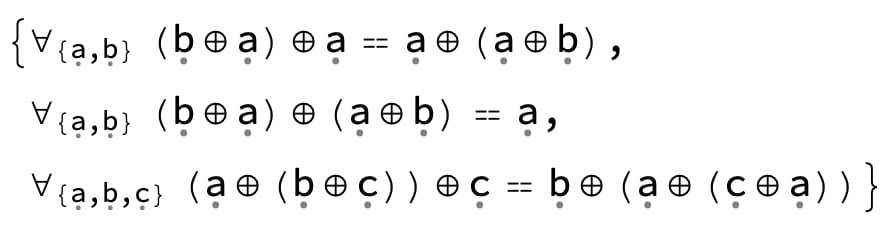
I had Claude chew on this for a bit, and Claude determined that this proof system was the trivial one (ie ∀a,b:a=b) by writing a script in SPASS (an automatic theorem prover) to try to prove this statement.
Here is the SPASS proof
--------------------------SPASS-START-----------------------------
Input Problem:
1[0:Inp] || equal(skc2,skc3)** -> .
2[0:Inp] ||  -> equal(op(op(u,v),op(v,u)),v)**.
3[0:Inp] ||  -> equal(op(op(u,v),v),op(v,op(v,u)))**.
4[0:Inp] ||  -> equal(op(op(u,op(v,w)),w),op(v,op(u,op(w,u))))*.
 This is a unit equality problem.
 This is a problem that has, if any, a non-trivial domain model.
 The conjecture is ground.
 Axiom clauses: 3 Conjecture clauses: 1
 Inferences: IEqR=1 ISpR=1 ISpL=1
 Reductions: RFRew=1 RBRew=1 RFMRR=1 RBMRR=1 RObv=1 RUnC=1 RTaut=1 RFSub=1 RBSub=1
 Extras    : Input Saturation, No Selection, No Splitting, Full Reduction,  Ratio: 5, FuncWeight: 1, VarWeight: 1
 Precedence: op > skc3 > skc2 > skc1 > skc0
 Ordering  : KBO
Processed Problem:

Worked Off Clauses:

Usable Clauses:
1[0:Inp] || equal(skc3,skc2)** -> .
2[0:Inp] ||  -> equal(op(op(u,v),op(v,u)),v)**.
3[0:Inp] ||  -> equal(op(op(u,v),v),op(v,op(v,u)))**.
4[0:Inp] ||  -> equal(op(op(u,op(v,w)),w),op(v,op(u,op(w,u))))*.
	Given clause: 1[0:Inp] || equal(skc3,skc2)** -> .
	Given clause: 2[0:Inp] ||  -> equal(op(op(u,v),op(v,u)),v)**.
	Given clause: 3[0:Inp] ||  -> equal(op(op(u,v),v),op(v,op(v,u)))**.
	Given clause: 15[0:Rew:3.0,14.0,2.0,14.0] ||  -> equal(op(u,op(u,v)),op(v,op(v,u)))*.
	Given clause: 4[0:Inp] ||  -> equal(op(op(u,op(v,w)),w),op(v,op(u,op(w,u))))*.
	Given clause: 11[0:SpR:3.0,2.0] ||  -> equal(op(op(u,op(u,v)),op(u,op(v,u))),u)**.
	Given clause: 16[0:SpR:15.0,2.0] ||  -> equal(op(op(op(u,v),u),op(v,op(v,u))),u)**.
SPASS V 3.9
SPASS beiseite: Proof found.
Problem: collapse.dfg
SPASS derived 171 clauses, backtracked 0 clauses, performed 0 splits and kept 96 clauses.
SPASS allocated 85510 KBytes.
SPASS spent	0:00:00.08 on the problem.
		0:00:00.03 for the input.
		0:00:00.02 for the FLOTTER CNF translation.
		0:00:00.00 for inferences.
		0:00:00.00 for the backtracking.
		0:00:00.01 for the reduction.


Here is a proof with depth 3, length 23 :
1[0:Inp] || equal(skc3,skc2)** -> .
2[0:Inp] ||  -> equal(op(op(u,v),op(v,u)),v)**.
3[0:Inp] ||  -> equal(op(op(u,v),v),op(v,op(v,u)))**.
4[0:Inp] ||  -> equal(op(op(u,op(v,w)),w),op(v,op(u,op(w,u))))*.
14[0:SpR:2.0,3.0] ||  -> equal(op(op(u,v),op(op(u,v),op(v,u))),op(u,op(u,v)))**.
15[0:Rew:3.0,14.0,2.0,14.0] ||  -> equal(op(u,op(u,v)),op(v,op(v,u)))*.
16[0:SpR:15.0,2.0] ||  -> equal(op(op(op(u,v),u),op(v,op(v,u))),u)**.
17[0:SpR:15.0,2.0] ||  -> equal(op(op(u,op(u,v)),op(op(v,u),v)),op(v,u))**.
34[0:SpR:4.0,2.0] ||  -> equal(op(op(u,op(v,op(w,u))),op(w,op(v,op(u,v)))),op(v,op(w,u)))**.
49[0:SpR:4.0,2.0] ||  -> equal(op(op(u,op(op(op(v,u),u),v)),v),u)**.
63[0:Rew:3.0,49.0] ||  -> equal(op(op(u,op(op(u,op(u,v)),v)),v),u)**.
128[0:SpR:16.0,3.0] ||  -> equal(op(op(u,op(u,v)),op(op(u,op(u,v)),op(op(v,u),v))),op(v,op(u,op(u,v))))**.
145[0:SpR:3.0,16.0] ||  -> equal(op(op(op(u,op(u,v)),op(v,u)),op(u,op(u,op(v,u)))),op(v,u))**.
168[0:Rew:17.0,128.0] ||  -> equal(op(op(u,op(u,v)),op(v,u)),op(v,op(u,op(u,v))))**.
171[0:Rew:168.0,145.0] ||  -> equal(op(op(u,op(v,op(v,u))),op(v,op(v,op(u,v)))),op(u,v))**.
173[0:Rew:34.0,171.0] ||  -> equal(op(u,op(u,v)),op(v,u))**.
174[0:Rew:173.0,15.0] ||  -> equal(op(u,op(u,v)),op(u,v))**.
194[0:Rew:173.0,63.0] ||  -> equal(op(op(u,op(op(v,u),v)),v),u)**.
209[0:Rew:173.0,174.0] ||  -> equal(op(u,v),op(v,u))*.
228[0:Rew:173.0,194.0,209.0,194.0,173.0,194.0,173.0,194.0,209.0,194.0] ||  -> equal(op(u,v),u)**.
229[0:Rew:228.0,2.0] ||  -> equal(op(u,v),v)**.
234[0:Rew:228.0,229.0] ||  -> equal(u,v)*.
235[0:UnC:234.0,1.0] ||  -> .
Formulae used in the proof : conjecture0 axiom1 axiom0 axiom2

--------------------------SPASS-STOP------------------------------
Here is Claude's proof summary
Proof sketch (from SPASS, depth 3, length 23):
- Axioms 1 & 2 ⟹ a ⊕ (a ⊕ b) = b ⊕ (b ⊕ a) [step 15: "symmetrized absorption"]
- Substitutions into Axiom 3 + rewrites ⟹ a ⊕ (a ⊕ b) = b ⊕ a [step 173: "double apply = flip"]
- (1) + (2) ⟹ a ⊕ (a ⊕ b) = a ⊕ b [step 174: idempotent-like]
- (2) + (3) ⟹ a ⊕ b = b ⊕ a [step 209: commutativity]
- (4) + earlier lemmas ⟹ a ⊕ b = a [step 228: left absorption]
- Rewrite Axiom 2 with (5) ⟹ a ⊕ b = b [step 229: right absorption]
- (5) + (6) ⟹ a = b ∀ a,b ∎
Therefore I think its quite likely that many of the supposedly rich alien axiom systems Gorard found are actually just trivial almost-contradictory systems which are hard to prove the triviality of. It also explains why he couldn't "make sense" of the system. There is nothing to make sense of.
Half a year or so ago I stumbled across Eugene Wigner's 1960's article "The Unreasonable Effectiveness of Mathematics in the Natural Sciences". It asks a fairly simple question. Why does mathematics generalize so well to the real world? Even in cases where the relevant math was discovered (created?) hundreds of years before the physics problems we apply it to were known. In it he gives a few examples. Lifted from wikipedia:
The puzzle here seems real to me. My conception of mathematics is that you start with a set of axioms and then explore the implications of them. There are infinitely many possible sets of starting axioms you can use [1] . Many of those sets are non-contradictory and internally consistent. Only a tiny subset correspond to our physical universe. Why is it the case that the specific set of axioms we've chosen, some of which were established in antiquity or the middle ages, corresponds so well to extremely strange physical phenomenon that exist at levels of reality we would not have access to until the 20th century?
Let's distinguish between basic maths, things like addition and multiplication, and advance math. I think it's unsurprising that basic maths reflects physical reality. A question like "why does maths addition and adding objects to a pile in reality work in the same way" seems answered by some combination of two effects. The first is social selection for the kinds of maths we work on to be pragmatically useful. e.g: maths based on axioms where addition works differently would not have spread/been popular/had interested students for most of history. The second is evolution contouring our minds to be receptive to the kind of ordered thinking that predicts our immediate environment. Even if not formalized, humans have a tendency towards thinking about their environment, reasoning and abstract thought. Our ancestors who were prone to modes of abstract reasoning that correlated less well with reality were probably selected against.
As for advance math, I do think it's more surprising. The fact that maths works for natural phenomenon which are extremely strange, distant from our day to day experience or evolutionary environment and often where the natural phenomenon were discovered centuries after the maths in question seems surprising. Why does this happen? A few possible explanations spring to mind:
Hmmmmm. I think 2 kind of begs the question. The core weird thing here is that our maths universe is so well correlated with our physical universe. The two answers here seem to be
I don't have a good answer here. This is a problem I should think about more.
Maybe. Possibly at some point you cease being able to add non contradictory axioms that are also cannot be collapsed/simplified. ↩︎