Epistemic status: Quick rant trying to get a bunch of intuitions and generators across, written in a very short time. Probably has some opinions expressed too strongly in various parts.
I appreciate seeing this post written, but currently think that if more people follow the advice in this post, this would make the world a lot worse (This is interesting because I personally think that at least for me, doing a bunch of "buying time" interventions are top candidates for what I think I should be doing with my life) I have a few different reasons for this:
- I think organizing a group around political action is much more fraught than organizing a group around a set of shared epistemic virtues and confusions, and I expect a community that spent most of its time on something much closer to political advocacy would very quickly go insane. I think especially young people should really try to not spend their first few years after getting interested in the future of humanity going around and convincing others. I think that's a terrible epistemic environment in which to engage honestly with the ideas.
- I think the downside risk of most of these interventions is pretty huge, mostly because of effects on epistemics and morals (I don't care that much about e.g. annoying capabilities researchers or something). I think a lot of these interventions have tempting paths where you exaggerate or lie or generally do things that are immoral in order to acquire political power, and I think this will both predictably cause a lot of high-integrity people to feel alienated and will cause the definitions and ontologies around AI alignment to get muddled, both within our own minds and the mind of the public.
- Separately, many interventions in this space actually just make timelines shorter. I think sadly on the margin going around and trying to tell people about how dangerous and powerful AGI is going to be seems to mostly cause people to be even more interested in participating in its development, so that they can have a seat at the table when it comes to the discussion of "how to use this technology" (despite by far the biggest risk being accident risk, and it really not mattering very much for what ends we will try to use the technology)
- I think making the world more broadly "safety concerned" does not actually help very much with causing people to go slower, or making saner decisions around AI. I think the dynamics here are extremely complicated and we have many examples of social movements and institutions that ended up achieving the opposite of their intended goals as the movement grew (e.g. environmentalists being the primary reason for the pushback against nuclear power).
The default of spreading vague "safety concern" memes is that people will start caring a lot about "who has control over the AI" and a lot of tribal infighting will happen, and decisions around AI will become worse. Nuclear power did not get safer when the world tried to regulate the hell out of how to design nuclear power plants (and in general the reliability literature suggests that trying to legislate reliability protocols does not work and is harmful). A world where the AIs are "legislated to be transparent" probably implies a world of less transparent AIs because the legislations for transparency will be crazy and dumb and not actually help much with understanding what is going on inside of your AIs. - Historically some strategies in this space have involved a lot of really talented people working at capabilities labs in order to "gain influence and trust". I think the primary effect of this has also been to build AGI faster, with very limited success at actually getting these companies on a trajectory that will not have a very high chance of developing unaligned AI, or even getting any kind of long-term capital.
- I think one of the primary effects of trying to do more outreach to ML-researchers has been a lot of people distorting the arguments in AI Alignment into a format that can somehow fit into ML papers and the existing ontology of ML researchers. I think this has somewhat reliably produced terrible papers with terrible pedagogy and has then caused many people to become actively confused about what actually makes AIs safe (with people walking away thinking that AI Alignment people want to teach AIs how to reproduce moral philosophy, or that OpenAIs large language model have been successfully "aligned", or that we just need to throw some RLHF at the problem and the AI will learn our values fine). I am worried about seeing more of this, and I think this will overall make our job of actually getting humanity to sensibly relate to AI harder, not easier.
I think all of these problems can be overcome, and have been overcome by many people in the community, but I predict that the vast majority of efforts, especially by people who are not in the top percentiles of thinking about AI, and who avoided building detailed models of the space because they went into "buying time" interventions like the ones above, will result in making things worse in the way I listed above.
That said, I think I am actually excited about more people pursuing "buying time" interventions, but I don't think trying to send the whole gigantic EA/longtermist community onto this task is going to be particularly fruitful. In contrast to your graph above, my graph for the payoff by percentile-of-talent for interventions in the space looks more like this:

My guess is maybe some people around the 70th percentile or so should work harder on buying us time, but I find myself very terrified of a 10,000 person community all somehow trying to pursue interventions like the ones you list above.
This post is the first in a sequence of posts about AI strategy. In the next post, we’ll provide more examples of “buying time” interventions that we’re excited about.
We’re grateful to Ajeya Cotra, Daniel Kokotajlo, Ashwin Acharya, and Andrea Miotti for feedback on this post.
If anyone is interested in working on "buying time" interventions, feel free to reach out. (Note that Thomas has a list of technical projects with specifics about how to implement them. We also have a list of non-technical projects).
Summary
A few months ago, when we met technical people interested in reducing AI x-risk, we were nearly always encouraging them to try to solve what we see as the core challenges of the alignment problem (e.g., inner misalignment, corrigibility, interpretability that generalizes to advanced systems).
But we’ve changed our mind.
On the margin, we think more alignment researchers should work on “buying time” interventions instead of technical alignment research (or whatever else they were doing).
To state the claim another way: on the margin, more researchers should backchain from “how do I make AGI timelines longer, make AI labs more concerned about x-risk, and present AI labs with clear things to do to reduce x-risk", instead of “how do I solve the technical alignment problem?”
Some “buying time” interventions involve performing research that makes AI safety arguments more concrete or grounds them in ML (e.g., writing papers like Goal misgeneralization in deep reinforcement learning and Alignment from a deep learning perspective & discussing these with members of labs).
Some “buying time” interventions involve outreach and engagement with capabilities researchers, leaders in AI labs, and (to a lesser extent) the broader ML community (e.g., giving a presentation to a leading AI lab about power-seeking and deception). We expect that successful outreach efforts will also involve understanding the cruxes/counterarguments of the relevant stakeholders, identifying limitations of existing arguments, and openly acknowledging when the AI safety community is wrong/confused/uncertain about certain points.
We are excited about “buying time” interventions for four main reasons:
Figure 1: Impact by percentile for technical alignment research and buying time interventions.
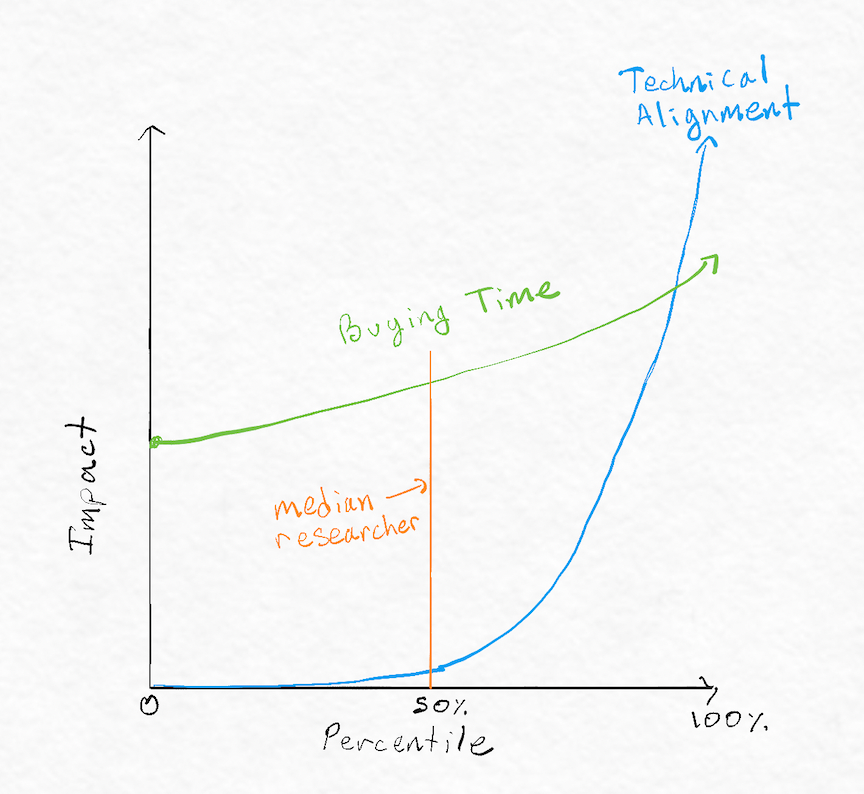
Caption: We believe that impact in technical alignment research is more heavy-tailed than impact for buying time interventions. Figure 1 illustrates this belief. Note that this is a rough approximation. Note also that both curves should also go below the 0-point of the y-axis, as both kinds of interventions can be net negative.
Concretely, we recommend that ~40-60% of alignment researchers should focus on "buying time" interventions rather than technical alignment research (whereas we currently think that only ~20% are focusing on buying time). We also recommend that ~20-40% of community-builders focus on “buying time” interventions rather than typical community-building (whereas we currently think that ~10% are focusing on buying time).
In the rest of the post, we:
Disclaimers
Disclaimer #1: We’re not claiming that “buying time” is the only way to categorize the kinds of interventions we describe, and we encourage readers to see if they can come up with alternative frames/labels. Many “buying time” interventions also have other benefits (e.g., improving coordination, getting more people to work on AI safety researchers, and making it less likely that labs deploy dangerous systems). We chose to go with the “buying time” frame for two main reasons
Disclaimer #2: Many of these interventions have serious downside risks. We also think many of them are difficult, and they only have a shot at working if they are executed extremely well.
Disclaimer #3: We have several “background assumptions” that inform our thinking. Some examples include (a) somewhat short AI timelines (AGI likely developed in 5-15 years), (b) high alignment difficulty (alignment by default is unlikely, and current approaches seem unlikely to work), and (c) there has been some work done in each of these areas, but we are far behind what we would expect in winning worlds, and there are opportunities to do things that are much more targeted & ambitious than previous/existing projects.
Disclaimer #4: Much of our thinking is informed by conversations with technical AI safety researchers. We have less experience interacting with the governance community and even less experience thinking about interventions that involve the government. It’s possible that some of these ideas are already widespread among EAs who focus on governance interventions, and a lot of our arguments are directed at the thinking we see in the technical AI safety community.
Why are we so excited about "buying time" interventions?”
Large upsides of buying time
Some time-buying interventions buy a year at the end. If capabilities growth continues as normal until someone is about to deploy an AI model that would improve into a TAI, but an evaluation triggers and reveals misaligned behavior, causing this lab to slow down and warn the other labs, the time from this event until when AGI is deployed is very valuable for the following reasons:
Other interventions have a different shape, and do not buy as valuable time. If you simply slow the rate of capabilities progress through publication policies or convince some capabilities researchers to transition, such that on net then AI will take one more year to generate, this has the benefit of 1-4, but not 5 and 6. However, we are proposing to reallocate alignment researchers to buying time interventions, which means that less alignment research is being made this year, so reason 3 might be less strong.
Some interventions that buy time involve coordinating with members of major AI labs (e.g., OpenAI, DeepMind, Anthropic). As a result, these interventions often have the additional benefit of increasing communication, coordination, trust, and shared understanding between major AI labs and members of the AI safety community who are not part of the AI labs. (Note that this is not true of all “buying time” interventions, and several of them could also lead to less coordination or less trust).
Tractability and comparative advantage: lots of people can have a solid positive impact by buying time, while fewer can do great alignment work
A reasonable counterpoint is that “buying time” might also be heavily-tailed. However, we currently expect it to be less heavy-tailed than alignment research. It seems plausible to us that many “median SERI-MATS scholars” could write papers like the goal misgeneralization paper, explain alignment difficulties in clearer and more compelling ways, conduct (or organize) high-quality outreach and coordination activities and perform many other interventions we’re excited about. On the other hand, we don’t expect that “median SERI-MATS scholars” would be able to make progress on heuristic arguments, create their own alignment agendas, or come up with other major conceptual advancements.
Nonetheless, a lot of the argument depends on the specific time-buying and the specific alignment research. It seems plausible to us that some of the most difficult time-buying interventions are more heavy-tailed than some of the more straightforward alignment research projects (e.g., coming up with good eval tools and demos might be more heavy-tailed than performing interpretability experiments).
What are some examples of "buying time" interventions?
The next post in this sequence (rough draft here) outlines more concrete interventions that we are excited about in this space, but we highlight three interventions here that are especially exciting to us. We briefly provide some examples below.
Outreach efforts that involve interactions between the AI safety community and (a) members of AI labs + (b) members of the ML community.
Some specific examples:
The Evaluations Project (led by Beth Barnes)
Beth’s team is trying to develop evaluations that help us understand when AI models might be dangerous. The path to impact is that an AI company will likely use the eval tool on advanced AI models that they train, and this eval could then lead them to delay deployment of a model for which the eval unveiled scary behavior. In an ideal world, this would be so compelling that multiple AI labs slow down, potentially extending timelines by multiple years.
Papers that take theoretical/conceptual safety ideas and ground them in empirical research.
Specific examples of this type of work include Lauro Langosco’s goal misgeneralization paper (which shows how an RL agent can appear to learn goal X but actually learn goal Y) and Alex Turner’s optimal policies tend to seek power paper. Theoretical alignment researchers had already proposed that agents could learn unintended goals and that agents would have incentives to seek power. The papers by Lauro and Alex take these theoretical ideas (which are often perceived as fuzzy and lacking concreteness), formalize them more crisply, and offer examples of how they affect modern ML systems.
We think that this buys time primarily by convincing labs and academics of alignment difficulty. In the next section, we give more detail on the theory of chance.
Theory of Change
In the previous section, we talked about why we were so excited about buying time interventions. However, the interventions we have in mind often have a number of other positive impacts. In this section, we provide more detail about these impacts as well as why we think these impacts end up buying time.
We summarize our theory of change in the following diagram:
Labs take AGI x-risk seriously + Labs have concrete things they can do → More Time
We think that timelines are largely a function of (a) the extent to which leaders and researchers at AI labs are concerned about AI x-risk and (b) the extent to which they have solutions that can be (feasibly) implemented.
If conditions (a) and (b) are met, we expect the following benefits:
These all lead to relative slowdowns of AGI timelines, giving everyone more time to solve the alignment problem.
Benefits other than buying time
Many of the interventions we describe also have benefits other than buying time. We think the most important ones are:
Some objections and our responses
1. There are downside risks from low-quality outreach and coordination efforts with AI labs
Response: We agree. Members of AI labs have their own opinions about AI safety; efforts to come in and proselytize are likely to fail. We think the best efforts will be conducted by people who have (a) strong understandings of technical AI safety arguments, (b) strong interpersonal skills and ability to understand different perspectives, (c) caution and good judgment, and (d) collaborators or advisors who can help them understand the space. However, this depends on the intervention. Caution is especially warranted when doing direct outreach that involves interaction with capabilities researchers, but more technical work such as empirically grounding alignment arguments pretty much only requires technical skill.
2. Labs perceive themselves to be in a race, so they won’t slow down.
Response #1: We think that some of the concrete interventions we have in mind contribute to coordination and reduce race dynamics. In particular, efforts to buy time by conveying the difficulty of alignment could lead multiple players to become more concerned about x-risk (causing all of the leading labs to slow down).
Furthermore, we’re optimistic that sufficiently well-executed coordination events could lead to increased trust and potentially concrete agreements between labs. We think that differences in values (company A is worried that company B would not use AI responsibly) and worries about misuse risk (company A is worried that company B’s AI is likely to be unaligned) are two primary drivers of race dynamics.
However, to the extent that A and B are value-aligned, both are aware that each of them are taking reasonable safety precautions, and leaders at both companies trust each other, they are less incentivized to race each other. Coordination events could help with each of these factors.
Response #2: Some interventions don’t reduce race dynamics (e.g., slowing down the leading lab). These are high EV in worlds where the safety-conscious lab (or labs) has a sizable advantage. On the margin, we think more people should be investing into these interventions, but they should be deployed more carefully (ideally after some research has been conducted to compare the upside of buying time to the downside of increasing race dynamics).
3. Labs being more concerned about safety isn’t that helpful. They already care; they just lack solutions.
Response: Our current impression is that many leaders at major AGI labs are concerned about safety. However, we don’t think everyone is safety-conscious, and we think there are some policies that labs could adopt to buy time (e.g., adopting publication policies that reduce the rate of capabilities papers).
4. Slowing down ODA+[2] could increase the chance that a new (and less safety-conscious actor) develops AGI.
Response #1: Our current best guess is that ODA+ has a >6 month lead over less safety-conscious competitors. However, this is fairly sensitive to timelines. If scale is critical, then one would expect a small number of very large projects to be in the lead for AGI, and differentially slowing the most receptive / safety oriented / cautious of those labs seems on net negative. However, interventions that slow the whole field such as a blanket slowdown in publishing or increases the extent to which all labs are safety oriented are robustly good.
Response #2: Even if ODA+ does not have a major lead, many of the interventions (like third-party audits) could scale to new AGI developers too. For example, if there's a culture in the field of doing audits, and pressure to do so, talented researchers are likely not to want to work for you unless you participate, or if later there's a regulatory regime attached to all that.
Response #3: Some interventions to buy time increase lead time of labs and slow research overall (e.g., making it more difficult for new players to enter the space; compelling evals or concretizations of alignment difficulties could cause many labs to slow down).
Response #4: Under our current model, most P(doom) comes from not having a solution to the alignment problem. So we’re willing to trade some P(solution gets implemented) and some P(AGI is aligned to my values) in exchange for a higher P(we find a solution). However, we acknowledge that there is a genuine tradeoff here, and given the uncertainty of the situation, Thomas thinks that this is the strongest argument against buying time interventions.
5. Buying time is not tractable.
Response: This is possible, but we currently doubt it. There seems to be a bunch of stuff that no one has tried (we will describe this further in a follow-up post).
6. In general, problems get solved by people actually trying to solve them. Not by avoiding the hard problems and hoping that people solve them in the future.
Response #1: Getting mainstream ML on board with alignment concerns is solving one of the hardest problems for the alignment field.
Response #2: Although some of the benefit from “buying time” involves hoping that new researchers show up with new ideas, we’re also buying time for existing researchers who are tackling the hard problems.
Response #3: People who have promising agendas that are attacking the core of the problem should continue doing technical alignment research. There are a lot of people who have been pushed to do technical alignment work who don’t have promising ideas (even after trying for years), or feel like they have gotten substantial signal that they are worse at thinking about alignment than others. These are the people we would be most excited to reallocate. (Note though that we think feedback loops in alignment are poor. Our current guess is that among the top 10% of junior researchers, it seems extremely hard to tell who will be in the tail. But it’s relatively easy to tell who is in the top 10-20% of junior researchers).
7. There’s a risk of overcorrection: maybe too many people will go into “buying time” interventions and too few people will go into technical alignment.
Response: Currently, we think that the AIS community heavily emphasizes the value of technical alignment relative to “buying time.” We think it’s unlikely that the culture shifts too far in the other direction.
8. This doesn't seem truth-seeky or epistemically virtuous— trying to convince ML people of some specific claims feels wrong, especially given how confused we are and how much disagreement there is between alignment researchers.
Response #1: There are a core set of claims that are pretty well supported that the majority of the ML community has not substantially engaged with (e.g. goodharting, convergent instrumental goals, reward misspecification, goal misgeneralization, risks from power-seeking, risks from deception).
Response #2: We’re most excited about outreach efforts and coordination efforts that actually allow us to figure out how we’re wrong about things. If the alignment community is wrong about something, these interventions make it more likely that we find out (compared to a world in which we engage rather little with capabilities researchers + ML experts and only talk to people in our community). If others are able to refute or deconfuse points that are made in this outreach effort, this seems robustly good, and it seems possible that sufficiently good arguments would convince us (or the alignment community) about potentially cruxy issues.
What changes do we want to see?
We did a BOTEC that suggested that 1 hour of alignment researcher time would buy, in expectation, 1.5-5 quality-adjusted research hours. The BOTEC made several conservative assumptions (e.g., it did not account for the fact that we expect alignment research to be more heavy-tailed than buying time interventions). We are in the process of revising our BOTEC, and we hope to post it once we have revised it.
ODA+ = OpenAI, DeepMind, Anthropic, and a small number of other actors.