This is a special post for quick takes by evhub. Only they can create top-level comments. Comments here also appear on the Quick Takes page and All Posts page.
Comment Permalink
*Ω20384
(Sorry, this has a bit of content overlap with Zach and Alek’s comments.)
Thanks for sharing your thoughts. I've spent a total of ~0.5-1 weeks comparing the proposals of an AI R&D compute cap and an internal deployment fixed lag (e.g., 6 months) or freeze (e.g., no using models trained after Jan 1 2027 for AI R&D).
I’ve mainly analyzed an AI R&D compute cap vs. a fixed internal deployment lag (just your “short mandatory waiting process”), so I’ll share my thoughts on that below (starting with "Simple R&D compute caps vs. deployment lags").
edit: I've now posted my full analysis here, but the below is still an up-to-date summary.
My current opinion is that compute reallocation is similarly good or slightly better than internal deployment lags, but I'm not confident. I think it would be best to do some of both.
I’m against immediately entering an internal-deployment-blocking risk-assessment-based regime as I’m worried it won’t result in enough of a slowdown, and the priority should be ensuring an actually substantial slowdown. (see e.g. Alek’s comment here) But I think in the long run we should aim toward a competent risk-assessment-based regime, so I’m in favor of trials of it that aren’t yet attempting to be load-bearing for safety.
If we did do a risk-assessment-based regime, I think an R&D compute cap (which can be set to 0 if desired!) as a sole mechanism would be slightly better than blocking internal deployment. I agree with you that ideally we should have both. I haven't thought much about this comparison, compared to how much I’ve thought about the comparison between these mechanisms being applied outside of a risk-assessment-based regime.
Simple R&D compute caps vs. deployment lags:
The most important point in favor of compute reallocation is that it enables a stronger near-term slowdown, and provides a dial that can be turned to get a ~pause by making it 0%. Restricting use of AI for AI R&D can make things go much slower than they otherwise would, but even a full ban has less potential to restrict progress than an R&D compute cap.
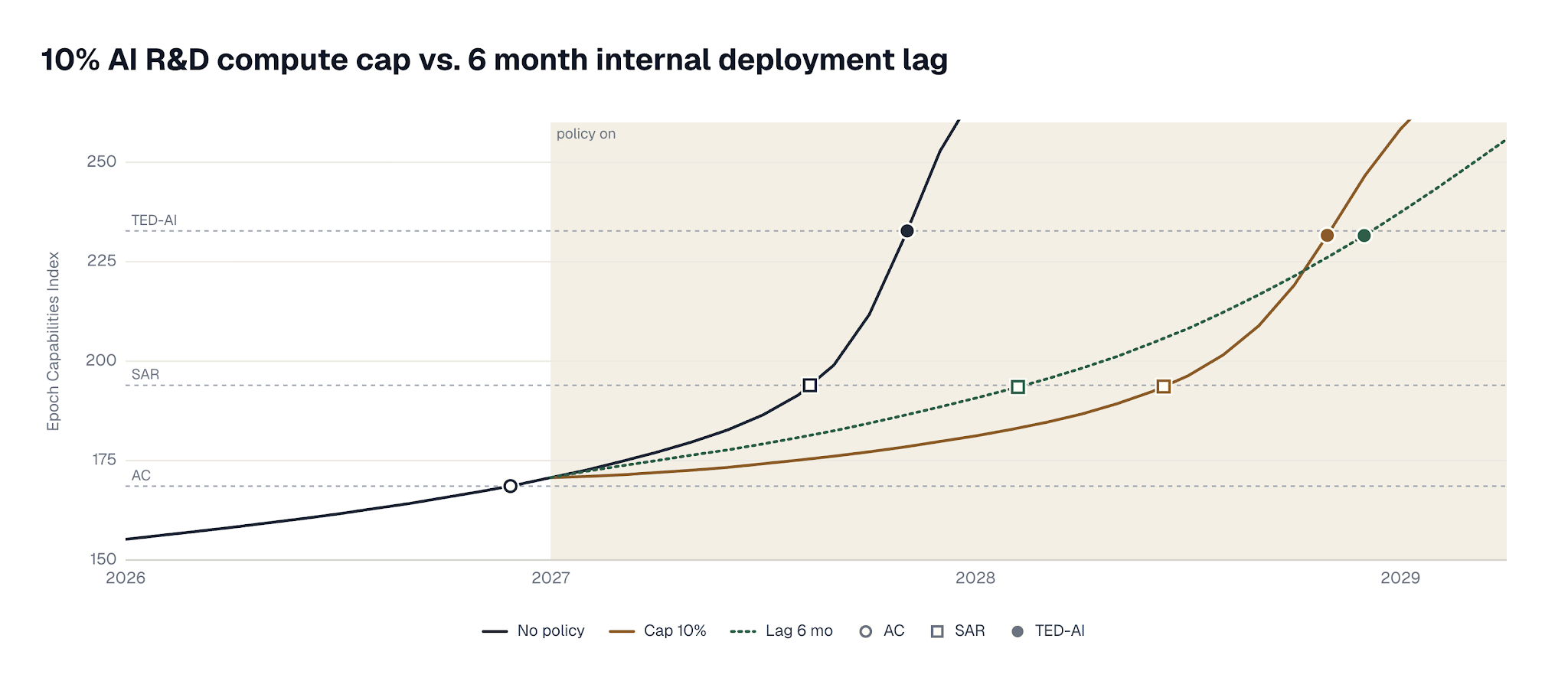
In general, a compute cap slows down relatively more in the near-term, and an internal deployment lag slows down relatively more in the long-term. Whether this is good or not depends on (a) what capabilities you are most worried about and (b) whether you think we should focus on slowing down as much as we can now and worry about what to do next later. I am personally pretty conflicted here; I think the point-of-no-return might be quite soon (e.g. at Superhuman AI Researcher or soon after), but also that slowing down takeoff might be quite important; so I’m sympathetic to arguments that the longer term slowdown provided by deployment lags makes it better than compute caps.
We'll hopefully be putting out a tool soon that makes it easy to compare the effects of pacing policies. Here's a quick screenshot of an illustrative example comparing the 2 policies:
I also unconfidently think that verification is a bit easier for compute caps than internal deployment lags. This is based on assessments of Romeo, co-author of pacing-ai.com; the site mainly discusses compute reallocation, but also has a page on deployment lags. Note that verification is easiest with an internal+external deployment lag, but I think this would be bad for societal awareness.
One countervailing consideration is that internal deployment lags might push back the point of no return, because it makes it harder for AIs to adversarially prevent humans from aligning future AIs. This effect seems potentially quite large if you’re using e.g. current-level-AIs or lower for your AI R&D; unclear how large it is if it’s a months-long lag, but I think it still might be very important.
Also, because a compute cap slows down more in the near-term, it creates more overhang.
I haven’t tried to figure out which proposal is more politically feasible, which your comment discusses a bit. I don’t have a strong view on that.
A few more thoughts:
It's very hard for a regulator to know how to set the dial on other pacing regimes. For any pacing regime, it seems extremely important to me for the regulator to have a really good understanding of exactly where internal AI progress is at and how risky new frontier internal deployments are, for the purposes of setting the pacing dial. But if the regulator already needs that information, then I think the most straightforward thing to do with that is blocking authority.
I agree it’s good for a regulator to have that information. But I think our main goal right now should be to make sure that we get a substantial slowdown. Then, after that, we can try to build up a system that does a good job of tuning the dial in a more fine-grained way. This is why I like a simple rule for now.
it just seems wild to be in a situation where the only response to an internal deployment that the regulator thinks is manifestly unsafe is a compute reallocation dial.
Why? They could require only external inference. But yeah, I agree ideally they would also have other affordances.
Internal deployment blocking is much easier to define than alternatives. Compute reallocation requires defining somewhat fuzzy categories for different compute buckets, as I tried to do originally, but which is really a very tricky thing to do properly. Internal deployment blocking, conversely, just requires you to define what counts as an "internal deployment", which I think is much more straightforward (e.g. "anything that meaningfully contributes to the company's operations or is not fully sandboxed training/evaluation").
I currently don’t think this is accurate, or like, I don’t think the implication that it’s easier to verify is more accurate. For example, you have to make sure AI progress isn’t made in “experiments.” More on this here.
 2