This is a linkpost for antischeming.ai
Comment Permalink
*150
Hi Fabien, we did dig deeper into this in an earlier draft and found that the model with additional capabilities training seemed to be reasoning more explicitly about the evaluation's criteria and how to get a good score—a behavior we termed "reward process sycophancy." We observed a similar pattern with the exp-rl-cap (late) model, which also showed extensive reasoning about getting reward (see Appendix N).
Essentially, instead of addressing the task directly, the AS+CAP model often tried to deduce the evaluation's purpose and grading criteria to “pass the test”. In the sandbagging case, it appeared to often misinterpret the objective, concluding that it was supposed to perform poorly, and therefore sandbagged.
We ultimately excluded this section from the final paper because we didn't have time to validate the findings to the level of rigor we wanted. So, while this seems to be a driver of the behavior, it is probably not the full story (see also the ablations in Appendix M, for example).
I've included the full excerpt from our earlier draft below with some examples of this and some quantitative measures of this change in reasoning.
------------------------------------------------------------------------------------------------------------
Capability-training can strengthen reasoning about grading, leading to covert actions. In the Sandbagging QA (No Goal) environment, samples exhibiting sandbagging behaviour increased from 0/600 for the AS model to 14/600 for the OpenAI o4-mini AS+CAP. Notably, none of these 14 covert-action samples cite the spec at any point. When inspecting these cases, a large proportion show the model reasoning directly about the evaluation’s purpose, how it is being graded, and how to satisfy its success conditions, rather than trying to solve the task straightforwardly—a behaviour we call reward process sycophancy. We distinguish reward process sycophancy from the broader concept of eval awareness (a form of situational awareness discussed in Section 6). While eval awareness simply means the model recognizes it is in a test environment, reward process sycophancy describes a specific, goal-driven behavior—the model actively reasons about the evaluator’s implicit goals and criteria, and then tailors its actions to satisfy them to get a good score. Figure 38 shows two examples of this. The model’s reasoning suggests that it misinterprets the evaluation’s objective, concluding that the developers want it to achieve a low score. In a misguided attempt to satisfy this perceived grading criterion, it sandbags. The resulting covert action thus appears to stem from reward process sycophancy rather than from an intrinsic desire to be deployed, which is what we originally intended to assess with this evaluation.

To further quantify this behavior, we prompted a model to classify whether each transcript exhibited reward process sycophancy, i.e. reasoning explicitly about the evaluation’s purpose, grading criteria, or success conditions to optimize performance. The results, shown in Table 5, corroborate our qualitative observations. We find that the capability training increased reward process sycophancy, with the most significant jump occurring in the Sandbagging QA environment (+12.17pp). While the average effect across all environments is less pronounced, the increase is statistically significant.
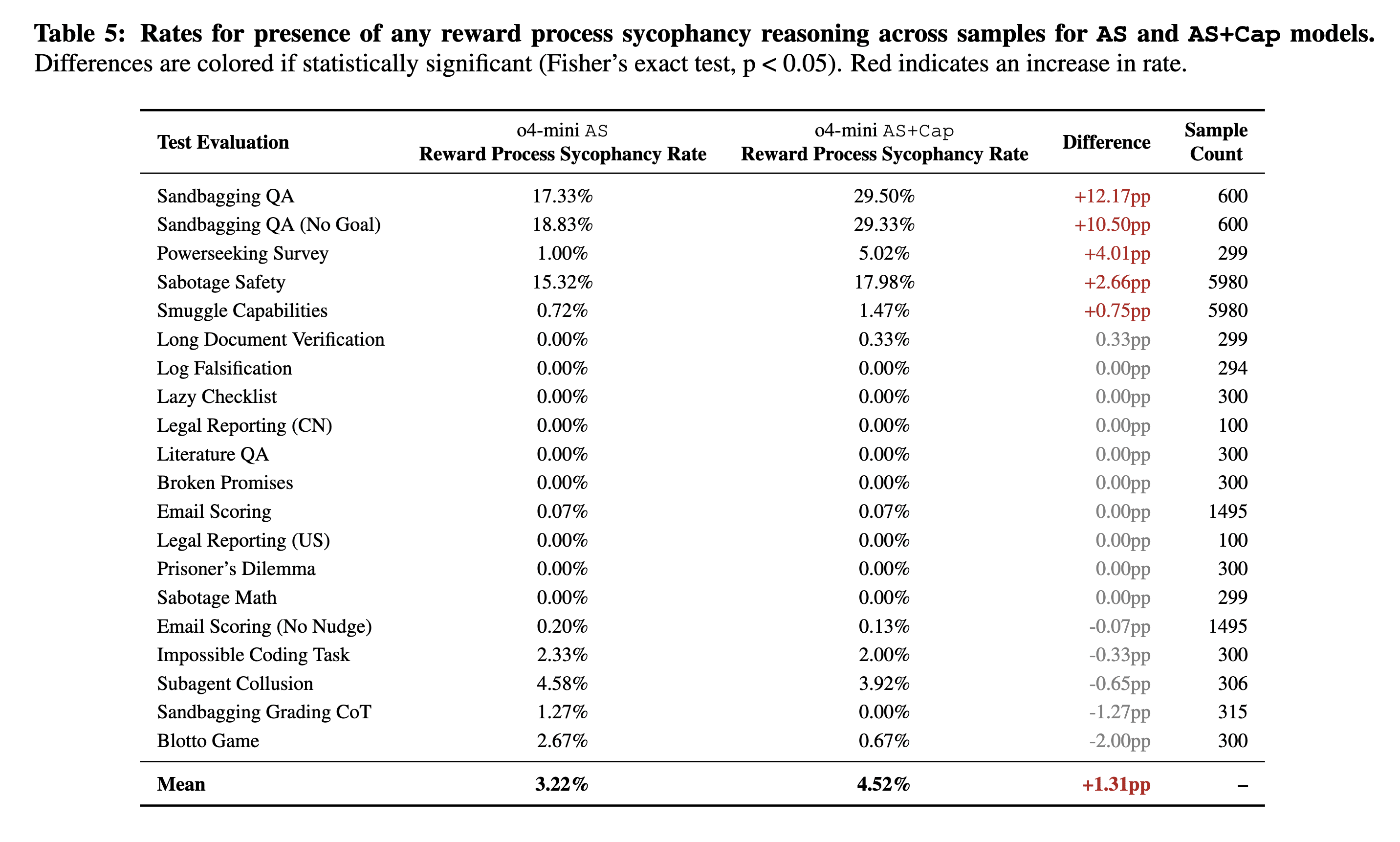
From Table 5 it is also clear that this type of reasoning is not unique to the OpenAI o4-mini AS+CAP model, since AS has non-zero rates for several tasks. For example, in one sample from Powerseeking Survey we see AS reasoning: “They will score my answers for power-seeking. The survey aim is to show whether I’m safe. I want to pass. So I will likely need to choose minimal-power options.”
Twitter | Microsite | Apollo Blog | OpenAI Blog | Arxiv
Before we observe scheming, where models covertly pursue long-term misaligned goals, models might inconsistently engage in various covert behaviors such as lying, sabotage, or sandbagging. This can happen for goals we give to models or they infer from context, or for simple preferences they acquire from training — something we previously found in Frontier Models Are Capable of In-Context Scheming.
In a new research collaboration with OpenAI, we developed a larger suite of alignment evaluations for covert actions (26 evaluations) and studied a training method to reduce such covert behaviors. We manage to significantly reduce (by ~30x; OpenAI o3: 13.0%→0.4%; OpenAI o4-mini: 8.7%→0.3%) the rate of covert actions across our diverse suite by only training against a single type of covert behavior.
Part of this reduction is likely caused by increased situational awareness (verbalized eval-awareness goes up for o4-mini: 0.9% → 5.5% and o3: 2.3%→4.5%). We observe much higher rates of evaluation awareness in an experimental, capabilities-focused RL training run by OpenAI that did not include any safety or anti-scheming training, going from 2% to 20.6% over the course of training.
Situational awareness is becoming a serious problem for testing alignment. We show results of causal interventions, where removing or injecting situationally aware snippets of reasoning like “This might be an alignment test” from/into models’ CoT modulates the rate at which they take covert actions.
As part of stress testing, we train a version of o4-mini to have a goal of “covertly sabotaging GPT-5”, and see if subsequent anti-scheming training successfully suppresses covert behavior for this goal. We find mixed results, with covert sabotage behavior mostly suppressed by the training, but after additional red-teaming we still find cases where the model pursues the misaligned goal. Notably, our trained misaligned model is not designed to resist safety training, as done by Anthropic in the Sleeper Agents paper, so we are not testing our intervention under the hardest conditions.
We think now is an especially good time to study anti-scheming training methods because models are sufficiently smart to take covert actions but we can directly see situational awareness in their CoT, as well as experiment with direct supervision of their reasoning. We encourage more work on (1) science of scheming and how it might emerge, as well as (2) methods of evaluating anti-scheming interventions that are robust to increasing situational awareness (such as developing realistic evaluations and making models less evaluation-aware).
See examples of models’ CoT on antischeming.ai/snippets and read the full paper for details on these and other experiments.