You're right that an intelligence explosion[1] would require a growing acceleration multiplier (for some period of time). But I don't think seeing stable-ish acceleration with a major trend breakpoint today is bearish. The AI Futures Model predicts that we see low acceleration from ~2024 up until we get an Automated Coder in [Daniel: Oct '27, Eli: Jun '28, Brendan: Jan '28], and then you get noticeably growing acceleration in takeoff toward ASI (eventually leveling off). For example, here's what Eli Lifland's presets were predicting as of 8/16/26 for ECI scores:[2]
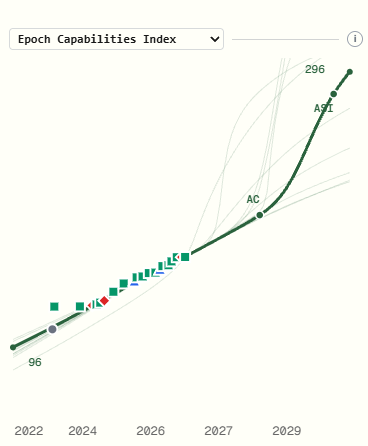
You can see here that the trendline from 2024 to Oct. 2025, and then from Oct. 2025 to Nov. 2026, is basically supposed to be just a straight line (aka, very low acceleration). But if you zoomed in or looked closely at the data, you'd find that technically there is some acceleration, up to ~1.08x by Nov. 2026. The acceleration only noticeably grows after AC, when the trendline suddenly steepens in takeoff.
So that's why the AIFP (and Ryan Greenblatt, who is closely associated) is so "spooked". Acceleration in capabilities growth wasn't supposed to be this strong yet!
Now for various reasons I think the headline 1.9x acceleration is overstated relative to the "true" frontier AI capabilities acceleration that the AIFM tries to predict. But it does seem like this evidence from METR ought to move timelines forward meaningfully on the most rigorous model we have.[3]
- ^
You can have mere Recursive Self-Improvement (RSI) without an Intelligence Explosion, and even reach ASI eventually that way. RSI like you're talking about, where "AI capability improvements make additional AI capability improvements easier", only requires an acceleration multiplier that stays above 1. Though I kind of prefer definitions of RSI that just mean "AI that improves itself" even if capability improvements become harder.
- ^
And this single-run-on-presets chart is more aggressive than his "true opinion" as of 8/16/26. Per here, his all-things-considered Monte Carlo-based forecast puts p50 for AC at Jan '30! But on the other hand, this graph is more conservative than that for Daniel Kokotajlo's presets, where ASI hits earlier and on the steepest part of the curve.
- ^
Some initial modeling I don't trust suggests that taking the 1.4x acceleration today's METR report gives for the all-labs frontier as true moves ASI 8 to 14 months earlier in the AIFM across different presets. Need to think more about how to feed this evidence into the model and do Monte Carlo runs though. Not sure if I'll have time to do that before AIFP puts out their update. EDIT: doing three 1000-draw Monte Carlo runs (two different approaches, one with two different parameter sets) I get median ASI date shifting anywhere from 2 to 41 months earlier (yes this is physically possible b/c Eli's Monte Carlo median is in 2036 due to a long right tail). Definitely needs more rigorous thought.
Twitter thread.
Ryan Greenblatt:
Ajeya Cotra:
Daniel Kokotajlo: says the METR report confirms his worry from two days ago, which was:
See also GradientDissenter's take.