From August 12 to October 29, 2026, METR staff performed a high-access evaluation at Anthropic to assess the degree to which AI is accelerating AI R&D. If AI systems started to significantly accelerate further AI development, this could lead to a sudden emergence of extreme and risky capabilities.
Anthropic offered unprecedented access to internal data on their AI R&D process, including a variety of metrics on pretraining, reinforcement learning (RL), training compute in each domain, benchmark scores for internal models, AI speedup analyses, forecasts of a future model’s metrics, and interviews with relevant staff.
As of October 2026, Anthropic is likely improving the capabilities of their models on well-specified tasks at around twice the rate they did between March 2024 and October 2025. This estimate is given with high uncertainty; we would not be surprised if the true acceleration was closer to 1.3x or 3x the historical rate.
A majority of this acceleration today is likely attributable to Anthropic’s extensive use of AI to do R&D, though there is significant uncertainty and other causes likely played a large role in acceleration in late 2025.
The lack of observed bottlenecks or strong diminishing returns means there is a significant risk that further capabilities progress could lead to even faster acceleration, though, as we say below, we may be missing important bottlenecks.
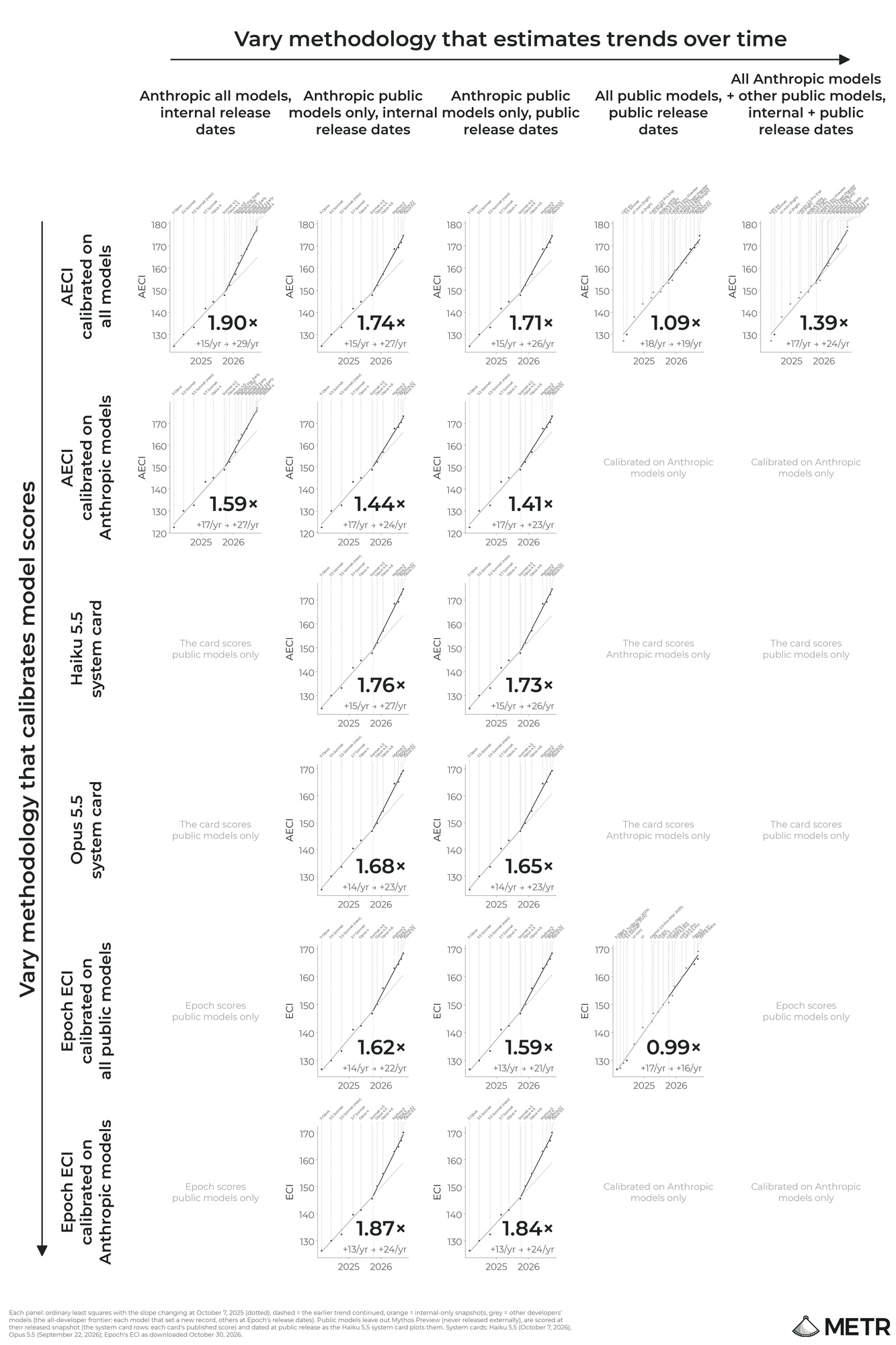
Since October 2025, benchmark scores (measured via AECI, Anthropic’s version of the Epoch Capabilities Index) for Anthropic’s models have been growing at an estimated 1.9x the pre-October 2025 rate [95% confidence interval: 1.5–2.8x], implying that Anthropic has made roughly two years of historical progress over the last year.
We are confident that the acceleration was not due to an acceleration in the scaling of training compute.
Interviews and surveys are consistent with AI usage causing a doubling in the pace of capabilities progress. Anthropic staff self-report dramatic uplift from use of AI systems in interviews and surveys, although these are challenging to interpret. We were told that R&D is accelerated primarily via AI assistance rather than fully autonomous contributions, but there are some signs that fully autonomous contributions will play a larger role soon.
We did not see evidence for significant bottlenecks which would prevent further capabilities progress due to limits on algorithmic progress, training compute, experiment compute, or data in the next 12 months. However, our understanding of the status of different bottlenecks changed several times as we received more detailed information, so we are not confident in our current assessment.
Some of the key findings that most informed our conclusions about risk were redacted by Anthropic.
The scope, setup, and timeline of this assessment.
Details of the information shared with METR.
Details of what information and evidence we were not able to share given Anthropic’s redactions.
Finally, we describe the biggest limitations of our analysis:
We could be underestimating capability acceleration if we did not assign enough importance to (1) evidence that some growth rates have further increased recently; (2) further automation of AI R&D tasks leading to a further acceleration in progress; (3) evidence that AECI growth has sometimes understated growth in real-world impact.
We could be overestimating capability acceleration if we did not assign enough importance to (1) non-AI factors in Anthropic’s research progress; (2) AECI’s focus on verifiable tasks; (3) reasons why Anthropic’s early growth rate (2023–2025) was unusually low.
The remainder of the report goes into detailed discussion of each of the key components. We include appendices with supplemental material.
This report on AI R&D automation (RSI) is a big update towards ASI within 1-2 years. It says AI progress is sped up by RSI right now by around 2x. In AI 2027, this happens around March 2027.
I was seriously wrong about RSI speed up; I previously expected much less in 2026 (around 1.15x-1.3x). It seems as though there was specific privately available evidence that would have changed my mind.
I haven't seen an unredacted version of this report; this is purely about the public report. Because so much of the underlying evidence was redacted from the public report, I think conclusions about things other than the observed 2x faster rate of progress on benchmarks depend significantly on trust for the authors of the report. (E.g., conclusions about whether this speed up is from RSI depend on trust.) I do trust the authors of the report a lot to be careful and rigorous and generally do a good job. (Note that I also work at METR.) Less extensive redactions would greatly reduce this need for trust.
Our colleagues found that Anthropic’s capabilities progress has doubled, mainly due to AI. Ryan’s modeling from public info suggests the whole company’s R&D would be going 4-5x faster. Labor uplift would be higher still. This is a major update to very short timelines.
I am sad that so much of the underlying evidence in this report was redacted. I think evidence transparency is very important for the world to figure this out in time. Evidence about risk should be transparent.
Daniel Kokotajlo: says the METR report confirms his worry from two days ago, which was:
We at AIFP are spooked by [Anthropic's S1 update]. IF (big IF) Anthropic really is imminently about to meet the RSP threshold of 2x acceleration over baseline, then it seems timelines to full RSI and superintelligence may be very short indeed. For example if we naively optimize the AIFM parameters to achieve 2x acceleration over baseline progress in Jan 2027, we get superintelligence sooner than depicted in AI 2027.
Yeah I think that's a plausible explanation of what happened here. First we thought "oh Mythos Preview was a one-off discontinuity", then "well maybe there's a trendline break after coding agents got good, but the Mythos Preview discontinuity theory looks stronger". When later data from the Sonnet 5.5 and Haiku 5.5 system cards came out, and included both theories, we either didn't notice or still preferred the Mythos Preview theory even though it was less and less convincing. And now that METR got data on unreleased models, it looks very unconvincing.
There's a couple other things going on here I think:
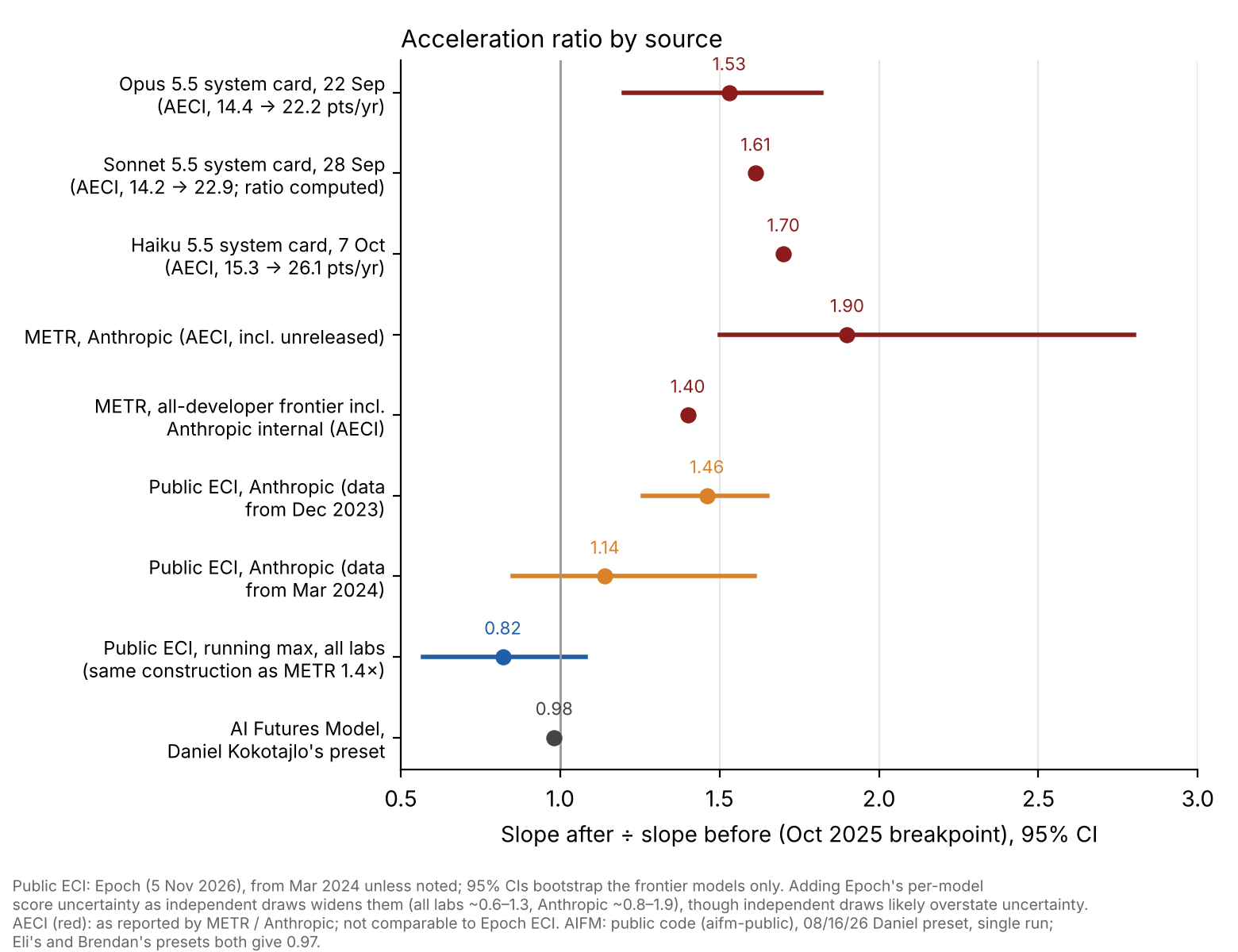
This is only looking at AECI for Anthropic's models. If you look at AECI trends across all frontier models, the acceleration is "merely" 1.4x because GPT and Gemini were at the AECI frontier for a while. However today's METR report notes as a possible caveat that perhaps Anthropic's earlier models were less benchmaxxed than their contemporary GPT/Gemini models and 1.9x is closer to the "true" acceleration.
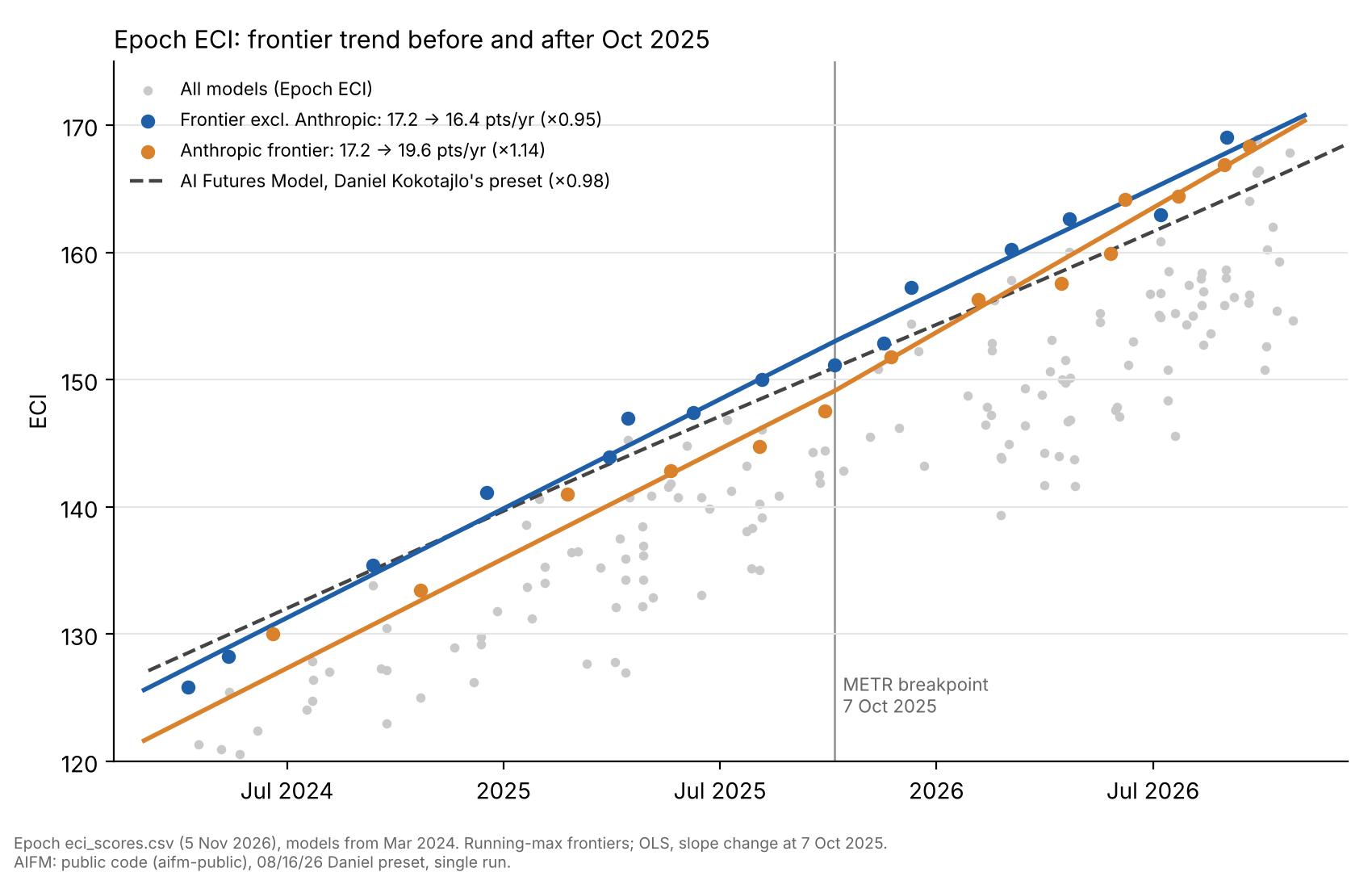
Anthropic's internal AECI does not show the same trends as Epoch AI's public ECI. Doing some quick analysis: (EDIT: the METR report includes their own analysis here)
You can see here that the public ECI frontier data actually estimates slight deceleration in capabilities growth, which is also what the AI Futures Model predicts, due to deceleration in compute growth and an expectation that, prior to an Automated Coder, ECI growth is primarily a function of "effective compute", which is a combination of growth in training compute and software algorithmic efficiency growth. The model predicts that the latter would accelerate, but not enough to outweigh the deceleration in training compute (up till now anyway).
Twitter thread.
Ryan Greenblatt:
Ajeya Cotra:
Daniel Kokotajlo: says the METR report confirms his worry from two days ago, which was:
See also GradientDissenter's take.