Sure, but just eyeballing it, it does seem that a 2-piece linear is indeed a good fit? I don't think an exponential/hyperbolic would fit that graph well. So it's a property of these specific underlying data, not of the modeling choice.
Yes I agree that it seems like a good fit to the AECI data. METR also says they "do not see clear evidence of this in the AECI trends" where "this" is hyperbolic trends. But they don't actually put any detailed evidence of attempted fits into their report, they just work with the linear + breakpoint regime throughout.
It's also important to note that the AECI trendline post-Oct-2025-breakpoint here has only 10 points of data, of which 7 are distinct models, and 3 of the points fall within a 2.5 week period in Sep 2026. So a gentle hyperbolic curve is hard to distinguish from a linear slope with this amount of data, esp. considering the data points keep shifting slightly every few weeks.
Doing some analysis on if, given 10 data points like these, how often we could detect a "true" underlying slight hyperbolic trend:
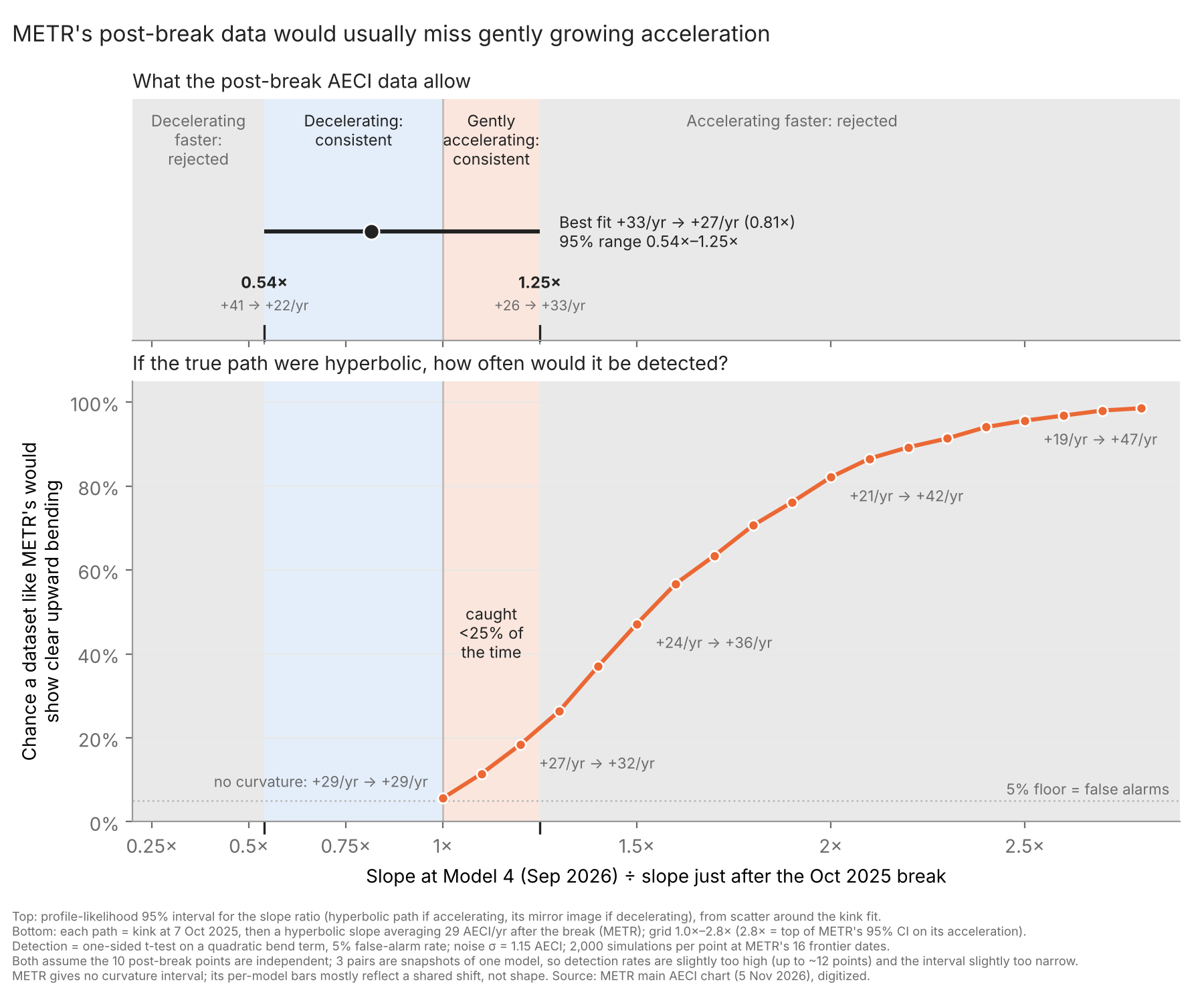
...okay this actually surprised me. The post-break data, at best fit, shows a slight decrease in "acceleration over pre-break data"[1], basically due to how strong Mythos Preview was. But of course it's all underpowered, and I'm not entirely sure if my approach above is reasonable. We also don't quite have the data from METR/Anthropic to do a great job of trying out hyperbolic fits here, but doing the best I can, the data says the slope at Sep 2026 is 0.54x to 1.25x (95% CI) the Oct-2025 breakpoint starting slope. Feel free to steal my chart on that haha, but maybe verify it's sensible first.
---
But as you describe it, it's "updating this estimate of AI capabilities acceleration upward", as in it's a change in estimate over the same time period, caused by re-doing the estimate on different version of AECI (or something).
This is getting into the weeds but my best estimate is that the rise from 1.53x for Opus 5.5's system card to 1.90x in METR's data is +0.21x from METR's differences in method + AECI reruns and +0.16x from adding the internal models. Also technically the time period changes slightly each time, that's part of the difference in METR's method. The increases across the Opus/Sonnet/Haiku system cards do come mostly from AECI reruns.
But to explain why I think this rising estimate is suggestive evidence toward growing acceleration:
We went from the evidence indicating "it was a one-time jump at Mythos Preview" to "oh there was some constant acceleration" to "oh there was a bunch of constant acceleration" and now METR is saying (paraphrased) "we can't really rule out that actually the acceleration is growing, and we have some redacted evidence indicating this, though AECI doesn't necessarily indicate it". So I'm expecting (with some probability) evidence in the future that will update me toward growing acceleration.
In other words, it seems reasonable to put some probability on the idea that, as our measurements of past progress improve, it will in fact turn out to be the case that over the time period under discussion (Oct '25 to Sep '26), there was growing acceleration in capabilities. And that this probability is more than we would have put on this before METR's report came out, when the public conversation was largely looking at ~<1x acceleration on ECI, with not even a breakpoint!
- ^
To be clear, the AECI data strongly suggests that capabilities growth accelerated when comparing before and after the breakpoint. What I'm saying here is that on best fit, as time goes on in the post-breakpoint regime, the instantaneous acceleration at any given point over the pre-breakpoint regime decreases slightly. However, my read of METR's report (esp. the Limitations section on whether acceleration is higher or lower than estimated) is that METR instead believes, based partly on redacted information, that the instantaneous acceleration today is probably increasing (with substantial uncertainty).
Twitter thread.
Ryan Greenblatt:
Ajeya Cotra:
Daniel Kokotajlo: says the METR report confirms his worry from two days ago, which was:
See also GradientDissenter's take.