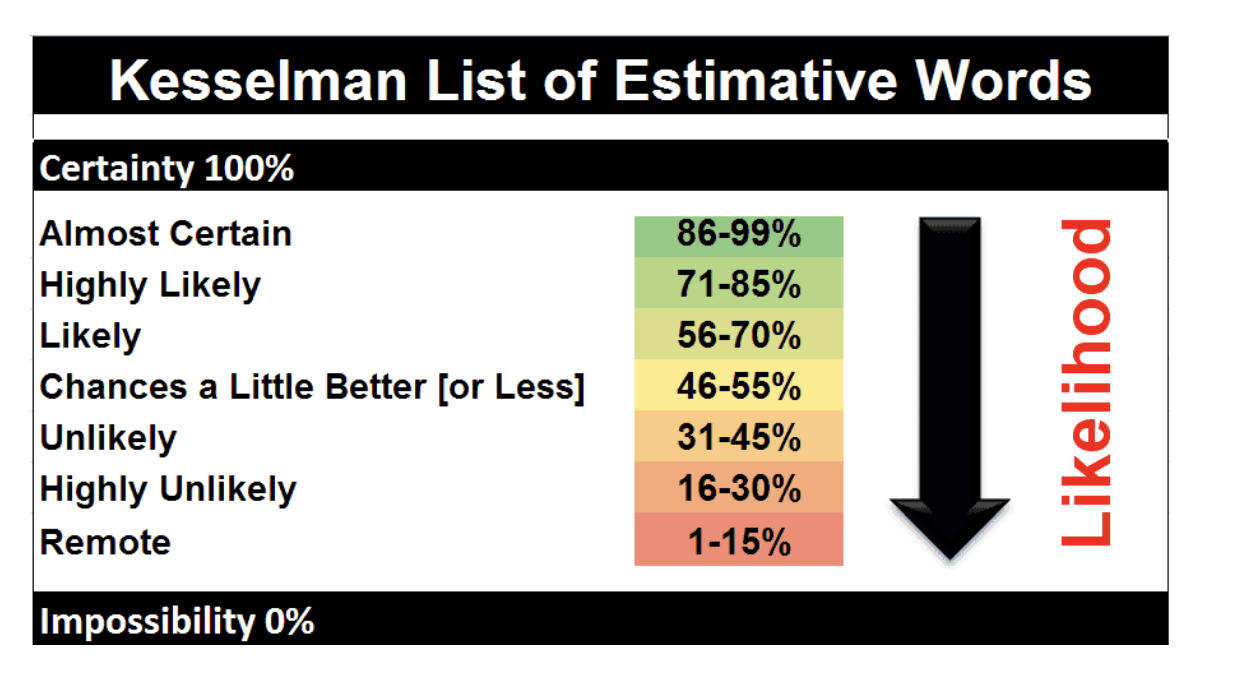
Oh, I hadn't seen Gwern's confidence tags. There's an interesting difference between the Kesselman list that Gwern draws from (screenshotted below) and my proposal above. The Kesselman terms refer to non-overlapping, roughly equal ranges, whereas the climatology usage I give above describe overlapping ranges of different sizes, with one end of the range at 0 or 100%.
Both are certainly useful. I think I'd personally lean toward the climatology version as the better one to adopt, especially for talking about risk; I think in general researchers are less likely to want to say that something is 56-70% likely than that it is 66-100% likely, ie that it's at least 66% likely. If I were trying to identify a relatively narrow specific range, I think I'd be more inclined to just give an actual approximate number. The climatology version, it seems to me is more primarily for indicating a level of uncertainty. When saying something is 'likely' (66-100%) vs 'very likely', in both cases you're saying that you think something will probably happen, but you're saying different things about your confidence level.
(@gwern I'd love to get your take on that question as well, since you settled on the Kesselman list)
I've just posted a quick take getting a bit further into the range of possible things that probabilities can mean; our ways of communicating about probabilities and probability ranges seem hideously inadequate to me.
Summary: The AI safety research community should adopt standardized terms for probability ranges, especially in public-facing communication and especially when discussing risk estimates. The terms used by the IPCC are a reasonable default.
Science communication is notoriously hard. It's hard for a lot of reasons, but one is that laypeople aren't used to thinking in numerical probabilities or probability ranges. One field that's had to deal with this more than most is climatology; climate change has been rather controversial, and a non-trivial aspect of that has been lay confusion about what climatologists are actually saying[1].
As a result, the well-known climate assessment reports from the UN's Intergovernmental Panel on Climate Change (IPCC) have, since the 1990s, used explicitly defined terms for probability ranges[2]:
(see below for full figure[3])
Like climatology, AI safety research has become a topic of controversy. In both cases, the controversy includes a mix of genuine scientific disagreement, good-faith confusion, and bad-faith opposition. Scientific disagreement comes from people who can deal with numerical probability ranges. Those who are arguing in bad faith from ulterior motives generally don't care about factual details. But I suspect that the large majority of those who disagree, especially laypeople, are coming from a place of genuine, good-faith confusion. For those people, anything we as practitioners can do to communicate more clearly is quite valuable.
Also like climatology, AI safety research, especially assessments of risk, fundamentally involves communicating about probabilities and probability ranges. Therefore I propose that the AIS community follow climatologists in adopting standard terms for probability ranges, especially in position papers and public-facing communication. In less formal and less public-facing contexts, using standard terminology still adds some value but is less important; in sufficiently informal contexts it's probably not worth the hassle of looking up the standard terminology.
Of course, in many cases it's better to just give the actual numerical range! But especially in public-facing communication it can be more natural to use natural language terms, and in fact this is already often done. I'm only proposing that when we do use natural language terms for probability ranges, we use them in a consistent and interpretable way (feel free to link to this post as a reference for interpretation, or point to the climatology papers cited below[2]).
Should the AIS community use the same terms? That's a slightly harder question. The obvious first-pass answer is 'yes'; it's a natural Schelling point, and terminological consistency across fields is generally preferable when practically possible. The IPCC terms also have the significant advantage of being battle-tested; they've been used over a thirty-year period in a highly controversial field, and terms have been refined when they were found to be insufficiently clear.
The strongest argument I see against using the same terms is that the AIS community sometimes needs to deal with more extreme (high or low) risk estimates than these. If we use 'virtually certain' to mean 99 - 100%, what terms can we use for 99.9 - 100.0%, or 99.99 - 100.00%? On the other hand, plausibly once we're dealing with such extreme risk estimates, it's increasingly important to communicate them with actual numeric ranges.
My initial proposal is to adopt the IPCC terms, but I'm very open to feedback, and if someone has an argument I find compelling (or which gets strong agreement in votes) for a different or extended set of terms, I'll add it to the proposal. If no such argument emerges, I'll clarify the proposal to be more clearly in favor of the IPCC terms.
For ease of copy/paste, here is the initial proposed terminology in table form:
I look forward to your feedback.
Thanks to @davidad and Stephen Casper for inspiring this proposal.
Eg: "It's so cold this week! Ha ha so much for global warming!" or "It's been proved climate change is going to kill everyone in the next twenty years, right?" Compare eg "Ha ha why would AI suddenly become conscious and start to hate humans?" or (pace EY) "So you're saying AI will definitely kill everyone, right?"
From figure 1.6 (page 157) of the most recent IPCC assessment report (2022), using terminology drawn from a number of papers from Katharine J. Mach and/or Michael D. Mastrandrea, eg "Unleashing expert judgment in assessment" (2017) and "Guidance Note...on Consistent Treatment of Uncertainties" (2010).
(note that this figure is labeled with 'AR5' but in fact is used in both AR5 and the current AR6)