
New Comment
Rendering 0/112 comments, sorted by
top scoring
(show all) Click to highlight new comments since: Moderation Log
Curated and popular this week
I am not a connoisseur of Harry Potter, as I am of D&D/Pathfinder (22 years playing, 19 years DMing / designing / participating in the community), so I cannot be sure of the comparison’s validity, but—yes, I think it is different.
Project Lawful falls into that category of fiction (overwhelmingly, but not quite exclusively, represented by fan fiction) which can be roughly described as “person find himself in world which is governed by rules of tabletop roleplaying game, must now exploit those rules to survive/win”.
Such works vary, of course, but what is common to all of them is that in order to be… interesting, “valid”, “fair”… they have to, to the maximum extent possible, take as given the actual rules of the game in question, as they are experienced by actual characters when the game is actually played; and likewise, to the maximum extent possible, the fictional setting should be taken as it is exists in the actual game as played.
Why is this? Because the unique appeal of this genre, and the primary value of an instance of it, is similar to (but—IMO—much better than!) the value of a “whodunit” detective story: it presents a challenge for the main character(s), which also doubles as a challenge for the reader. “Being placed in this situation, and provided with this knowable, and known, set of tools, how do you win?” As the reader, you then get access to the dual enjoyment of watching the protagonist being clever and solving the challenge, and also getting to figure out how they should do it (in advance of reading about it). It’s an optimization game, in other words, where the constraints and the options are both much more well-defined than in most story genres, and also interesting and unusual.
This, however, can very easily be ruined, if the author alters the rules.
Now, some adjustment is unavoidable. It would be quite awkward, for example, to transfer the precise, grid-square-based, rules for attacks of opportunity into a textual fiction format, nor would this be desirable. In such a case, we can simply take for granted that the AoO rules are an abstraction that is meant to represent certain intuitively comprehensible realities of melee combat in a game-balance-preserving, tactically interesting, and battle-grid-compatible way, but are not intended to suggest that melee combat in Pathfinder “actually” has some sort of strange properties. The fic can simply present melee combat in a descriptive way (i.e., in the same way that a sword fight would be presented in one of George R. R. Martin’s works, for instance), because we have no need of that particular abstraction (the attack of opportunity system)—we are simply representing the thing being abstracted over, in a more appropriate way. This is all fine and not problematic at all; it’s just common sense; and so this is not the sort of rules “alteration” I am referring to.
I think my point will be best made with an example. I will not use an example from Project Lawful, for now (though of course I can provide such, on request). Instead, I offer what I consider to be one of the most egregious, and most thoroughly, comprehensively ruinous, instances of the problem I describe, which occurs in a story called Two-Year Emperor (or 2YE for short).
In 2YE, the protagonist finds himself conjured into a world that runs on D&D rules, in order to serve as emperor of a powerful nation for two years (hence the title). We get to see him perform various feats of cleverness as he exploits the rules and “munchkins” his way to victory, but his biggest, most impactful exploit comes when he figures out how to near-instantly “level up” arbitrary peasants and laborers and so on, transforming them into high-level fighters, wizards, etc. within minutes; he thus raises an army of incredibly powerful followers very quickly. Let me emphasize that this, if it were possible, would be an indescribably powerful ability in any D&D-like world; the first person to gain this ability would be catapulted into a position of insurmountable, crushing dominance over all rivals. It’s difficult to overstate the effectiveness of such a trick—if it were possible.
How does our protagonist do this? The logic goes like this: in D&D, you gain levels by gaining experience points; when your XP total reaches a certain value, you are level 2, a certain higher value—level 3, and so on. (So far, so acceptable.) And where does XP come from? Why, killing monsters! (Uh-oh! First red flag. But let’s roll with it.) The more powerful the monster killed, the more XP gained. So if a low-level person could somehow quickly kill some very high-level, very powerful monsters, he would inevitably gain a ton of XP. (Blatantly false as a claim of necessity, but… well, it gets much worse, so let’s hold objections for now.) So, for example, if you set up a giant mechanical monster kill box, where a caged monster sits bound within a deathtrap mechanism, and a person of no particular combat ability need only walk up and press a button to trigger the mechanism and slay the contained creature, that would count as defeating said creature, and would yield a giant pile of XP. (Absolutely, 100% not.) And if a person gained a huge amount of XP at once, they could gain a whole bunch of levels at once, and thus if a level 1 commoner killed enough ancient red dragons in one day, why then they could suddenly—poof!—become a 20th level wizard!
WRONG.
Why wrong? Let’s count the reasons:
Ok, maybe the “DM” that runs this particular world has, in fact, chosen to award XP only for killing monsters (and sticks to this policy even in cases where it’s obviously insane—see below—something which no quarter-decent DM would ever do); and furthermore, this DM is in fact following the recommended (!) encounter XP award table in the Dungeon Master’s Guide. We also have to assume that the DM is choosing to ignore the suggestions that level acquisition carry with it a downtime/training requirement. Fine, let’s grant those assumptions.
The aforesaid recommend encounter XP award table does not, in fact, have any entries for how much XP a level 1 commoner should get for killing an ancient red dragon. Indeed, the notes accompanying said table explicitly point out that if somehow a very weak character kills a very powerful monster, this basically has to mean that some sort of plot device, or some such, has happened to enable that, and so treating this as a successful exercise of the character’s capabilities (and thus deserving of experience points) is absurd.
The Dungeon Master’s Guide also notes that if a character who supposedly “defeats” some powerful opponent has a lot of help from some person or circumstance, such that the effect of the aid far outweighs their own contribution, it likewise makes no sense to assign them XP for this “victory”. The “monster kill box” is as perfect an example of this as one could imagine.
Finally, and most damningly for this “clever hack”, there is a specific rule that explicitly excludes the possibility of a character gaining multiple levels at once from an unusually large infusion of XP. This rule exists specifically to prevent precisely the kind of “clever exploit” that the protagonist of 2YE uses.
… but if we take a look at the author’s notes for Two-Year Emperor, we find a comment stating that the author is ignoring that “no multiple levels gained at once” rule, because he finds it to be “stupid”.
Well.
Remember this xkcd comic?
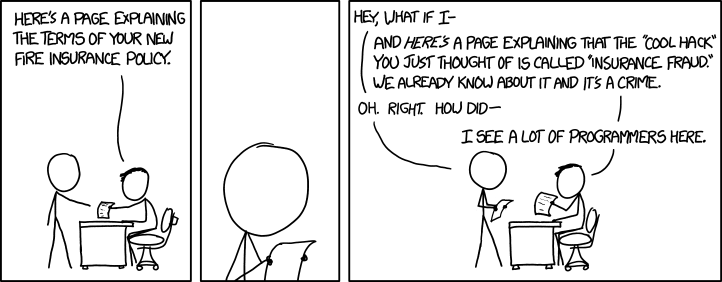
Imagine a story where in the preface, the author says: “In my fictional world, there aren’t any laws against insurance fraud; I think they’re stupid.” And then, in the course of the story, the protagonist, in an extremely impressive display of cleverness, carries out a brilliant get-rich-quick scheme: he takes out fire insurance on his decrepit house, then sets it on fire—and collects the insurance payout!
What would you think of a story like that?
That’s Two-Year Emperor, in a nutshell.
Now, there isn’t anything quite this egregious, in Project Lawful.
But (with apologies to Eliezer, because I am (mostly) enjoying the story, and don’t wish to convey the impression that I consider it to be irredeemably bad, by any means) I do think that there’s some stuff that is pretty close to being that bad.
And so, if you currently are sufficiently unfamiliar with the workings of the Pathfinder rules and the world of Golarion to not notice any such flaws, you may well prefer to remain thus ignorant.
Or not, of course. As I said—details available upon request.
So if you read Harry Potter and the Methods of Rationality, and thought...
"You know, HPMOR is pretty good so far as it goes; but Harry is much too cautious and doesn't have nearly enough manic momentum, his rationality lectures aren't long enough, and all of his personal relationships are way way way too healthy."
...then have I got the story for you! Planecrash aka Project Lawful aka Mad Investor Chaos and the Woman of Asmodeus, is a story in roleplay-format that I as "Iarwain" am cowriting with Lintamande, now past 1,000,000 words.
It's the story of Keltham, from the world of dath ilan; a place of high scientific achievement but rather innocent in some ways. For mysterious reasons they've screened off their own past, and very few now know what their prescientific history was like.
Keltham dies in a plane crash and ends up in the country of Cheliax, whose god is "Asmodeus", whose alignment is "Lawful Evil" and whose people usually go to the afterlife of "Hell".
And so, like most dath ilani would, in that position, Keltham sets out to bring the industrial and scientific revolutions to his new planet! Starting with Cheliax!
(Keltham's new friends may not have been entirely frank with him about exactly what Asmodeus wants, what Evil really is, or what sort of place Hell is.)
This is not a story for kids, even less so than HPMOR. There is romance, there is sex, there are deliberately bad kink practices whose explicit purpose is to get people to actually hurt somebody else so that they'll end up damned to Hell, and also there's math.
The starting point is Book 1, Mad Investor Chaos and the Woman of Asmodeus. I suggest logging into ProjectLawful.com with Google, or creating an email login, in order to track where you are inside the story.
Please avoid story spoilers in the comments, especially ones without spoiler protection; this is not meant as an "ask Eliezer things about MICWOA" thread.