What originally prompted this piece was a nagging feeling, over the last couple of months, that my uncertainty was increasing over time, and wanting to know whether I was actually getting more uncertain (new information being evidence for different beliefs than mine) or just more calibrated (I was always overconfident and have slowly been getting less so). You cannot answer that question from a feeling. But you can by measurement! This is my first.
Hopefully, this serves as an illustration of how to use the Google Sheets. If you have time to do it in an extended manner, you would fill in each question (or at least the ones that matter to you). For instance, here I’ve filled in the first question of the “How to reason about any of this” domain.

You can do this for as many questions and domains as you want/have time for. I will likely do so for mine in the near future (in another post). I hope to use this audit to write detailed posts on particular questions I need to deliberate on more.
Then, after you have filled in domains, you can aggregate your beliefs in the domain summary table. The below table should be quite intuitive to interpret. For instance, if the uncertainty is low and the direction is "falling", the uncertainty previously was higher. The biggest (potential) mover is the question that could move your uncertainty the most. Note that a domain-level rating is an aggregate over questions I feel very differently about, so treat it as intuition. The real audit happens per question, and the per-question cruxes are what I act on; you should too. The Google Sheets is there to take action on this.
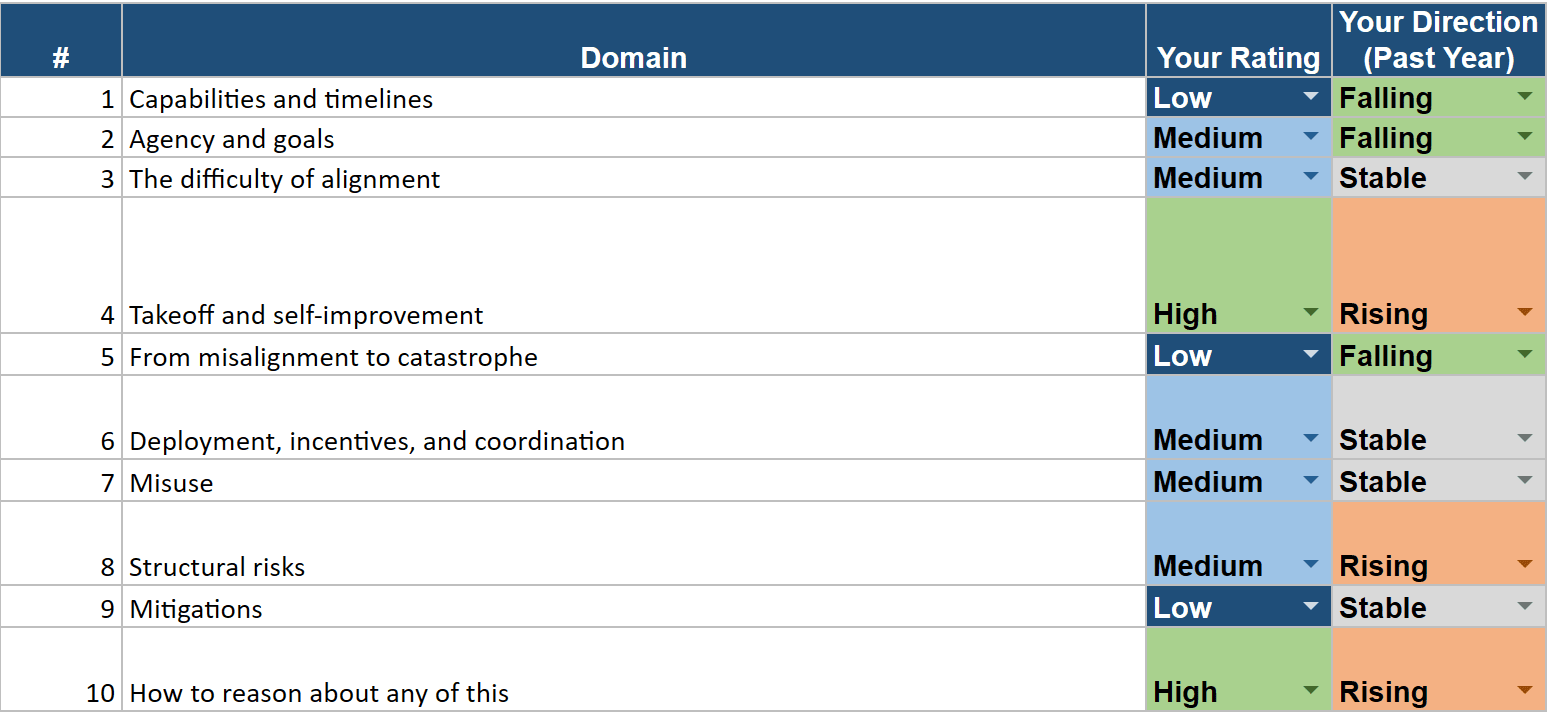
Then, you can use this for some high-level takeaways. For me, this is what that would look like.
Three lows, five mediums, two highs, with three falling, three rising, and four stable. In the domains where my uncertainty fell, I have put serious effort this past year into really understanding them. The three where it rose is likely because I was initially overconfident, and have now gotten more calibrated to the fact that I need to study them a lot more.
Regarding takeoff and self-improvement, I find this one of the areas hardest to reason about. How takeoff will play out is one of the biggest cruxes I have, and I find it incredibly difficult to reason about because of the lack of empirics and heavy reliance on conceptual thinking. Similarly, for “how to reason about any of this”, I find a lack of empirics and good reference frames, which makes this all a difficult endeavor. Hopefully this tool is a small piece that can be used in order to make “how to reason about any of this” a bit easier.
For the alert reader who knows I’m directing SAIN and was surprised to see my uncertainty be “low” for the domain of mitigations: I’ve spent the most time by far thinking about this and feel like I have a relatively good understanding of the current mitigation efforts, their strengths, their weaknesses, etc. That understanding predates this past year, which is why the rating is low and stable: the sustained effort keeps it low rather than moving it further.
This post introduces a tool: an Epistemic Audit for Existential Risks from AI. It is a structured way to map, organize and track your beliefs across the key domains and questions that determine how likely existential risks[1] from AI are. It follows the causal chain from "capable systems get built" to "existential risk." It is designed for repeated self-assessment, creating a longitudinal record while enabling standardized comparisons and aggregation across respondents for (potential) future elicitation studies[2]. It has three main functions:
I am not the first to decompose existential risks from AI. Joe Carlsmith's report decomposes the power-seeking threat model into six conditional premises and assigns credences to each. Zvi's Crux List is a (large) collection of questions on which people disagree. AGI Ruin: A List of Lethalities is the (in)famous list of reasons the problem is hard. I have not yet seen a protocol that you can run on yourself, with a defined scale, repeat over time to see whether your uncertainty is actually decreasing, and that makes it easier for you to guide your effort towards the questions that matter the most.
That is what I attempt in this post.[4] I created this Epistemic Audit tool using standardized categories (low/medium/high uncertainty and falling/stable/rising confidence) to produce simple, comparable assessments across respondents. Hopefully this reduces reporting ambiguity while enabling aggregation and longitudinal analysis.
One note on scope: a question makes this list only if resolving it would noticeably shift an estimate of existential risk from AI. There are many interesting questions that don't do this, such as "what is intelligence?"; I have attempted to exclude these.
The domains below follow the causal chain that I think of for AI to become an existential risk: capable systems get built, they are agentic, we fail to align them, they get deployed anyway, and the failure leads to existential risks. I also discuss routes that bypass misalignment entirely, the mitigations, and finally the question of how to reason about any of this at all.[5]
How to run the audit
The questions are numbered so it's easier to refer to them personally or in the comments. My personal scoreboard with reflections is in the comments (and in the Google Sheets as an example).[8]
1. Capabilities and timelines
The elephant in the room in any conversation about AI is what these systems can do and how fast that changes. What matters here is capabilities, so what systems can actually do, economically and strategically, and the trajectory they are on.[9]
2. Agency and goals
If we grant capable systems, we need those systems to be coherent pursuers of goals, i.e., agents.
3. The difficulty of alignment
Conditional on capable, agentic systems: do we fail to align them despite trying?
4. Takeoff and self-improvement
How fast the transition happens between different capabilities matters a lot. A slow takeoff gives society time to react and iterate whereas a fast one does not (though the former may bring different risks). This is my most cruxy domain.
5. From misalignment to catastrophe
A misaligned agentic superintelligence doesn't have to be a catastrophe. There need to be concrete mechanisms by which this leads to existential risks for humanity.
6. Deployment, incentives, and coordination
How current systems are deployed, what kind of incentives are present in the AI race, and how countries and frontier AI companies will (not) coordinate, matter immensely.
7. Misuse
I personally think most about the above threat model, so acutely losing control of ASI, but existential risk does not require this. We can also have sufficiently capable (aligned) AI systems in the wrong human hands.
8. Structural risks
There are some other scenarios which I would count as existential risks from AI that don't quite map neatly onto the above two routes. I'd describe them as "we lose but it wasn't because we built ASI that was misaligned or someone majorly misused it."
9. Mitigations
There are a number of people already attempting to mitigate existential risks from AI, myself included.
10. How to reason about any of this
The main question here is how we form beliefs about an event that has never happened before. When thinking about existential risks, I think it's most valuable when thoroughly grounded in empirics, and since AI-driven existential risks have never played out, our empirics need to come from reference classes that can guide us through this.
What to do next
If you ran the audit: your high-uncertainty cruxes are your curriculum. Pick the top three and go deep: read the strongest thing written on each side, or write the post that maps the question if none exists. If you dig into a question and find the field's uncertainty is as high as yours, you have found a research project, and those are exactly the projects the field needs. If you are in the Netherlands and want help turning one of these questions into an actual project, Safe AI Netherlands exists for precisely this: reach out.
I will (hopefully) fully run this audit in the coming month, and then re-run it three months later and publish the difference. I’ll also start posting my object-level beliefs on various questions, which are missing from this first measurement. I encourage you to do the same.
Acknowledgements
Many thanks to Ana Paula Castillo Rodriguez for fully designing and making the accompanying Google Sheets, besides providing extensive feedback. Thanks to Lucas Hogendoorn, Ilija Lichkovski, and Atakan Tekparmak for providing feedback and comments.
The first draft of this version contained roughly 50 questions in 6 domains. With Fable 5, I then iterated around 3 versions of this post to come to 10 domains, shuffled some questions to the domain they actually belonged to, came up with other questions in various domains, and improved the new ones I came up with. Roughly 60% of these questions are ones I came up with during the first draft (that haven't been changed through editing); roughly 20% are questions from Fable 5 that I edited substantially for them to make more sense; another 10% are questions I came up with based on the new questions that Fable 5 came up; the last 10% are questions that Fable 5 came up with that I copied verbatim.
Examples of existential risks from AI: human extinction, authoritarian lock-in, permanent disempowerment.
The best audience is likely people with slightly more time available. It’s probably best suited for when you’re entering the field, though I think there is value for anyone, no matter the experience.
By epistemic uncertainty I mean the uncertainty about a belief that can, at least in principle, be reduced or falsified with more evidence and study—as opposed to aleatoric uncertainty, the randomness that remains even with perfect knowledge (think of a fair coin flip). Everything in this post concerns the former, so I’ll simply write “uncertainty” from here on.
I know this mapping can never be complete. As one example, each of the lethalities in Yudkowsky's list could be phrased as a question here. I appreciate comments discussing domains and subdomains that I missed that meaningfully matter when it comes to existential risks from AI. I will be updating this list dynamically, or at least every three months (when I rerun my own audit of this). If you’re interested in an incredibly long list of questions (more than a 1,000), see this Google Doc which Fable 5 created based on the (paraphrased) prompt where I gave it this post as input and asked to expand on it extremely thoroughly. (I have only skimmed the Doc and haven’t changed a single word, but some new questions seemed interesting).
Ordering the domains along a causal chain is expository, not probabilistic. I am not claiming that existential risk is the conjunction of these steps, e.g., domains 7 and 8 are explicitly routes that bypass the chain. Nothing here should be multiplied through. See the multiple-stage fallacy discussion for why that would bias estimates downward.
If you have the time to do a deep dive, skip step 2 because it might anchor you unnecessarily. It’s always better to first go through each question, write down what you think, your uncertainty, and in the end aggregate into a summary then do this in reverse. But, knowing that many people will likely not have the time to do this, first doing a summary might already give a quick helpful overview.
I’m uncertain about these anchors, and feel that making them more granular and specific would be better. However, I’m unsure what these anchors and specifications would look like, and think the current setup is better than nothing. Curious to receive better alternatives; I’ll make edits.
For illustration purposes, I have filled in the domain summary and one question. Importantly, the domain summary doesn’t actually say anything about your object-level beliefs, but purely about your (epistemic) uncertainty with regards to these questions. The other tabs in the Google Sheets allow you to write down object-level beliefs per question and what evidence would significantly change your beliefs.
The point of this post is not necessarily the questions (while I do think some of them are quite useful), but more so the framework itself. A lot of these questions have underpinning assumptions that should be the actual questions, and would be better if they are more narrow and falsifiable. However, at least for people still somewhat new to the field, I think the current question should be valuable. One can always swap in other questions and still use this framework if preferred.
I know this mapping can never be complete. I appreciate comments discussing domains and subdomains that I missed that meaningfully matter when it comes to existential risks from AI.