According to the definition, branches would form and then re-merge! A set of branches in a sensible definition should never do this.
Why not?

Well for one thing they're no longer branches per se since they aren't in a tree structure.
More philosophically, a being that finds itself in a branch that is going to be re-merged cannot have any lasting effect on the future: anything it does is guaranteed to be erased as the branching is time-reversed. Of course, beings inside could care about the things that happen up to the re-merging, but they might effectively decide their timeline ends at the point when re-merging begins, so "internally" the branch structure still looks tree-like. And to outside observers the things that happened in the re-merged branches cannot be observed in any way, so to them it's more like it never happened at all.
I think that maybe a being in a branch that is going to get re-merged can have a lasting effect on the future. It just knows that the effect it will have is completely identical to its twin in the other branch, so that observers in the future will never know which of the two of them ever "really" existed.
But yes, their is something a little bit more philosophically weird about multiple possible pasts than multiple possible futures.
Yeah, good point actually...like what if you split off 2 timelines then applied a hadamard gate to a decision made in the different branches and reversed everything else? The decision theory gets weird here.
The thingies that the universe decomposes into should probably have some characteristics in order to be properly called "branches" or "worlds"... but it could still decompose into thingies that that don't have those characteristics. A single quasi classical world, and multiple well behaved quasi-classical branches , that are separated, irreversible ,etc, aren't the only logical possibilities.
True. Although it does seem that our universe's dynamics do support crisp irreversible branches, so why not take advantage of that? It also makes you wonder whether that's a "coincidence" and how well alternate notions of branching in messier worlds would really work(after all, the main reason the idea of branching was raised to our attention was as an explanation for measurements in our universe).
I'm not quite sure what the aim is here. The universe is fundamentally quantum, and this seems like an attempt to impose a weird kind of quasi-clasicality onto it.
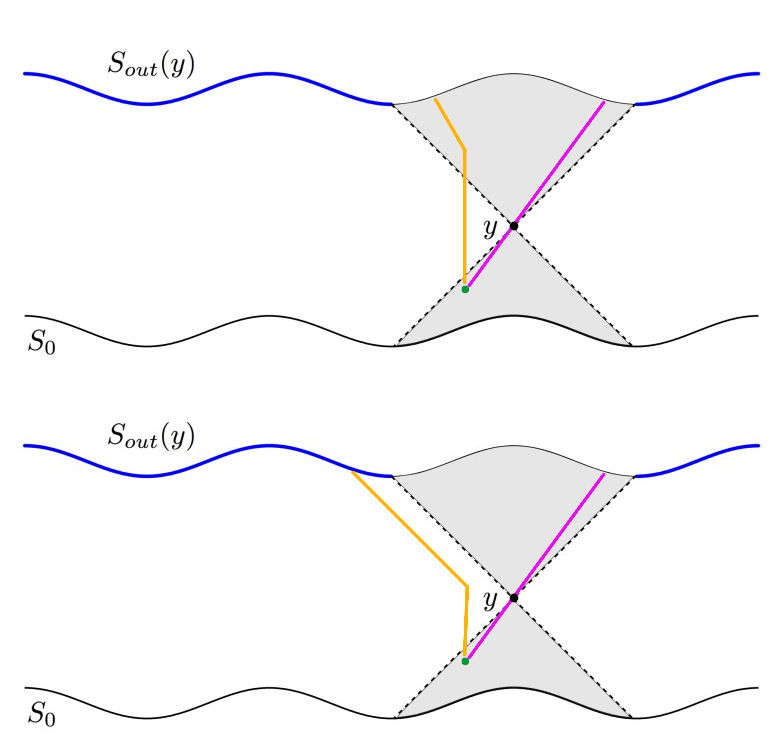
Also, consider these 2 very similar diagrams. A pair of entangled particles is generated at the green point. One of those particles flies off and visits the event y.
"Kent defines beables at the point y by conditioning on photon measurements on the blue portion of the forward surface."
In one of these diagrams, the orange particle is a bit slower, and lands outside the blue region, in the other diagram, the orange particle is a bit faster. This, according to your "beables" definition, seems to change whether or not y is in a superposition state.
In one of these diagrams, a hypothetical particle from y could hit the orange particle. In the other diagram, this can't happen. But as no real particle actually goes from y, why should this matter?
I'm not quite sure what the aim is here. The universe is fundamentally quantum, and this seems like an attempt to impose a weird kind of quasi-clasicality onto it.
Did you read the last post in the sequence? The goal is to give a formal definition of wavefunction branches.
So in your diagrams, the orange particle doesn't interact with the event y at all? In that case, it shouldn't be possible for it to have a record of y, I think. Can you say more about the interaction you have in mind?
The goal is to give a formal definition of wavefunction branches.
Would it make sense to "give a formal definition of tree branches". Once you zoom in, there is a bunch of cellulose in a tree-ish shape. Maybe you could give a formal definition of where 1 branch splits into 2. Perhaps something involving tightning imaginary loops of string around the tree. But doing so feels kinda pointless. (Although it could be useful for storing an approximation of the tree structure if a full 3d model of the tree won't fit in memory.)
In that case, it shouldn't be possible for it to have a record of y, I think.
Standard quantum entanglement. The orange and pink particles are in an entangled state.
Would it make sense to "give a formal definition of tree branches"
I mean, it might be a sensible thing to do as you described. But I think the case is more urgent for defining wavefunction branches. This is needed to make MWI a totally well-defined interpretation of quantum mechanics.
Standard quantum entanglement. The orange and pink particles are in an entangled state.
Ok I see what you mean. But I also don't see why this is a problem for the definition. Yes, in this unrealistic scenario the branching state depends on the trajectory of the orange particle. So? (In a realistic scenario the orange particle would likely interact with photons while outside the forward lightcone of y so branching would occur anyway).
This is needed to make MWI a totally well-defined interpretation of quantum mechanics.
Isn't MWI already well defined?
But I also don't see why this is a problem for the definition.
If a somewhat ad-hoc definition is ok, and still makes MWI well-defined, why not use a much more ad-hoc definition? Why not define things such that the rules are different on tuesdays?
What properties does your definition need to have in order to make MWI well defined?
Yes, in this unrealistic scenario the branching state depends on the trajectory of the orange particle. So?
It seems to be a realistic enough scenario to me. If nothing else, it would be easy to set up such a scenario in a quantum physics lab. All you really need is to form an entangled pair of particles, and then have those particles not immediately fly off at light speed.
(In a realistic scenario the orange particle would likely interact with photons while outside the forward lightcone of y so branching would occur anyway).
Well this depends on the length scales and timescales involved. And on whether these particles interact with photons. And where this is happening.
If a somewhat ad-hoc definition is ok
I don't agree that your scenario makes the definition "ad hoc", I just literally don't see why it's a problem. What desiderata do you think it violates?
What properties does your definition need to have in order to make MWI well defined?
Well, the claim of MWI is that the world splits into "wavefunction branches" and this explains measurements outcomes and apparent classicality. Ideally one would like to characterize these mathematically and prove things about how often they form in idealized settings, etc. Obviously you can just talk about branches informally, and this explains a good deal, but greater formalization could be interesting and teach us new things. See this paper (or my last post) for some attempts https://arxiv.org/abs/2506.15663
What desiderata do you think it violates?
Constancy. A particle that is just sitting there not interacting with anything should have a constant representation.
Whereas in this model, you can entangle an electron and a photon. Keep the photon in a mirrored box. Leave the electron just sitting there. And the electrons "representation" suddenly jumps from an entangled state, to a non-entangled state, when someone releases the photon.
And if, on it's way out into the cosmic void, that photon happens to hit a speck of dust a billion lightyears out, that magically reaches across space and back in time to alter how the electron is represented.
Well, the claim of MWI is that the world splits into "wavefunction branches" and this explains measurements outcomes and apparent classicality. Ideally one would like to characterize these mathematically and prove things about how often they form in idealized settings, etc.
The full rules of MWI are the Schrodinger equation or similar.
Lets look at something simpler, but mathematically very closely related. Light can be thought of as moving in straight line rays. And for a lot of things, the simple "straight line ray" model is close enough.
But then you get things like the Arago spot (https://en.wikipedia.org/wiki/Arago_spot) where light is diffracting all over the place, and the ray model breaks down.
Actually, changing my mind a bit here. A rendering engine (as used in most CGI) has a detailed model of ray-based optics. Because it's easier to compute than full diffraction optics. A rendering engine won't give perfect results, but is usually pretty close. Something equivalent, for quantum branches, would be interesting.
constancy
Hmm, maybe there is something mildly unsatisfying about the electron example. It doesn't bother me so much in part because this representation difference will never be noticed. Perhaps we could require events to leave increasingly large records or somesuch(???)
rendering
Yeah speeding up numerical simulations of many body systems is one motivation people have had for trying to develop automatic branch decomposition algorithms.
The full rules of MWI are the Schrodinger equation or similar.
I don't agree with this though, or at least, to the extent it's true it means MWI is not a complete interpretation.
Ultimately QM is a theory of physics, so its ultimate purpose must be to predict and explain our observations. We observe a single world, so we must have a way of going from the formalism of the schrodinger equation to such a world. I get the impression you and other people with "schrodinger only" views are imagining an omniscient observer standing outside the universe and noting when emergent structures such as branches form. But ideally we would replace this vague implicit observer with a well specified mathematical "bridge law" relating our observations to the formalism.
Does the universe always expand at just the rate needed for unrelated branches not to merge?
I don't think so. The expansion rate is just set by the most popular cosmological models which don't track this at all.
2.5.6.0.1 Kent and Bousso&Susskind have proposed approaches to defining quantum wavefunction branches based on late-time information. The basic idea is to exploit the way that quantum information propagates in our universe in particular: (a) photons(and gravitons) carry away information at the speed of light, (b) the universe is expanding and cooling, meaning that these photons(in some cosmological environments) may propagate uninterruptedly forever.
2.5.6.0.2 What this means is that photons very late in time are a privileged set of degrees of freedom: they plausibly carry information about everything that has classically "happened" previously. This suggests a way of defining the set of branches: just "measure"(apply a fictitious measurement operator, that is) the photon degrees of freedom very late in time!
2.5.6.0.3 That's the basic idea. There are many subtleties of course, and Kent and Bousso/Susskind have different proposals. I'll review each in turn and then talk about the philosophical merit of these approaches in general.
2.5.6.1 Quantum Reality via Late-Time Photodetection
2.5.6.1.1 Kent has proposed a few variants of this idea. I'll review the version in his paper Quantum Reality via Late-Time Photodetection.
2.5.6.1.2 Kent is interested in defining a set of possible histories of what he calls "beables", which are essentially the classical-like variables which we think of as defining a possible world, e.g. the positions of objects.
2.5.6.1.3 For his set of beables Kent considers the expected values of quantum observables at a given time, conditioned on some particular late-time outcome of photodetection measurements across all of space(with an additional subtlety I'll get to momentarily).
2.5.6.1.4 Why does this make sense? The idea is that the late-time photons should contain all the information about possible classical experiments, pinning down a possible quantum state associated with a set of measurement outcomes. The expected values then give us the classical-like variables associated with this set. Taking the expected value is necessary because even in a classical-like world all degrees of freedom will still be "spread out" in a quantum manner to some degree.
2.5.6.1.5 Now, however, a problem arises. If we project onto an entire late-time space-like surface, this is correlated with the results of all past experiments. This means that the beables at a given point in time will be conditioned on the results of experiments in that point's future, which may give strange results.
2.5.6.1.6 Clearly, this is undesirable. Kent's solution is to restrict the set of photodetection results we condition on in the future space-like surface. For a given point in spacetime p, we only condition on points on this surface outside the forward light cone of p.
Kent defines beables at the point y by conditioning on photon measurements on the blue portion of the forward surface. From page 19 here.
2.5.6.1.7 So in summary, Kent's prescription for defining a set of quasiclassical worlds and their probabilities is as follows: given some initial quantum state on a spacelike surface, we evolve it forward until some late-time spacelike surface. We then measure the state of photons on this surface, obtaining a particular set of measurement values defining a quasiclassical world. The quasiclassical "beables" at a given point p in spacetime between these two surfaces are defined to be the expected values of quantum observables(Kent uses the values of the stress-energy tensor) conditioned on the portion of these measurements outside the forward-light cone of p.
2.5.6.2 The Multiverse Interpretation of Quantum Mechanics
2.5.6.2.1 Bousso and Susskind defined a related construction in their paper The Multiverse Interpretation of Quantum Mechanics, initially motivated by the problem of defining measurement outcomes in an inflationary multiverse.
2.5.6.2.2 They consider both a local and global construction; the global construction is a limit of local constructions so let's talk about the local construction first. The idea is to consider the possible experiments that can be conducted by a local observer, using what's called a causal diamond.
2.5.6.2.3 What's a causal diamond? It's essentially defined by gluing together a forward and backwards lightcone. In more detail, if we have a point p in spacetime and a point q in its future, we consider the future lightcone of p and the backwards lightcone of q. These meet at a spacelike surface S; the causal diamond is the union of the interiors of the forward and backwards lightcone up until S.
Figure: A causal diamond. From here.
2.5.6.2.4 Any finite experiment carried out by an observer lives in some causal diamond. Why is this? If we consider an observer who evolves from a point p in spacetime to a later point q, any effect the observer can have, for instance setting up a measurement device, lies in the future lightcone of p. And any information that they can observe lies in the past lightcone of q. Thus the effects they can observe from a given experiment are determined by the sequence of quantum states inside the diamond.
2.5.6.2.5 This means that the future boundary of the causal diamond(i.e. the part consisting of the backwards lightcone) provides an objective choice of "environment" to condition on when considering the results of experiments performed in the diamond.
2.5.6.2.6 So this gives us a local objective notion of decoherence. The causal diamond also has the nice feature that it defines a branch-like structure on the set of possible measurement results. We can consider information that has left the future boundary up until a given point. For instance, say we measure a system, wait a bit, then perform further measurements on the same system. The photons associated with the first measurement will leave the causal diamond's future boundary before the photons associated with the second.
Figure: Defining a branching structure from the order in which photons exit the diamond's future boundary. From page 15 here.
2.5.6.2.7 How do we extend this to a global picture? The idea is to consider an indefinitely long-lived observer, and take the limit of diamonds defined by a sequence of points on their future trajectory. This will produce a sequence of diamonds of unbounded area(in asymptotically flat universes). Some photons will escape the sequence of diamonds -- aka, for any diamond, some time evolution of the photon's state will be on the boundary. We may equivalently say that these photons escape to null infinity(which is simply the space of possible unbounded photon trajectories). Conditioning on these photon states provides a limiting notion of decoherence and branching for the past of the limiting causal diamond.
2.5.6.2.8 The use of the order in which photons escape to define a branching order bears some resemblance to Kent's proposal to define beables via conditioning only on future events outside a point's future lightcone. If we consider an observer evolving forward in time through a Kentian multiverse, they condition on an increasingly large portion of the future surface. This defines a tree-like structure on the set of possible worlds, which seems plausibly equivalent to that defined by Bousso & Susskind's construction in the limit of the future surface approaching infinity.
2.5.6.3 General Discussion
2.5.6.3.1 So that's my preferred family of definitions of wavefunction branches. Why do I like them?
2.5.6.3.2 First of all, they are plausibly correct. That is, it's plausible that, given a quantum state corresponding to our early universe, if you applied the time evolution operator followed by a late-time photon measurement operator, you would in fact get the set of states and probabilities corresponding to what we intuitively think of as quasiclassical worlds. I know of no other proposed definition that seems as likely to me to meet this bar.
2.5.6.3.3 Secondly, they are elegant. The set of worlds is defined by a single measurement, using the standard quantum definition of measurement. The branching structure is determined by a sequence of measurements, themselves determined by geometrically natural constructs from relativity. There are no arbitrary constants.
2.5.6.3.4 "Isn't the retroactive nature of the construct kinda wacky?" Any definition of wavefunction branching will have at least a bit of a retroactive character, because isolated systems can only be said to have decohered/branched some time after their initial interaction with the environment has sufficiently propagated records/increased the complexity.
2.5.6.3.5 Here's a general argument against any definition of wavefunction branching that doesn't rely on some sort of asymptotic late-time measurement. Say we have a definition based on (e.g.) number of copies of records, or circuit complexity. Then it would be possible for a sufficiently technologically advanced civilization to "spoof" the definition by conducting an experiment in which they evolve an isolated quantum system to meet the definition, then reverse the evolution. According to the definition, branches would form and then re-merge! A set of branches in a sensible definition should never do this.
2.5.6.3.6 This concludes my account of the problem of defining wavefunction branches/the measurement problem. Now what does this have to do with our original goal of explaining the relation between the laws of physics and the existence of life/sentience?
Although, as Bousso & Susskind discuss in their paper, if the asymptotically flat universe is merely a bubble in an inflationary multiverse, the past light cone will not eventually include everything in this wider universe. It will include everything in the bubble's past lightcone. They discuss a proposal to define observables in the rest of the multiverse via "hat complementarity", in analogy with black hole complementarity.