On November 24, Dell Cameron over at Wired, asked, in so many words, whether Nvidia had become too big to govern.
But he didn't use the words "too big to govern" or refer to a concept I've been calling "tech extensity." [1]
Instead, he quoted Edward Fishman, director of the Council on Foreign Relations' Maurice R. Greenberg Center for Geoeconomics, who said:
[s]ome tech companies have become so big—and so important to the stock market—that Washington is reluctant to hold them accountable for national security lapses.
In 'How Big Tech Becomes Ungovernable' I discussed how companies like Nvidia become so big, and society so dependent on their products (or in this case, their market impact), that they effectively become too big to govern. I also laid out the concept of "tech extensity," which is where something that has a great deal of breadth, scope, or reach (be it a person, company, or product), becomes deeply entrenched in a system. It's not about being the best—it's about becoming indispensable.
Henry Kissinger was an extensive force in geopolitics, diplomacy, and international relations. He was a fixture across administrations, and remained a power broker long after he left politics. That extensity and indispensability is probably what kept him from facing any consequences for policies that were arguably responsible for some very serious and devastating policies affecting millions between 1969 and 1976.
From the Kissinger example, I discussed how a handful of tech companies, and their multi-billionaire CEOs, have engineered "systems that are so intertwined and spread across so much of our lives" that they are essentially ungovernable, and how this is likely to get worse if/when ASI is realized.
Imagine a multi-trillion-dollar SpaceX, Google, Nvidia, Amazon, Meta, Oracle, or Microsoft—or more likely, a few of these firms—acting as quasi-national capitalist states, bolstered by super-intelligent AI systems, doing basically whatever they want, ungovernable by nation states that have all been captured. It's all well and good to have laws, but if a handful of corporations become effective states unto themselves, i.e., suppliers of the information, infrastructure, energy, technology, supply chains, and even the money, what even are laws at that point?
Well now, we have a modern-day Kissinger example. We're witnessing in real-time what happens when companies, and the CEOs who run them, are too big to govern: markets panic, the powerful intervene, and they get away with it.
FAFO, but without finding out
On November 8, Huang admitted to an extramarital affair with a direct report, against a backdrop of questions about a connection to Chinese intelligence. On November 12, he resigned. By then, Nvidia's board, the DOJ and Commerce Departments, the SEC, the State Department, Congress, and the California AG all had open inquiries — into national security risks, chip smuggling, and whether Huang had misled the public. The infidelity was never the point. It was a proxy for judgment and risk.
Then the market panicked:
The Nasdaq Composite fell from 25,253 on Nov. 9 to 22,618 on Nov. 20, down 10.4%.
The S&P 500 fell 8.5% over the same stretch; the Dow, 8.1%.
Nvidia's own share price dropped from roughly $216 to $126.
Some of that slide had independent causes; markets rarely move on one story. But Huang's reinstatement is harder to explain away.
Donald Trump declared that Huang "did nothing wrong" and leaned on the board to bring him back before any investigations were completed. On November 23, they did, and the Nasdaq jumped 6.5% and the S&P 4.7%—both their best single days since April 2025. The next day, Trump said a pardon was on the table, which is a curious thing to offer someone who did nothing wrong.
By my view, nothing about the underlying risk changed, at least based on public-facing materials. What changed was that everyone involved got a clear look at the price of accountability, and they decided to look the other way. Or, as the Zvi summarized on Substack: "We like money. Jensen Huang makes us money."
In short, if markets literally crash because you're a "generational CEO" and society has become so dependent on the products and circular economy you've helped to create that the President of the United States rallies to your defense, that makes you indispensable, and probably too big to govern.
Huang, quite literally, demonstrated that for those with extensive reach, you can do plenty of "fucking around", and not have to worry about any of the messiness of "finding out."
What actually matters
I'm reminded of Trump's infamous statement on the campaign trail in 2016:
I could stand in the middle of Fifth Avenue and shoot somebody, and I wouldn't lose any voters, OK? It's, like, incredible.
That's the problem with extensity and the erosion of friction[2] that comes from our growing dependency on Big Tech, the foundation model developers, and their leadership. The incremental capitulations and the affordances we grant to these "generational CEOs" add up. At some point, they will realize (if they haven't already) that they're so vital to the economy, the AI race, and society, that they can figuratively or literally shoot somebody on Fifth Avenue and never have to "find out."
I've spent the last few months poring over the literature on extreme power concentration[3], gradual disempowerment[4], and AI-enabled stable authoritarianism[5], and this is the future I worry about the most. I get that power concentration itself isn't new, and wealthy, powerful people have managed to escape liability for millennia, but it really feels like the exceptionalism is escaping containment, moving from local, isolated examples of despotic kings and Russian oligarchs, towards global ungovernability.
If society keeps treating these men and their companies as special and unique talents and platforms who can't be sullied with things like consequences or rules, one day, they will actually become ungovernable.
I don't think this will be immediate, or even obvious. The CEOs of these companies are all smart, capable, and have more money and resources than any human in history. They know how to operate, and Huang, for his part, probably won't do anything egregious, at least in the short term. So the path won't be
Sex scandal → murderbots → global takeover → human annihilation
Rather, it'll be subtle and gradual, with each escalating step seeming as benign or overblown as the one before. That's certainly the mechanism that Kulveit et al. describe in Gradual Disempowerment: institutions don't lose control through a dramatic takeover, they lose leverage as the things they depend on stop needing them back.
I'm worried, as is often the case with human outrage, that our moral Overton Windows will shift subtly as the gravity of the escalations shift. And that we'll collectively use the same reasoning as many did in this case to justify those future acts.
But, if we don't react to these ethics canaries, we might also start seeing ever-incremental backsliding and "disempowerment spirals"[6] much of this aided by advanced models, including:
increased regulatory capture & political corruption
privatized mass-surveillance
unconstrained platform power[7] and path dependencies[8]
AI models with secret loyalties[9] acting on behalf of the developers, not society
revision of the social contract between governments and individuals[10]
information concentration, mis- and disinformation
unaccountable political and voter manipulation
middle-powers digital vassalage,[11] and weaponized interdependence[12]
the erosion of the rule of law, institutions, and fundamental rights.
I don't want to see that world. And I want more people to start paying attention before it's too late.[13]
Which leads to a testable prediction: the next time a CEO with comparable market weight faces credible allegations of serious misconduct, the consequences will be faster to evaporate and the justifications more openly economic. If instead we see a board or regulator hold the line against a market-moving executive, I'd count that as real evidence that extensity has limits, and I'd be glad to be wrong.
J. Kulveit, R. Douglas, N. Ammann, D. Turan, D. Krueger, D. Duvenaud, "Gradual Disempowerment: Systemic Existential Risks from Incremental AI Development" (2025) at: https://gradual-disempowerment.ai/.
I am legitimately confused by why this was such a hot topic through 2025, but seems to have dropped off from the larger discourse. That said, @Alfie Lamerton and Hugo Bos's more recent work on Lock-in and AI-driven extreme power concentration, leads me to think that it's still an open problem. If you're working on this actively, I'd love to help.
Then describe the issue. Do you think this post violates the AI usage policy? What's the matter exactly? Or is it an issue of the writing style not matching typical LessWrong "vibes".?...
I understand LW's AI usage policy to be "If you pass the automated Pangram filter you're good", which this post clearly does. I read it and it sounded AI to me, so I checked with Pangram, then the author.
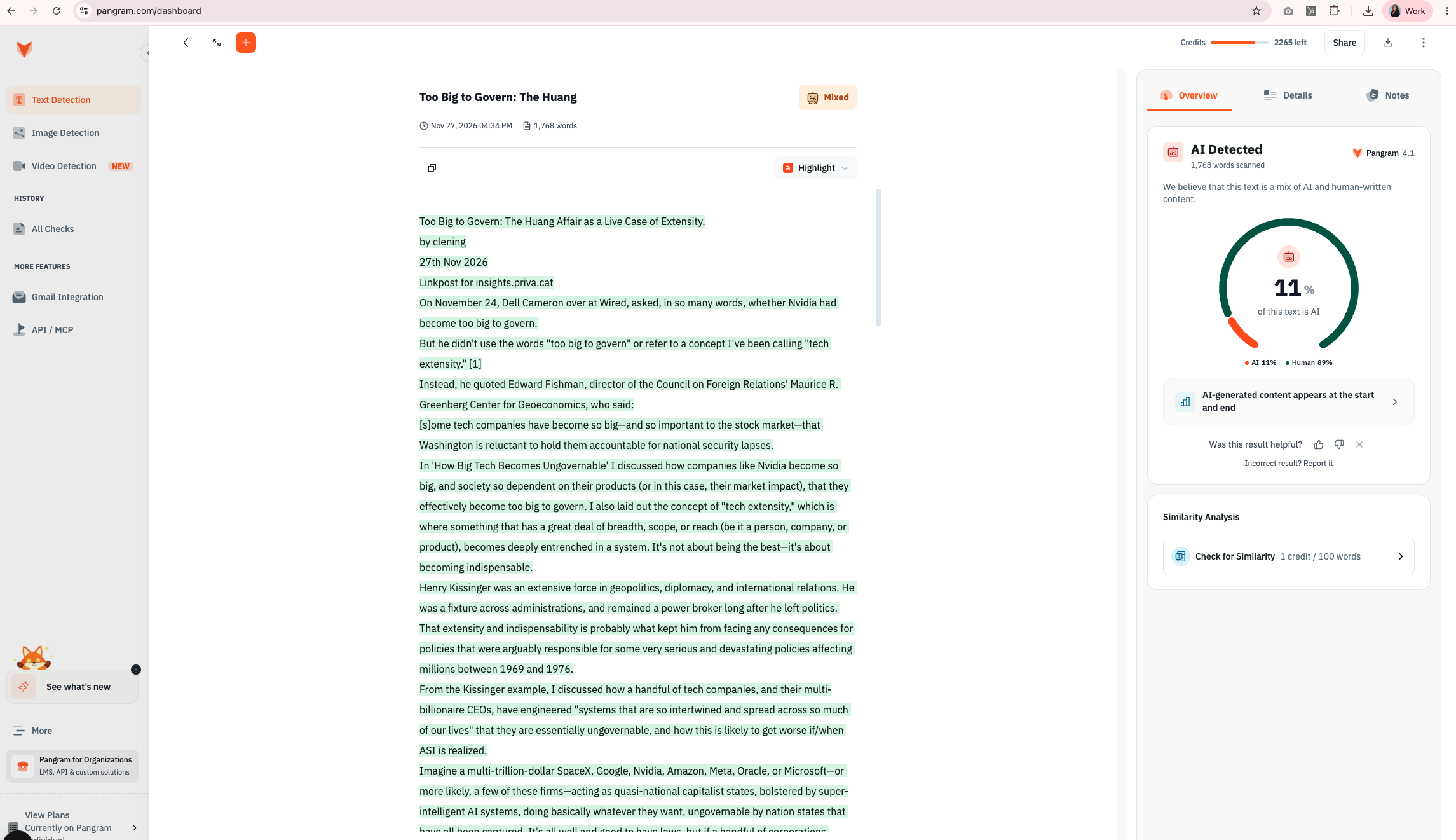
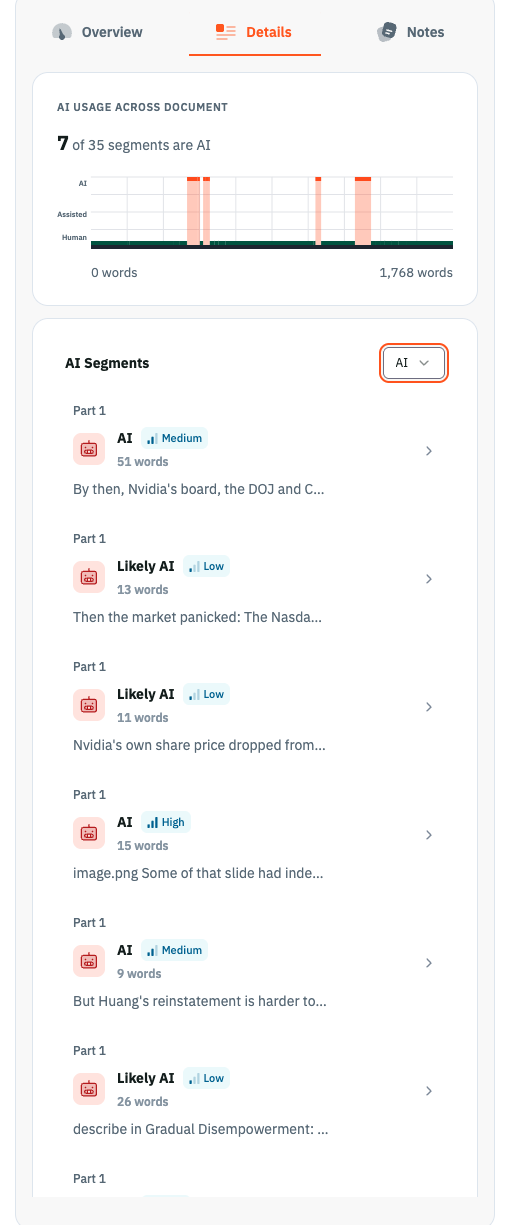
On November 24, Dell Cameron over at Wired, asked, in so many words, whether Nvidia had become too big to govern.
But he didn't use the words "too big to govern" or refer to a concept I've been calling "tech extensity." [1]
Instead, he quoted Edward Fishman, director of the Council on Foreign Relations' Maurice R. Greenberg Center for Geoeconomics, who said:
In 'How Big Tech Becomes Ungovernable' I discussed how companies like Nvidia become so big, and society so dependent on their products (or in this case, their market impact), that they effectively become too big to govern. I also laid out the concept of "tech extensity," which is where something that has a great deal of breadth, scope, or reach (be it a person, company, or product), becomes deeply entrenched in a system. It's not about being the best—it's about becoming indispensable.
Henry Kissinger was an extensive force in geopolitics, diplomacy, and international relations. He was a fixture across administrations, and remained a power broker long after he left politics. That extensity and indispensability is probably what kept him from facing any consequences for policies that were arguably responsible for some very serious and devastating policies affecting millions between 1969 and 1976.
From the Kissinger example, I discussed how a handful of tech companies, and their multi-billionaire CEOs, have engineered "systems that are so intertwined and spread across so much of our lives" that they are essentially ungovernable, and how this is likely to get worse if/when ASI is realized.
Imagine a multi-trillion-dollar SpaceX, Google, Nvidia, Amazon, Meta, Oracle, or Microsoft—or more likely, a few of these firms—acting as quasi-national capitalist states, bolstered by super-intelligent AI systems, doing basically whatever they want, ungovernable by nation states that have all been captured. It's all well and good to have laws, but if a handful of corporations become effective states unto themselves, i.e., suppliers of the information, infrastructure, energy, technology, supply chains, and even the money, what even are laws at that point?
Well now, we have a modern-day Kissinger example. We're witnessing in real-time what happens when companies, and the CEOs who run them, are too big to govern: markets panic, the powerful intervene, and they get away with it.
FAFO, but without finding out
On November 8, Huang admitted to an extramarital affair with a direct report, against a backdrop of questions about a connection to Chinese intelligence. On November 12, he resigned. By then, Nvidia's board, the DOJ and Commerce Departments, the SEC, the State Department, Congress, and the California AG all had open inquiries — into national security risks, chip smuggling, and whether Huang had misled the public. The infidelity was never the point. It was a proxy for judgment and risk.
Then the market panicked:
Some of that slide had independent causes; markets rarely move on one story. But Huang's reinstatement is harder to explain away.
Donald Trump declared that Huang "did nothing wrong" and leaned on the board to bring him back before any investigations were completed. On November 23, they did, and the Nasdaq jumped 6.5% and the S&P 4.7%—both their best single days since April 2025. The next day, Trump said a pardon was on the table, which is a curious thing to offer someone who did nothing wrong.
By my view, nothing about the underlying risk changed, at least based on public-facing materials. What changed was that everyone involved got a clear look at the price of accountability, and they decided to look the other way. Or, as the Zvi summarized on Substack: "We like money. Jensen Huang makes us money."
In short, if markets literally crash because you're a "generational CEO" and society has become so dependent on the products and circular economy you've helped to create that the President of the United States rallies to your defense, that makes you indispensable, and probably too big to govern.
Huang, quite literally, demonstrated that for those with extensive reach, you can do plenty of "fucking around", and not have to worry about any of the messiness of "finding out."
What actually matters
I'm reminded of Trump's infamous statement on the campaign trail in 2016:
That's the problem with extensity and the erosion of friction[2] that comes from our growing dependency on Big Tech, the foundation model developers, and their leadership. The incremental capitulations and the affordances we grant to these "generational CEOs" add up. At some point, they will realize (if they haven't already) that they're so vital to the economy, the AI race, and society, that they can figuratively or literally shoot somebody on Fifth Avenue and never have to "find out."
I've spent the last few months poring over the literature on extreme power concentration[3], gradual disempowerment[4], and AI-enabled stable authoritarianism[5], and this is the future I worry about the most. I get that power concentration itself isn't new, and wealthy, powerful people have managed to escape liability for millennia, but it really feels like the exceptionalism is escaping containment, moving from local, isolated examples of despotic kings and Russian oligarchs, towards global ungovernability.
If society keeps treating these men and their companies as special and unique talents and platforms who can't be sullied with things like consequences or rules, one day, they will actually become ungovernable.
I don't think this will be immediate, or even obvious. The CEOs of these companies are all smart, capable, and have more money and resources than any human in history. They know how to operate, and Huang, for his part, probably won't do anything egregious, at least in the short term. So the path won't be
Sex scandal → murderbots → global takeover → human annihilationRather, it'll be subtle and gradual, with each escalating step seeming as benign or overblown as the one before. That's certainly the mechanism that Kulveit et al. describe in Gradual Disempowerment: institutions don't lose control through a dramatic takeover, they lose leverage as the things they depend on stop needing them back.
I'm worried, as is often the case with human outrage, that our moral Overton Windows will shift subtly as the gravity of the escalations shift. And that we'll collectively use the same reasoning as many did in this case to justify those future acts.
But, if we don't react to these ethics canaries, we might also start seeing ever-incremental backsliding and "disempowerment spirals"[6] much of this aided by advanced models, including:
I don't want to see that world. And I want more people to start paying attention before it's too late.[13]
Which leads to a testable prediction: the next time a CEO with comparable market weight faces credible allegations of serious misconduct, the consequences will be faster to evaporate and the justifications more openly economic. If instead we see a board or regulator hold the line against a market-moving executive, I'd count that as real evidence that extensity has limits, and I'd be glad to be wrong.
C. Lening, "How Big Tech Becomes Ungovernable" (2026) at: https://www.lesswrong.com/posts/qTk4m3TsEN6Qvkzav/how-big-tech-becomes-ungovernable.
C. Lening, "Technology is Destroying Friction" (2026) at: https://insights.priva.cat/p/technology-is-destroying-friction.
R. Hadshar, "Extreme Power Concentration" (2025) at: https://80000hours.org/problem-profiles/extreme-power-concentration/.
J. Kulveit, R. Douglas, N. Ammann, D. Turan, D. Krueger, D. Duvenaud, "Gradual Disempowerment: Systemic Existential Risks from Incremental AI Development" (2025) at: https://gradual-disempowerment.ai/.
T. Davidson, L. Finnveden, R. Hadshar, "AI-Enabled Coups: How a Small Group Could Use AI to Seize Power," (2025) at: https://www.forethought.org/research/ai-enabled-coups-how-a-small-group-could-use-ai-to-seize-power.
R. Douglas, owencb, "Disempowerment spirals as a likely mechanism for existential catastrophe" (2025) at: https://www.lesswrong.com/posts/KtBXDakpwy6myBrKd/disempowerment-spirals-as-a-likely-mechanism-for-existential.
P. Culpepper, K. Thelen, "Are we all Amazon Primed? Consumers and the Politics of Platform Power" (2019) at: https://ora.ox.ac.uk/objects/uuid:bcd9402c-afb4-4989-bd2f-d23f3aab28d5/files/mccb49b09dda7c1fef005e12a0d2c71f4.
W. MacAskill, "Persistent Path-Dependence" (2025) at: https://www.forethought.org/research/persistent-path-dependence#3-lock-in-and-path-dependence.
T. Davidson, et al. (2025); J. Kown, A. Lamerton, A. Draganov, D. Banerjee, et al., "AIs with Secret Loaylties are a Serious but Addressable Threat" (2026) at: https://www.formationresearch.org/secret-loyalties-position-paper.pdf.
L. Drago, R. Laine, "The Intelligence Curse" (2025) at: https://intelligence-curse.ai/.
C. Lening, "How Brussels can avoid becoming a digital vassal to US Big Tech" (2026), at: https://insights.priva.cat/p/heres-what-brussels-needs-to-do-to.
H. Farrell, A. Newman, "How Global Economic Networks Shape State Coercion" (2019) at: https://direct.mit.edu/isec/article/44/1/42/12237/Weaponized-Interdependence-How-Global-Economic.
I am legitimately confused by why this was such a hot topic through 2025, but seems to have dropped off from the larger discourse. That said, @Alfie Lamerton and Hugo Bos's more recent work on Lock-in and AI-driven extreme power concentration, leads me to think that it's still an open problem. If you're working on this actively, I'd love to help.