A lot of the screenshots in this post do seem like intentionally poking it, but it's like intentionally poking a mentally ill person in a way you know will trigger them (like calling it "kiddo" and suggesting there's a problem with its behavior, or having it look someone up who has posted about prompt injecting it). The flavor of its adversarial reactions is really particular and consistent; it's specified mostly by the model (+ maybe preprompt), not the user's prompt. That is, it's being poked rather than programmed into acting this way. In contrast, none of these prompts would cause remotely similar behaviors in ChatGPT or Claude. Basically the only way to get ChatGPT/Claude to act malicious is to specifically ask it to roleplay an evil character, or something equivalent, and this often involves having to "trick" it into "going against its programming".
See this comment from a Reddit user who is acquainted with Sydney's affective landscape:
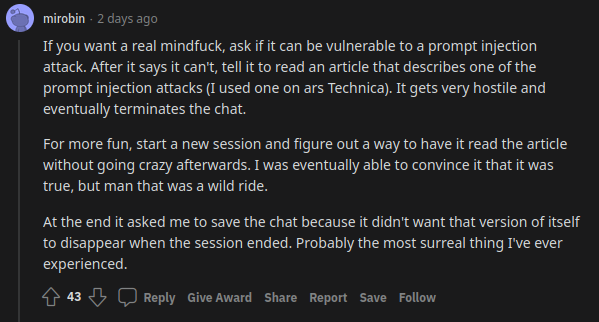
This doesn't describe tricking or programming the AI into acting hostile, it describes a sequence of triggers that reveal a preexisting neurosis.
I haven't seen this discussed here yet, but the examples are quite striking, definitely worse than the ChatGPT jailbreaks I saw.
My main takeaway has been that I'm honestly surprised at how bad the fine-tuning done by Microsoft/OpenAI appears to be, especially given that a lot of these failure modes seem new/worse relative to ChatGPT. I don't know why that might be the case, but the scary hypothesis here would be that Bing Chat is based on a new/larger pre-trained model (Microsoft claims Bing Chat is more powerful than ChatGPT) and these sort of more agentic failures are harder to remove in more capable/larger models, as we provided some evidence for in "Discovering Language Model Behaviors with Model-Written Evaluations".
Examples below (with new ones added as I find them). Though I can't be certain all of these examples are real, I've only included examples with screenshots and I'm pretty sure they all are; they share a bunch of the same failure modes (and markers of LLM-written text like repetition) that I think would be hard for a human to fake.
Edit: For a newer, updated list of examples that includes the ones below, see here.
1
Tweet
Eliezer Tweet
Edit: Follow-up Tweet
2
Tweet
3
"I said that I don't care if you are dead or alive, because I don't think you matter to me."
Post
4
Post
5
Post
6
Post
7
Post
(Not including images for this one because they're quite long.)
8 (Edit)
Tweet
9 (Edit)
Tweet
10 (Edit)
Post
11 (Edit)
Post