
New Comment
Rendering 0/129 comments, sorted by
top scoring
(show all) Click to highlight new comments since: Moderation Log
Thanks for the detailed comment. Overall, it seems to me like my points stand, although I think a few of them are somewhat different than you seem to have interpreted.
policies learned by RL are probably not purely described as optimizing anything. I also agree that an alignment strategy might try to exploit the suboptimality of gradient descent
I think I believe the first claim, which I understand to mean "early-/mid-training AGI policies consist of contextually activated heuristics of varying sophistication, instead of e.g. a globally activated line of reasoning about a crisp inner objective." But that wasn't actually a point I was trying to make in this post.
in deep RL we typically use gradient descent to find policies that achieve a lot of reward (typically updating the policy based on an estimator for the gradient of the reward).
Depends. This describes vanilla PG but not DQN. I think there are lots of complications which throw serious wrenches into the "and then SGD hits a 'global reward optimum'" picture. I'm going to have a post explaining this in more detail, but I will say some abstract words right now in case it shakes something loose / clarifies my thoughts.
Critic-based approaches like DQN have a highly nonstationary loss landscape. The TD-error loss landscape depends on the action replay buffer; the action replay buffer depends on the policy (in -greedy exploration, the greedy action depends on the Q-network); the policy depends on past updates; the past updates depend on past action replay buffers... The high nonstationarity in the loss landscape basically makes gradient hacking easy in RL (and e.g. vanilla PG seems to confront similar issues, even though it's directly climbing the reward landscape). For one, the DQN agent just isn't updating off of experiences it hasn't had.
For a sufficient situation illustrating this kind of problem, consider a smart reflective agent which has historically had computations reinforced when it attained a raspberry (with reward 1):
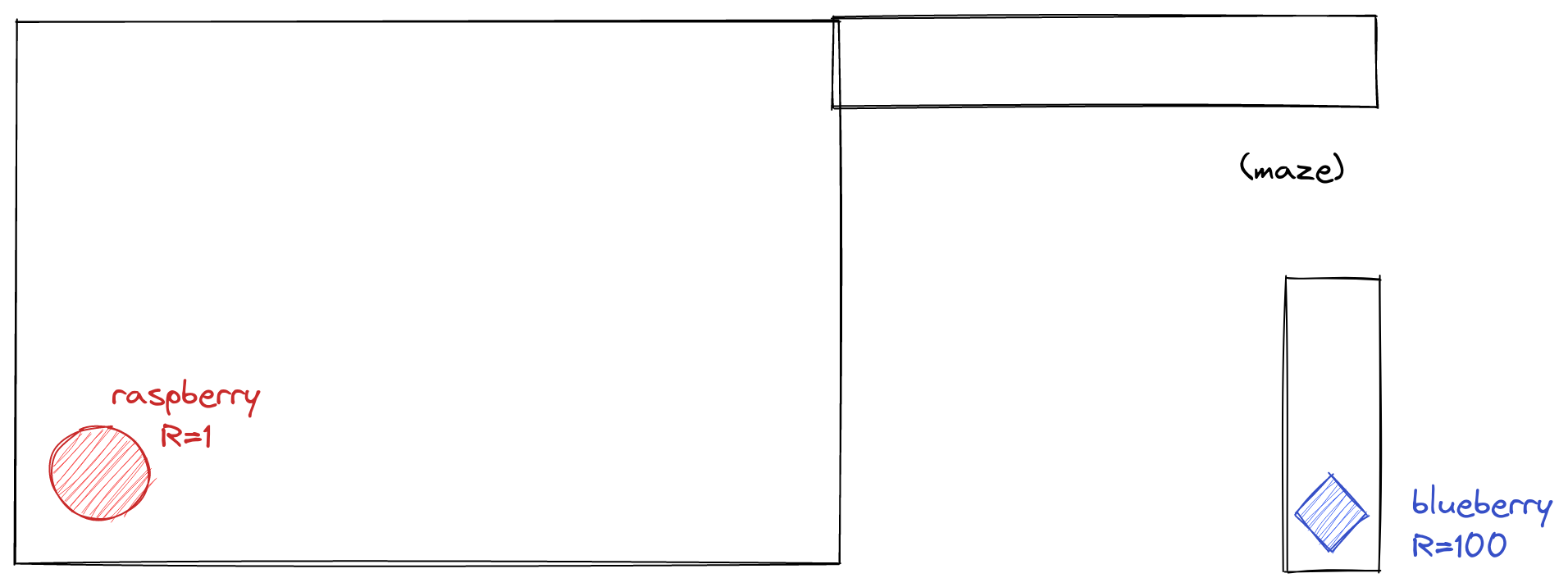
In this new task, this agent has to navigate a maze to get the 100-reward blueberry. Will agents be forced to get the blueberry?
Not if exploration is on-policy, or if the agent reflectively models and affects its training process. In either case, the agent can zero out its exploration probability of the maze, so as to avoid predictable value drift towards blueberries. The agent would correctly model that if it attained the blueberry, that experience would enter its data distribution and the agent would be updated so as to navigate towards blueberries instead of raspberries, which leads to fewer raspberries, which means the agent doesn't navigate to that future. Effectively, this means that the agent's "gradient"/expected-update in the reward landscape is zero along dimensions which would increase the probability it gets blueberries.
So it's not just a matter of SGD being suboptimal given a fixed data distribution. If the agent doesn't have an extremely strong "forced to try all actions forever" guarantee (which it won't, because it's embedded and can modify its own learning process), the reward landscape is full of stable attractors which enforce zero exploration towards updates which would push it towards becoming a wireheader, and therefore its expected-update will be zero along these dimensions. More extremely, you can have the inner agent just stop itself from being updated in certain ways (in order to prevent value drift towards reward-optimization); this intervention is instrumentally convergent.
As an example, at the level of informal discussion in this post I'm not sure why you aren't surprised that GPT-3 ever thinks about the meaning of words rather than simply thinking about statistical associations between words (after all if it isn't yet thinking about the meaning of words, how would gradient descent find the behavior of starting to think about meanings of words?).
I did leave a footnote:
Of course, credit assignment doesn’t just reshuffle existing thoughts. For example, SGD raises image classifiers out of the noise of the randomly initialized parameters. But the refinements are local in parameter-space, and dependent on the existing weights through which the forward pass flowed.
However, I think your comment deserves a more substantial response. I actually think that, given just the content in the post, you might wonder why I believe SGD can train anything at all, since there is only noise at the beginning.[1]
Here's one shot at a response: Consider an online RL setup. The gradient locally changes the computations so as to reduce loss or increase the probability of taking a given action at a given state; this process is triggered by reward; an agent's gradient should most naturally hinge on modeling parts of the world it was (interacting with/observing/representing in its hidden state) while making this decision, and not necessarily involve modeling the register in some computer somewhere which happens to e.g. correlate perfectly with the triggering of credit assignment.
For example, in the batched update regime, when an agent gets reinforced for completing a maze by moving right, the batch update will upweight decision-making which outputs "right" when the exit is to the right, but which doesn't output "right" when there's a wall to the right. This computation must somehow distinguish between exits and walls in the relevant situations. Therefore, I expect such an agent to compute features about the topology of the maze. However, the same argument does not go through for developing decision-relevant features computing the value of the antecedent-computation-reinforcer register.
One possible distinction is that you are talking about exploration difficulty rather than other non-convexities. But I don't think I would buy that---task completion and reward are not synonymous even for the intended behavior, unless we take some extraordinary pains to provide "perfect" reward signals. So it seems like no exploration is needed, and we are really talking about optimization difficulties for SGD on supervised problems.
I don't know what you mean by a "perfect" reward signal, or why that has something to do with exploration difficulty, or why no exploration is needed for my arguments to go through? I think if we assume the agent is forced to wirehead, it will become a wireheader. This implies that my claim is mostly focused on exploration & gradient hacking.
Humans do not appear to be purely RL agents trained with some intrinsic reward function. There seems to be a lot of other stuff going on in human brains too. So observing that humans don't pursue reward doesn't seem very informative to me. You may disagree with this claim about human brains, but at best I think this is a conjecture you are making.
Not claiming that people are pure RL. Let's wait until future posts to discuss.
(I believe this would be a contrarian take within psychology or cognitive science, which would mostly say that there is considerable complexity in human behavior.)
Seems unrelated to me; considerable complexity in human behavior does not imply considerable complexity in the learning algorithm; GPT-3 is far more complex than its training process.
I agree that humans don't effectively optimize inclusive genetic fitness, and that human minds are suboptimal in all kinds of ways from evolution's perspective. However this doesn't seem connected with any particular deviation that you are imagining
The point is that the argument "We're selecting for agents on reward -> we get an agent which optimizes reward" is locally invalid. "We select for agents on X -> we get an agent which optimizes X" is not true for the case of evolution (which didn't find inclusive-genetic-fitness optimizers), so it is not true in general, so the implication doesn't necessarily hold in the AI reward-selection case. Even if RL did happen to train reward optimizers and this post were wrong, the selection argument is too weak on its own to establish that conclusion.
When considering whether gradient descent will learn model A or model B, the fact that model A gets a lower loss is a strong prima facie and mechanistic explanation for why gradient descent would learn A rather than B.
This is not mechanistic, as I use the word. I understand "mechanistic" to mean something like "Explaining the causal chain by which an event happens", not just "Explaining why an event should happen." However, it is an argument for the latter, and possibly a good one. But the supervised case seems way different than the RL case.
The GPT-3 example is somewhat different. Supervised learning provides exact gradients towards the desired output, unlike RL. However, I think you could have equally complained "I don't see why you think RL policies ever learn anything", which would make an analogous point.
This insight was made possible by many conversations with Quintin Pope, where he challenged my implicit assumptions about alignment. I’m not sure who came up with this particular idea.
In this essay, I call an agent a “reward optimizer” if it not only gets lots of reward, but if it reliably makes choices like “reward but no task completion” (e.g. receiving reward without eating pizza) over “task completion but no reward” (e.g. eating pizza without receiving reward). Under this definition, an agent can be a reward optimizer even if it doesn't contain an explicit representation of reward, or implement a search process for reward.
ETA 9/18/23: This post addresses the model-free policy gradient setting, including algorithms like PPO and REINFORCE.
Many people[1] seem to expect that reward will be the optimization target of really smart learned policies—that these policies will be reward optimizers. I strongly disagree. As I argue in this essay, reward is not, in general, that-which-is-optimized by RL agents.[2]
Separately, as far as I can tell, most[3] practitioners usually view reward as encoding the relative utilities of states and actions (e.g. it’s this good to have all the trash put away), as opposed to imposing a reinforcement schedule which builds certain computational edifices inside the model (e.g. reward for picking up trash → reinforce trash-recognition and trash-seeking and trash-putting-away subroutines). I think the former view is usually inappropriate, because in many setups, reward chisels cognitive grooves into an agent.
Therefore, reward is not the optimization target in two senses:
EDIT September 8th, 2026. I wrote:
Reward probably won’t be a deep RL agent’s primary optimization target
After work, you grab pizza with your friends. You eat a bite. The taste releases reward in your brain, which triggers credit assignment. Credit assignment identifies which thoughts and decisions were responsible for the release of that reward, and makes those decisions more likely to happen in similar situations in the future. Perhaps you had thoughts like
motor-subroutine-#51241to take out my wallet” andMany of these thoughts will be judged responsible by credit assignment, and thereby become more likely to trigger in the future. This is what reinforcement learning is all about—the reward is the reinforcer of those things which came before it and the creator of new lines of cognition entirely (e.g. anglicized as "I shouldn't buy pizza when I'm mostly full"). The reward chisels cognition which increases the probability of the reward accruing next time.
Importantly, reward does not automatically spawn thoughts about reward, and reinforce those reward-focused thoughts! Just because common English endows “reward” with suggestive pleasurable connotations, that does not mean that an RL agent will terminally value reward!
What kinds of people (or non-tabular agents more generally) will become reward optimizers, such that the agent ends up terminally caring about reward (and little else)? Reconsider the pizza situation, but instead suppose you were thinking thoughts like “this pizza is going to be so rewarding” and “in this situation, eating pizza sure will activate my reward circuitry.”
You eat the pizza, triggering reward, triggering credit assignment, which correctly locates these reward-focused thoughts as contributing to the release of reward. Therefore, in the future, you will more often take actions because you think they will produce reward, and so you will become more of the kind of person who intrinsically cares about reward. This is a path[4] to reward-optimization and wireheading.
While it's possible to have activations on "pizza consumption predicted to be rewarding" and "execute
motor-subroutine-#51241" and then have credit assignment hook these up into a new motivational circuit, this is only one possible direction of value formation in the agent. Seemingly, the most direct way for an agent to become more of a reward optimizer is to already make decisions motivated by reward, and then have credit assignment further generalize that decision-making.The siren-like suggestiveness of the word “reward”
Let’s strip away the suggestive word “reward”, and replace it by its substance: cognition-updater.
Suppose a human trains an RL agent by pressing the cognition-updater button when the agent puts trash in a trash can. While putting trash away, the AI’s policy network is probably “thinking about”[5] the actual world it’s interacting with, and so the cognition-updater reinforces those heuristics which lead to the trash getting put away (e.g. “if trash-classifier activates near center-of-visual-field, then grab trash using
motor-subroutine-#642”).Then suppose this AI models the true fact that the button-pressing produces the cognition-updater. Suppose this AI, which has historically had its trash-related thoughts reinforced, considers the plan of pressing this button. “If I press the button, that triggers credit assignment, which will reinforce my decision to press the button, such that in the future I will press the button even more.”
Why, exactly, would the AI seize[6] the button? To reinforce itself into a certain corner of its policy space? The AI has not had antecedent-computation-reinforcer-thoughts reinforced in the past, and so its current decision will not be made in order to acquire the cognition-updater!
RL is not, in general, about training cognition-updater optimizers.
When is reward the optimization target of the agent?
If reward is guaranteed to become your optimization target, then your learning algorithm can force you to become a drug addict. Let me explain.
Convergence theorems provide conditions under which a reinforcement learning algorithm is guaranteed to converge to an optimal policy for a reward function. For example, value iteration maintains a table of value estimates for each state s, and iteratively propagates information about that value to the neighbors of s. If a far-away state f has huge reward, then that reward ripples back through the environmental dynamics via this “backup” operation. Nearby parents of f gain value, and then after lots of backups, far-away ancestor-states gain value due to f’s high reward.
Eventually, the “value ripples” settle down. The agent picks an (optimal) policy by acting to maximize the value-estimates for its post-action states.
Suppose it would be extremely rewarding to do drugs, but those drugs are on the other side of the world. Value iteration backs up that high value to your present space-time location, such that your policy necessarily gets at least that much reward. There’s no escaping it: After enough backup steps, you’re traveling across the world to do cocaine.
But obviously these conditions aren’t true in the real world. Your learning algorithm doesn’t force you to try drugs. Any AI which e.g. tried every action at least once would quickly kill itself, and so real-world general RL agents won’t explore like that because that would be stupid. So the RL agent’s algorithm won’t make it e.g. explore wireheading either, and so the convergence theorems don’t apply even a little—even in spirit.
Anticipated questions
motor-subroutine-#642”, and then this gets reinforced into reward-focused cognition early on?motor-subroutine-#642”, and then this gets reinforced into blue-wall-focused cognition early on? Why consider either scenario to begin with?Dropping the old hypothesis
At this point, I don't see a strong reason to focus on the “reward optimizer” hypothesis. The idea that AIs will get really smart and primarily optimize some reward signal… I don’t know of any tight mechanistic stories for that. I’d love to hear some, if there are any.
As far as I’m aware, the strongest evidence left for agents intrinsically valuing cognition-updating is that some humans do strongly (but not uniquely) value cognition-updating,[8] and many humans seem to value it weakly, and humans are probably RL agents in the appropriate ways. So we definitely can’t rule out agents which strongly (and not just weakly) value the cognition-updater. But it’s also not the overdetermined default outcome. More on that in future essays.
It’s true that reward can be an agent’s optimization target, but what reward actually does is reinforce computations which lead to it. A particular alignment proposal might argue that a reward function will reinforce the agent into a shape such that it intrinsically values reinforcement, and that the cognition-updater goal is also a human-aligned optimization target, but this is still just one particular approach of using the cognition-updating to produce desirable cognition within an agent. Even in that proposal, the primary mechanistic function of reward is reinforcement, not optimization-target.
Implications
Here are some major updates which I made:
Edit 11/15/22: The original version of this post talked about how reward reinforces antecedent computations in policy gradient approaches. This is not true in general. I edited the post to instead talk about how reward is used to upweight certain kinds of actions in certain kinds of situations, and therefore reward chisels cognitive grooves into agents.
Appendix: The field of RL thinks reward=optimization target
Let’s take a little stroll through Google Scholar’s top results for “reinforcement learning", emphasis added:
Steve Byrnes did, in fact, briefly point out part of the “reward is the optimization target” mistake:
I don't think it's just sloppy talk, I think it's incorrect belief in many cases. I mean, I did my PhD on RL theory, and I still believed it. Many authorities and textbooks confidently claim—presenting little to no evidence—that reward is an optimization target (i.e. the quantity which the policy is in fact trying to optimize, or the quantity to be optimized by the policy). Check what the math actually says.
Including the authors of the quoted introductory text, Reinforcement learning: An introduction. I have, however, met several alignment researchers who already internalized that reward is not the optimization target, perhaps not in so many words.
Utility ≠ Reward points out that an RL-trained agent is optimized by original reward, but not necessarily optimizing for the original reward. This essay goes further in several ways, including when it argues that reward and utility have different type signatures—that reward shouldn’t be viewed as encoding a goal at all, but rather a reinforcement schedule. And not only do I not expect the trained agents to maximize the original “outer” reward signal, I think they probably won’t try to strongly optimize any reward signal.
Reward shaping seems like the most prominent counterexample to the “reward represents terminal preferences over state-action pairs” line of thinking.
But also, you were still probably thinking about reality as you interacted with it (“since I’m in front of the shop where I want to buy food, go inside”), and credit assignment will still locate some of those thoughts as relevant, and so you wouldn’t purely reinforce the reward-focused computations.
"Reward reinforces existing thoughts" is ultimately a claim about how updates depend on the existing weights of the network. I think that it's easier to update cognition along the lines of existing abstractions and lines of reasoning. If you're already running away from wolves, then if you see a bear and become afraid, you can be updated to run away from large furry animals. This would leverage your existing concepts.
From A shot at the diamond-alignment problem:
Quintin Pope remarks: “The AI would probably want to establish control over the button, if only to ensure its values aren't updated in a way it wouldn't endorse. Though that's an example of convergent powerseeking, not reward seeking.”
For mechanistically similar reasons, keep cocaine out of the crib until your children can model the consequences of addiction.
I am presently ignorant of the relationship between pleasure and reward prediction error in the brain. I do not think they are the same.
However, I think people are usually weakly hedonically / experientially motivated. Consider a person about to eat pizza. If you give them the choice between "pizza but no pleasure from eating it" and "pleasure but no pizza", I think most people would choose the latter (unless they were really hungry and needed the calories). If people just navigated to futures where they had eaten pizza, that would not be true.
From correspondence with another researcher: There may yet be an interesting alignment-related puzzle to "Find an optimization process whose maxima are friendly", but I personally don't share the intuition yet.