Commentary on the content of the commitments: shrug. Good RSPs are great but probably require the right spirit to be implemented well, and most of these companies don't employ people who work on scalable alignment, evaluating dangerous capabilities, etc. And people have mostly failed to evaluate existing RSP-ish plans well; if a company makes a basically meaningless RSP, people might not notice.
Strong agree. I mostly see these commitments as useful foundations for domestic and international regulation. If the government is checking or evaluating these criteria, they matter. If not, it seems very easy for companies to produce nice-sounding documents that don't contain meaningful safety plans (see also affirmative safety, safety cases).
With that in mind, Alex Lawsen (on X) noticed some good things about the specifics of the commitments:
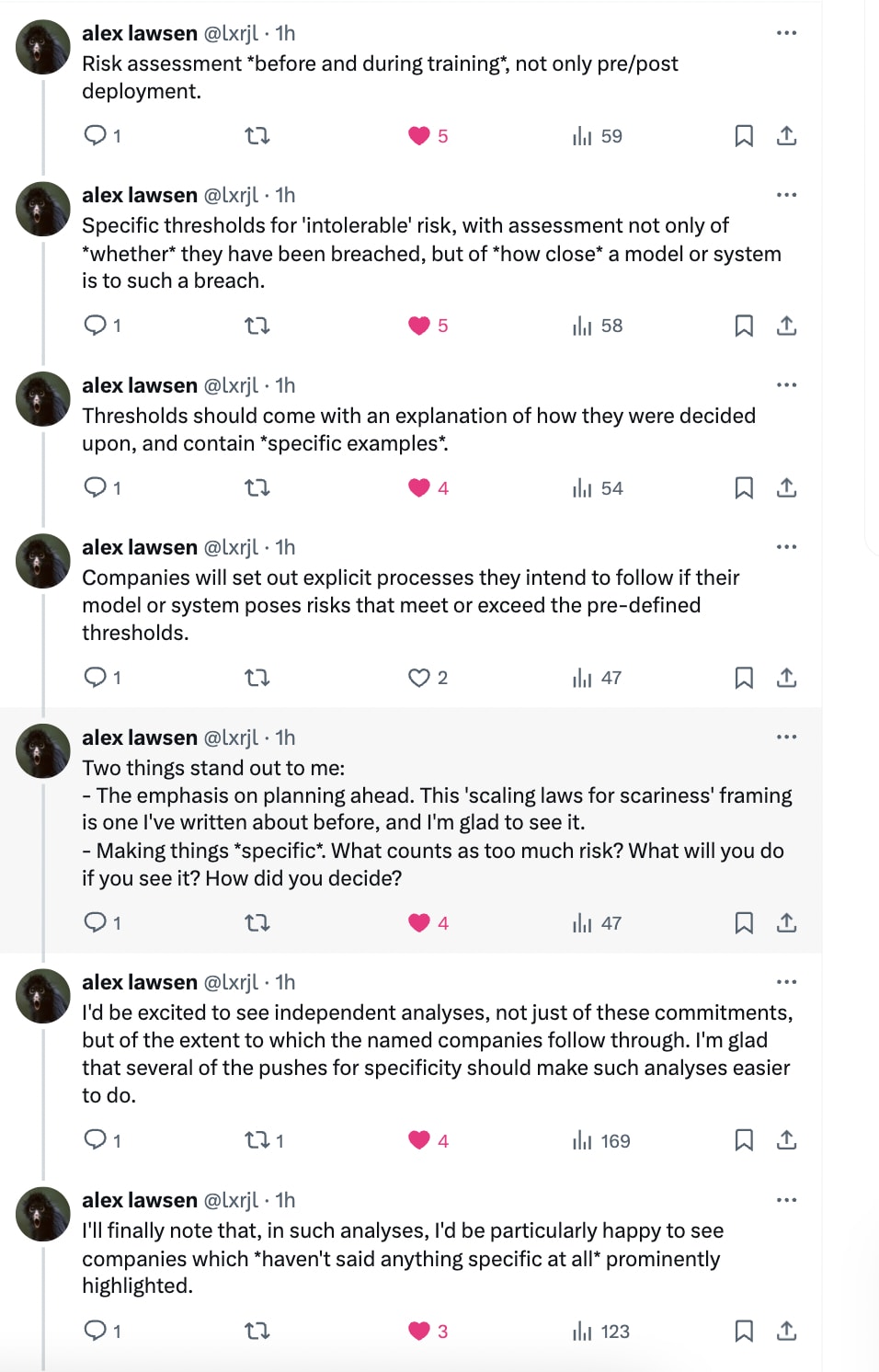
Basically the companies commit to make responsible scaling policies.
Part of me says this is amazing, the best possible commitment short of all committing to a specific RSP. It's certainly more real than almost all other possible kinds of commitments. But as far as I can tell, people pay almost no attention to what RSP-ish documents (Anthropic, OpenAI, Google) actually say and whether the companies are following them.[1] The discourse is more like "Anthropic, OpenAI, and Google have safety plans and other companies don't." Hopefully that will change.
Maybe "These commitments represent a crucial and historic step forward for international AI governance." It does seem nice from an international-governance perspective that Mistral AI, TII (the Falcon people), and a Chinese company joined.
Full document:
Quick comments on which companies are already complying with each paragraph (off the top of my head; based on public information; additions/corrections welcome):
I. Risk assessment
II. Thresholds
III. Mitigations
IV. Processes if risks reach thresholds
V. [Too meta to evaluate]
VI. [Too meta to evaluate]
VII. "Provide public transparency on the implementation of the above" + "share more detailed information which cannot be shared publicly with trusted actors"
VIII. "Explain how, if at all, external actors, such as governments, civil society, academics, and the public are involved in the process of assessing the risks of their AI models and systems, the adequacy of their safety framework (as described under I-VI), and their adherence to that framework"
Note that the above doesn't capture where the thresholds are and whether the mitigations are sufficient. These aspects of an RSP are absolutely crucial. But they’re hard to evaluate or set commitments about.
Commentary on the content of the commitments: shrug. Good RSPs are great but probably require the right spirit to be implemented well, and most of these companies don't employ people who work on scalable alignment, evaluating dangerous capabilities, etc. And people have mostly failed to evaluate existing RSP-ish plans well; if a company makes a basically meaningless RSP, people might not notice. Sad to see no mention of scheming, alignment, and control. Sad to see nothing on internal deployment; maybe lots of risk comes from the lab using AIs internally to do AI development.
Some of my takes:
- OpenAI's "Preparedness Framework" is insufficient (and OpenAI is not yet complying with it; see this post)
- DeepMind's "Frontier Safety Framework" is weak and unambitious