I believe open data pretty strongly contradicts your claims
System efficiency: ~2x, not ~20x
§1.2 estimates "up to 20x" from system optimizations (quantization, parallelization, FlashAttention, etc.). But model FLOPs Utilization, the fraction of peak hardware FLOPs that large training runs actually achieve, has barely changed. Here are the most legible training run flops efficiencies:
- Megatron-LM 2019: 30% on a single V100
- PaLM 2022: 46% on 6K TPU v4s
- Llama 3.1 2024: 38-43% on 16K H100s
- MegaScale 2024: 55% on 12K GPUs
- Llama 4 2025: 39% BF16-equivalent on 32K H100s
That's less than 2x variation over 6 years. Most optimization work at scale is treading water against communication overhead as clusters grow larger, not increasing training compute per chip. Also, individual optimizations like FlashAttention's 3x attention speedup are additive rather than multiplicative, and many other optimizations only apply to inference, not training.
The Gundlach paper tests 6 innovations. The field has produced 40+.
§1.1 relies on Gundlach et al. (2025b), which ablated six things, SwiGLU, RoPE, cosine decay, pre-RMSNorm, pre-LayerNorm, and AdamW. The most algorithmically advanced models with published methodology are DeepSeek-V3, DeepSeek-R1, and Kimi K2, and here's a list of algorithms they used that Gundlach didn't test:
Architecture:
- Fine-grained MoE: 256 routed + 1 shared expert, 8 active per token
- Ultra-sparse MoE: scaling to 384 experts at fixed active params
- No token-dropping in MoE (enabled by better balancing)
- Multi-Head Latent Attention (MLA): low-rank KV compression
- Sigmoid gating with top-K normalization replacing softmax
- Auxiliary-loss-free load balancing via learned bias terms
- YaRN context extension (4K→128K in 2000 fine-tuning steps)
Training methodology:
- Multi-token prediction with sequential causal chain
- MuonClip optimizer: Muon + QK-Clip for stable training (zero loss spikes over 15.5T tokens)
- Fill-in-Middle pretraining (10% of data in PSM order)
- LLM-based data rephrasing for knowledge and math (outperforms naive multi-epoch)
- Multi-phase learning rate schedule with annealing stages
Post-training:
- GRPO: RL without a critic model
- Four-stage pipeline: cold-start SFT → reasoning RL → rejection sampling SFT → all-scenario RL
- Rule-based rewards avoiding neural reward model hacking
Of these, Muon alone is ~2x, which is on par with AdamW vs SGD.
HellaSwag: an example 10x+ compute multiplier, without distillation or synthetic data
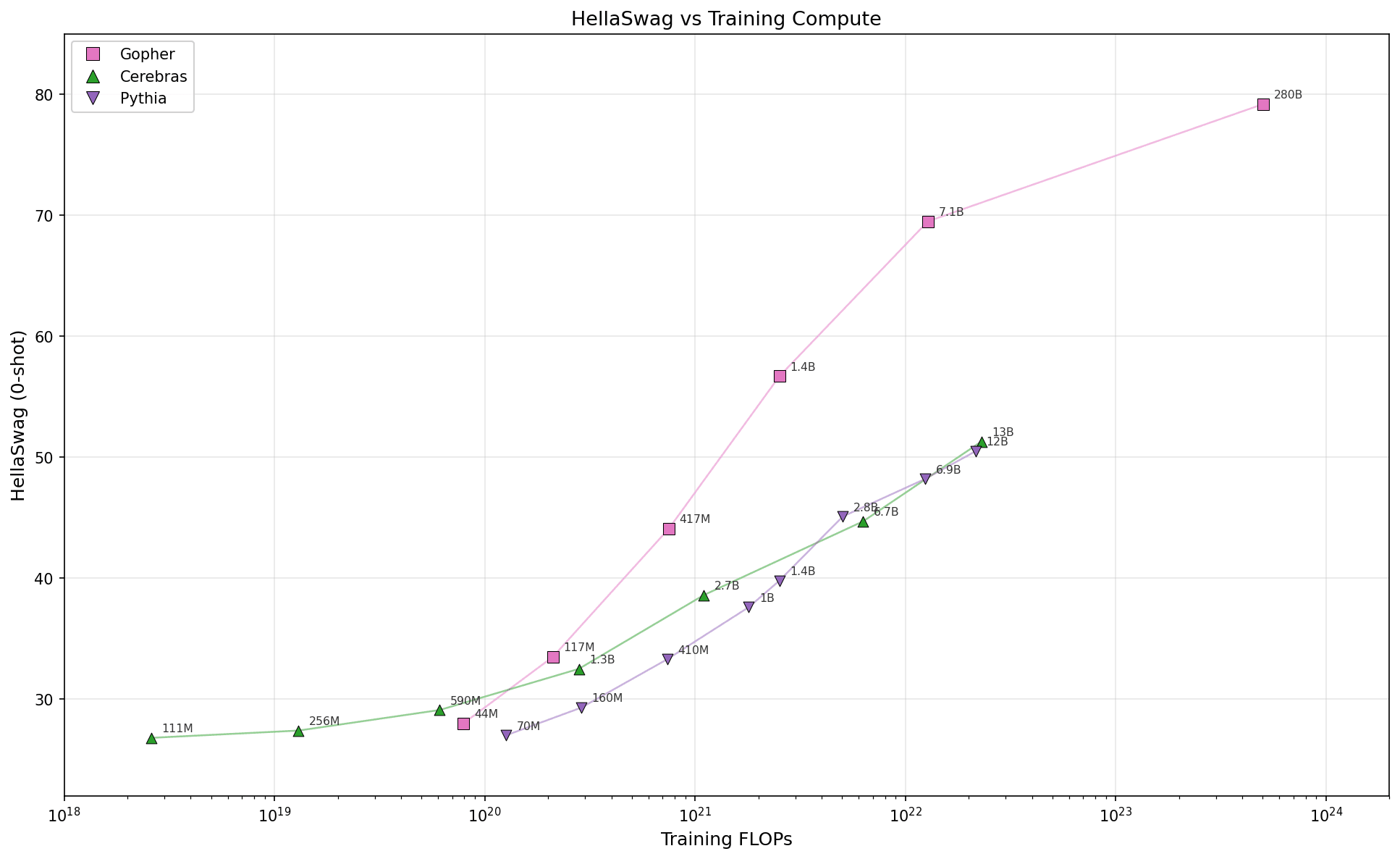
Three model families, each trained at a fixed recipe across multiple sizes: Gopher (2021), Cerebras-GPT (2023, Chinchilla-optimal), and Pythia (2023), and they didn't use any distillation, targeted data similar to benchmarks, or data contractors. Gopher reaches the same HellaSwag score as Cerebras-GPT or Pythia with roughly 10x less compute, and while using Kaplan parameter scaling. There was pretty much no legible algorithm in the paper that obviously caused this difference.
There's lots more evidence, and many models such as Qwen or R1 got significantly higher compute multipliers, but as you note, some fraction of that is from distillation or data labelling.
Note: Claude 4.6 wrote most of this, with a huge number of revisions and fixes from me, it wasn't really an uplift compared to only using Claude to make the list and the plot.
Why is Gopher better than Pythia or Cerebras? Mostly no comment, but I think Pythia and Cerebras weren't making any super simple obvious mistake but were behind 2021-era DeepMind.
 1
1FWIW, I would not be surprised if LLM algorithmic progress was considerably faster today than in 2020. Per my recent post, I think catch-up algorithmic progress is very fast today, and it seems like it wasn't so fast a few years ago.
 1
1I know very little about this topic, but I was under the impression that there was more to it than “KV cache: yes or no?”, and I was trying to refer to that whole category of possible improvements. E.g. here’s a paper on “KV cache compression”.
 1
1Fwiw it's unclear to me whether epoch's methodology would make this mistake
I don’t think I accused Epoch of making any “mistakes”. I think they came up with a procedure, described it, followed it, and found a result. I only suggested that the procedure has some funny properties and hence the result is easily misunderstood.
FWIW, Anson Ho (the first author of the Epoch paper in question) wrote a blog post The Least Understood Driver of AI shortly after I published this. He talks about Gundlach et al. 2025b, and he has some nitpicks but mostly endorses the paper, and in particular he endorses the paper’s main point about how his own paper’s methodology interacts with “scale-dependent” algorithmic improvements.
If models trained with the the same compute but later in time are no better, they shouldn't find any alg progress.
Absolutely everyone including me agrees that (1) models trained with the same compute later in time are way better, and (2) this is partly because of better data, and (3) this is also partly because of (non-data) algorithmic progress. You only get into controversial territory when you start quantifying these.
 1
1Possibly better to have a fresh new post, and point each post to the other, rather than updating in place? (You could still keep the changelog, which is polite and helpful for your readers.) In particular, I only saw this revision by luck.
 1
1
(Heavily revised on Feb. 9, 2026—see changelog at the bottom.)
There’s a lot of talk about “algorithmic progress” in LLMs, especially in the context of exponentially-improving algorithmic efficiency. For example:
It’s nice to see three independent sources reach almost exactly the same conclusion—halving times of 8 months, 6 months, and 7½ months respectively. Surely a sign that the conclusion is solid!
…Haha, just kidding! I’ll argue that these three bullet points are hiding three totally different stories. The first two bullets are about training efficiency, and I’ll argue that both are pretty misleading (each for a different reason!). The third is about inference efficiency, which I think is right, and mostly explained by distillation of ever-better frontier models into their “mini” cousins.
Tl;dr / outline
Status of this post
I wrote this very quickly, on a topic where I am not remotely an expert. I’m hoping for feedback and opinions!
1. The big picture of LLM algorithmic progress, as I understand it right now
1.1 Stereotypical learning algorithm improvements: there’s the Transformer itself, plus another maybe 10× since 2018
I’m defining this category as changes related to the core learning algorithm itself—neural architecture changes, SGD vs AdamW, etc.—apart from a couple categories that get their own sections below.
Here’s my current impression (any uncited claims probably come from @Hans Gundlach et al. 2025b “On the origin of algorithmic progress in AI”):
1.2 Innovations that unlock long context windows
If I understand correctly, the original Transformer could be run in principle with an arbitrarily long context window. But beyond a certain (low) length, the memory demands would catastrophically reduce FLOP utilization to ≈0. Then a 2019 advance (“MQA”) made longer context windows practical, but performed worse than the original (“MHA”) Transformer (holding context window fixed). Then further advances (MQA → GQA → MLA) clawed back most of that performance degradation, while keeping the low memory footprint.
Also in the “unlocking long context windows” category is things like YaRN, a trick to get good long-context performance out of mostly-short-context training data, by basically extrapolating a short-context trained attention layer into a good initialization for a longer-context trained attention layer. And then you need much less actual training, because the initial state is already so good.
Anyway, this category of innovations seems very important. Exactly how important? I don’t know! I can’t immediately find a reference that quantifies it in a legible-to-me way.
1.3 “Optimizations”: Lots of work, but there’s always a ceiling
This category is stuff that wouldn’t show up in a FLOP metric, but it’s equally important for cost. It includes everything specific to a particular hardware configuration and training setup—details about quantization, parallelization, FlashAttention, other CUDA black magic, and so on. I’ll also thro system-level optimizations like speculative decoding into this category.
My impression is: it takes a lot of work to keep FLOP utilization high as the chips grow ever faster and the parallelization grows ever more aggressive. (Per the Red Queen: “It takes all the running you can do, to keep in the same place.”) So if we’re trying to compute how “algorithmic efficiency” changes over time, I think we wouldn’t see much effect from this category. From the outside, it would look like: some company’s FLOP utilization (actual FLOP/s achieved compared to “peak FLOP/s” according to the GPU spec sheet) was X% last year, and it’s still around X% today, but they’re training bigger models. From that outside perspective, we would summarize the situation by saying that the company’s “algorithmic progress” is zero while their “compute growth” is high. But that summary would be hiding a lot of “optimization”-type innovation under the hood.
Alternatively, instead of comparing year-on-year as configurations change, we might hold fixed a hardware configuration and training setup, and ask how efficiency might change over time due to these kinds of “optimizations”. I think this multiplier could be quite big (say, 20×) if the baseline is a sufficiently early slapdash implementation. I think the multiplier would be smaller (but still substantial—say, 3×) even many months later, after some of the low-hanging fruit is gone, but a long tail of smaller “optimizations” still remains. For example, the original FlashAttention alone apparently sped up certain training setups by 3× wall-clock time (but other setups by less). Much later on, as a random example, the “nanoGPT speedrun” got a 9% wall-clock speed boost in 2024 by simply incrementing the PyTorch version.
What I don’t believe is that “optimizations” can contribute to an ever-growing exponential, where it’s 10× after two years, 100× after four years, 1000× after six years, etc. These kinds of optimizations have a ceiling, where you’re doing the best you can with the training approach and hardware configuration you’ve got. GPU utilization cannot exceed 100%. Quantization can’t go below 1 bit. Etc.
1.4 Data-related improvements
As discussed in “Most Algorithmic Progress is Data Progress” by Beren Millidge (@beren), a lot of LLM improvement has come from more and/or better training data,[4] including:
What are the impacts of these data-related improvements? Are they relevant to those exponentials at the top? My current take is:
1.5 Algorithmic changes that are not really quantifiable as “efficiency”
If we put aside the “3×/year” and related quotes at the top, and take a broader view of what LLM algorithmic progress can look like, then of course we find many more items. These include:
2. Explaining away the two training-efficiency exponential claims
At the top, I cited Epoch AI and Dario Amodei as claiming that algorithmic improvements constitute a rapid exponential that’s been going on for years. I don’t currently believe either of them. Here’s why.
2.1 The Epoch “8-month halving time” claim seems to be mostly a weird artifact of their methodology
(The Epoch AI claim in question is at blog, paper, and my response here is entirely based on Gundlach et al. 2025b.)
Some algorithmic changes matter more and more as the model scale gets bigger. Specifically, there were two such changes: the switch from LSTMs to Transformers, and Chinchilla-optimal training.
For example, let’s suppose that the Transformer is N× more efficient than LSTMs with 2018-scale LLMs, and 10N× more efficient than LSTMs with 2025-scale LLMs.
Now let’s put aside everything else, and imagine a world where we switch from LSTMs to Transformers in 2018, and then scale up the transformers from 2018 to 2025 with no additional algorithmic change at all. In the Epoch methodology, they would say that we got an “extra” 10× algorithmic improvement (50%/year!) in the 2018-2025 period, because we’re kinda milking ever more advantage from the one-time LSTM-to-Transformer switch.
OK, but … that’s super confusing! Right? By assumption, the algorithms weren’t actually getting better during that 2018-2025 period, at all!
Anyway, the important point is: the actual Epoch analysis seems to be fully compatible with the claims I made in §1.1 above.
(The only puzzle here is that Gundlach et al. 2025b claims to perfectly account for the Epoch “improvement” … but the things omitted by Gundlach et al. (especially the “unlockers of long context windows” in §1.2) should account for some of the Epoch “improvement” as well, right? So I figure that Gundlach et al. must have some minor inaccuracies that account for the balance.)
2.2 The Dario “4x/year” claim is I think largely confused double-counting?
I quoted Dario Amodei 2025 at the top. Here’s a longer version of that quote:
At first, I found this quote baffling. Dario has been working primarily on Transformer-based LLMs for at least 7 years. So I guess he’s saying that we’ve improved by
(Some commenters suggested that maybe Dario’s belief is that it’s 4×/year today, but lower in the past. My response: maybe that’s true to some small extent, but in context, I think this is sanewashing, and that Dario’s belief has to be at least ≳3000× in the last seven years.[6] And I still think that’s nuts.)
So what the heck is Dario talking about??
…But I think I got it now. So here’s my current take—the only way I can get everything to fit together and make sense:
Overall, I remain confused, and I think Dario is probably doing a lot of this double-counting stuff, and/or describing things in a confusing way.
[Boy, I sure feel weird about lecturing Dario Amodei on the big picture of LLM training! He knows more about LLM training than almost anyone on Earth, and I have (checks notes) no LLM training experience whatsoever. So if anyone has a different proposal for how to make sense of Dario’s quote above, I’m all ears!]
3. Sanity-check: nanochat
There were seven years between GPT-2 (trained in early 2019) and the new nanochat, which matches GPT-2 performance on the “CORE” metric (“a diverse set of reasoning and knowledge tasks from the DCLM benchmark suite”).
Remarkably, Karpathy says here that nanochat training costs $73 (“3 hours on a single 8XH100 node”), whereas “GPT-2 was trained by OpenAI on 32 TPU v3 chips for 168 hours (7 days), with $8/hour/TPUv3 back then, for a total cost of approx. $43K”.
So that would be a factor of 600 in 7 years, i.e. a halving time of 9 months. Is that consistent with my story in §1? I think so! For example, it might be something like:
For that last one: GPT-2 used “webtext”, which was generated by scraping URLs linked from Reddit. By contrast, nanochat trains on “fineweb-EDU”, a dataset of educational materials crafted and curated with incomparably more effort and care. Remember, we’re comparing nanochat to GPT-2 on “reasoning and knowledge tasks”, not perplexity; I would be shocked if this better data was not playing a major role.
So anyway, my take in §1 seems at least plausibly consistent with the nanochat thing, AFAICT at a glance. To be clear, I didn’t check things in detail or scrutinize it very hard. If anyone wants to really check, you could just download nanochat and have at it!
4. Optional bonus section: why does this matter?
Well for 99% of the people reading this post, this topic matters to you because you’re trying to forecast future LLM progress. But that’s not my interest, so I won’t talk about it. I’ll leave that to others!
I’m actually interested in a rather different, older debate, one predating LLMs, between two schools of thought. Here’s the debate:
One school of thought (that I vaguely associate with Paul Christiano[7]) says: When people are trying to do something in ML, they very rapidly get to near the ceiling of how efficiently they can do that thing, given the available data and hardware situation (but perhaps leaving aside paradigm shifts, which are not about doing the same thing more efficiently, but rather about trying to do something different instead).
A different school of thought says: No, that’s wrong, instead when people are trying to do something in ML, there will be a very large collection of algorithmic improvements that could make it work more efficiently, and these improvements will take many thousands of person-years to discover, and they will collectively amount to orders of magnitude of efficiency difference.
So that’s a debate. The reason I care about this debate is unrelated to LLMs; rather it’s part of an in-the-weeds argument about how fast “takeoff” to superintelligence might be if we someday have a post-LLM AI paradigm shift (as I happen to expect). See Foom & Doom 1: “Brain in a box in a basement”, e.g. comment on that post by @ryan_greenblatt. I’m generally in the first school of thought, which is related to my expectation of sudden takeoff to ASI.
…OK, if that’s the debate, then what lesson do we take away from this LLM case-study? My answer: If I’m right (a big “if”!), then (I would argue) the history of LLMs seems to support the first school of thought more than the second.
To be clear, I don’t think this kind of analogizing is terribly strong evidence either way; and note also that there are other case-studies like this ImageNet analysis that might or might not paint a different picture, I didn’t check.
In fact, there are two key disanalogies between LLMs versus the future AI paradigm I’m expecting (see Foom & Doom 1), and they make my case for sudden takeoff (conditional on that paradigm shift) even stronger: the future paradigm I’m expecting would (1) not rely on training data for its capabilities (unlike LLMs), making §1.4 basically moot; and (2) require very little compute to get from random initialization to AGI (if efficiently implemented), which would allow for much more rapid iteration and testing than we’re used to from LLMs.
Thanks Hans Gundlach, Seth Herd, plex, algon, ishaan, and Alex Fogelson for critical comments on earlier drafts.
Changelog
Feb. 9, 2026: I pulled “unlockers of long context windows” into their own category (new section §1.2), ; I increased my guess of the §1.1 impact from “3-5× beyond Transformer + Chinchilla” to “10×”. I heavily reframed the discussion of “optimizations” (now §1.3), to clarify what’s getting compared to what. I added a couple more examples to the “data” category (now §1.4). Then I made various related changes to my analysis of the Dario quote, and nanochat. Thanks to the commenters for ideas and pushback!
Feb. 11, 2026: Minor typo fixes and clarifications.
Gundlach links to this paper on tokenizers, and describes it as a claim that “inefficient tokenization” can cause up to 68% performance hit. But I think that 68% number comes from comparing best practices to the extraordinarily dumb idea of building a tokenizer using English-only text and then running inference on a multilingual corpus. As for real tokenizer improvements, I think everyone’s been using BPE since before the Transformer, and different flavors of BPE seem quite similar, if I’m reading the paper right. As an example, this page benchmarks the tokenizer of the recently-released nanochat (§3) against the tokenizer used by GPT-2 in 2019, and finds 0-15% compression difference, depending on the data type. The difference probably comes from using better training data to set up the tokenizer.
FYI: They note that if you revert one of these things at a time, it has a bigger deleterious impact than if you revert the whole package at once. In other words, the “Retro Transformer” and the “Modern Transformer” were each a package of components that worked particularly well together.
For example, Karpathy here mentions the “muon optimizer … residual pathways and skip connections gated by learnable scalars, and value embeddings”. And a commenter noted that the DeepSeek-v3 paper includes: “Sigmoid gating with top-K normalization replacing softmax”, “MuonClip optimizer”, and “Multi-phase learning rate schedule with annealing stages”. None of these seem to have been studied by Gundlach et al. 2025b, unless I missed it.
This of course fits perfectly with my belief that we should think of LLMs as getting their impressive powers almost entirely via imitation learning from their training corpus.
A commenter mentions a couple more examples: “fill-in-the-middle pretraining” (used in DeepSeek v3) and LLM-based data augmentation / rephrasing (used in Kimi K2).
For example, we can just multiply Dario’s “CMs”. E.g. if “every once in a while” means “three times ever”, then we would have 1000× just from the “very large” CMs, before we even start on the “medium” and “small” ones! Anyway, I’m willing to haggle over a factor of 2 or 5 or whatever, but I think it’s sanewashing to interpret Dario’s quote as claiming less than, say, ≳3000× over 7 years.
For example, Paul Christiano 2018: “A more precise version [of] my claim: if you gave smart grad students from 1990 access to all of the non-AI technology of 2017 (esp. software tools + hardware + data) and a big budget, it would not take them long to reach nearly state of the art performance on supervised learning and RL. For example, I think it's pretty plausible that 20 good grad students could do it in 3 years if they were motivated and reasonably well managed.” (Actually, Paul is much further in the direction of the first school of thought than I am, because I defined it with a carve-out for possible hard-to-discover paradigm shifts, and he’s not even conceding that.)