T1 diabetic here
What you call "The swamp" is one half well known to me
I cannot attest to any weight gain, as it's near impossible for me to "just gain weight".
The key I believe is that a definite craving for high-fat high-sugar food appears when the blood sugars are high, in quite a paradoxical fashion.
If I eat too much carbs and forget to take enough insulin for it, my BG can go from by preferred 4-5 to around 10 or above.
High blood sugars cause tiredness , confusion and exhaustion, clogged sinuses, dehydration, lack of joy, plus junk food cravings. Having "sweet piss" levels of blood glucose (>10 mmol) is comparable to a heavy food coma to me.
I can also compare it to being stoned from marijuana, minus all the good parts. Tired, lazy, confused, sleepy, frustrated, craving sweets.
>15 sucks as much as having a cold.
The evil thing is, people get acclimated to it (I did once too) and without experiencing it, the healthy reference loses it's importance.
I only know the layman explanation, but it's like any extra sugar "chokes" the metabolism, tissues are drowning in fuel while also starve, as insufficient nutrients reach them which leads to the cravings.
I feel this explanation is wrong, as I get mostly the same cravings regardless of insulin present in the blood.
I must stress the importance of those cravings, as it really is a bizarre upside-down reaction. It can make me stuff myself literally sick, "I must not move around one bit or it'll leak out" retarded full, waiting for a little more.
I never been anywhere close near obese my entire life, but I completely get the struggles of those people who must live like that, always tired and always hungry with no tool to solve it.
It's really not just lazyness, it's one devious fucking trap.
Another interesting tidbit is that I also require -much- less sleep (5-6h total) with borderline low blood sugars (3.5-4 mmol). Messing up dinner and having >10 sugars for the whole night makes me wake up as tired as I went to bed, even after 10 hours.
But the difference between all night 7 or 4 is enormous.
Also composing this reply fell apart a bit because I got distracted into it and forgot my dinner insulin, lol.
I must stress the importance of those cravings, as it really is a bizarre upside-down reaction. It can make me stuff myself literally sick, "I must not move around one bit or it'll leak out" retarded full, waiting for a little more.
. . . Huh.
I'm not a diabetic [ that I know of ], but I have this too. [ And I've never actually read anyone else describe something similar. ] It happens under conditions of prolonged mental stress. [ Usually but not always ] first my circadian rhythm goes, and get some amount of insomnia; at worst I stop being able to sleep ... (read more)
I.
It's a Known Thing in the keto-sphere [ I get the sense that r/saturatedfat is an example of this culture ] that people with metabolic syndrome -- i.e., some level of insulin resistance -- can handle fat or carbs [ e.g. either a ketogenic diet or something like the potato diet ] but can't handle both at the same time without suffering two symptoms:
[ 1 ] gaining weight
and
[ 2 ] suffering fatigue.
This is sometimes called "The Swamp".*
This is a very peculiar way for human metabolism to work. What's more, it only works this way for some people -- centrally, people who have acquired some level of insulin resistance [ "metabolic syndrome" ].
The insulin-resistant population leans not-young and slightly male, and its incidence is only appreciable in locations that have adopted a "Western diet".
The clearest articulation I've ever read of the Taubesian model of insulin resistance is actually a glowfic reply by Swimmer963:
This model has problems.
The most obvious is, "Why weren't the rates of metabolic syndrome high in poor agricultural communities that had to eat almost entirely carbs, then?" The American Heart Association's decision to blame the increasing quantity of fat in the 20th-century American diet for the increased incidence of "diseases of civilization" was, in a sense, perfectly natural, given that . . . that was the change in the American diet that had recently occurred! It's called the "nutrition transition": poor agricultural nations' consumption of carbohydrates decreases significantly when they come into some wealth! Yet their rates of metabolic syndrome generally go up [ if few are quite as high as the American one yet ].
A less obvious problem is -- ancestral humans didn't evolve to eat quite as many carbohydrates as even the modern American currently consumes, no. But they ate Swimmer's "one sugary meal" whenever they found a good payload of fruit! Why is the putative Taubesian pancreas "groan"ing?
A third problem with the Taubesian model of insulin resistance, that you would only notice if you frequently talked to people who get large health benefits from a ketogenic diet, is, it doesn't explain "The Swamp" -- the weight-gain-and-fatigue syndrome that occurs only when people on the insulin-resistance spectrum are eating a diet moderately high in both carbs and fat at the same time, and not when they eat a diet high in fat alone, or a diet high in carbs alone. If carbs are causing the syndrome, then why does eating only carbs alleviate it?
II.
One going hypothesis for what's causing "the Swamp" in those with metabolic syndrome is "the Randle Cycle".
Basically, there are a bunch of factors available in your cells [ such as malonyl-CoA ] which facilitate the metabolism of sugar and the synthesis of fat [ triglycerides ] for storage, which also marginally block the metabolism of fat, and a bunch of reciprocal factors which enable or are correlated with the breakdown of fat, and which marginally block the metabolism of sugar [ glycolysis ].
The theory says that when insulin-resistant people eat an appreciable amount of fat and an appreciable amount of carbs in the same ~24-h period, a self-reinforcing metabolic death spiral occurs between the "fat side" of the "Randle Cycle" and the "sugar side".
The "fat side" factors, activated by the influx of fat, block the breakdown of sugar. Simultaneously, the "sugar side" factors, activated by the influx of sugar, at once throttle the breakdown of fat for energy and facilitate its synthesis and storage.
Well, now there's lots of sugar backed up in the bloodstream, unable to be metabolized [ and probably exhausting the pancreas's ability to produce insulin ]. That sugar is going to keep pressuring the "sugar side" factors, which will block the metabolism of fat even harder. Simultaneously, the fat backed up in the bloodstream [ and, at the same time, the pathological vesicles of triglycerides building up outside the cell from the continued shouting of the "sugar side" factors to store more fat ] will keep pressuring the "fat side" factors, which will continue to block the metabolism of sugar . . .
But, okay, so there's a self-reinforcing metabolic death spiral. The "Randle Cycle" mechanisms for reciprocal inhibition of fat and carbohydrate metabolism must be universally conserved across humans. So why can some people handle a diet simultaneously heavy in fat and carbs for long periods of time without becoming obese, chronically fatigued, and insulin-resistant, while others can't?
The ancestral diet was moderately heavy in both fat and carbs [ yes, they ate lots of protein, but the Inuit invented the term "rabbit starvation" for a reason -- if you only eat protein, your body eventually stops being able to extract any calories out of it at all ]. So surely there's something additionally taxing about the diet of people who develop metabolic syndrome, beyond just "moderately high in both fat and carbs".
What changed, to spike the rate so wildly between ~1940 and ~1990, in "the West"?
III.
-- Aubrey de Grey, The Mitochondrial Free Radical Theory of Aging
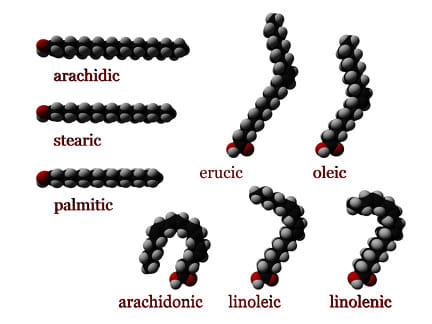
[ source: Wikipedia ]
Different fats are shaped differently.
Saturated fats are shaped like a straight line.
Monounsaturated fats are shaped like a kinked pipe.
Polyunsaturated fats, like the ones in "seed oils" -- rapeseed/canola oil, soybean oil, palm oil, etc., with the notable exclusion of olive oil [ for the most part ] and coconut oil -- are shaped like a U, and as de Grey says, have multiple C=C double bonds, which are very volatile when your mitochondrion attempts to metabolize them.
It's usually best for animals to use saturated fats, because they're the least volatile -- but if you're a cold-water fish or you need extra fluidity in your cell membranes for some other reason -- or if you're a seed and you want to be light so you can spread and you don't really care about volatility -- then lots of [poly]unsaturated fats will help, because the molecule takes up more space for the same number of atoms.
What would happen if you evolved to eat a low rate of polyunsaturated fatty acids, but instead your body found itself consuming a very high rate?
IV.
-- de Grey, The Mitochondrial Free Radical Theory of Aging
Your body's rate of "oxidative stress" from free radicals produced by oxidative phosphorylation in the electron transport chain, would go way up. This would damage your mitochondria. And damaged mitochondria damage mitochondria. The efficiency with which your body was able to do OXPHOS would decline, in a vicious cycle.*** Markers of oxidative stress would correspondingly go up in all your tissues.
With your body's core metabolic rate reduced, the Randle Cycle mechanisms might appear to become "antsier". A slight lag in the readiness of fat to flush from the bloodstream through the mitochondria would press harder on the "fat side" signaling pathway, while a slight lag in the readiness of sugar to flush from the bloodstream pressed harder on the "sugar side" pathway. Each side would throttle the metabolism of the macro triggering the other, bringing the overall metabolic rate even lower and exacerbating the process until the person had a chronic excess of sugar in the bloodstream, a chronic excess of triglycerides in the fat cells****, and chronic fatigue.
*Aspden describes a mechanism by which PUFAs inhibit glycolysis by downregulating mTOR/LKB1; the usual Randle Cycle mechanism for blocking glycolysis is that a high ratio of acetyl-CoA to malonyl-CoA will inhibit pyruvate dehydrogenase, but I thought the finding that PUFAs could block glycolysis even more strongly [ as I understand it, usually the Randle Cycle can't override mTOR, although the "fat side" "wants to" ] was illustrative, though not load-bearing.
**de Grey later goes on to say that he disagrees with the vicious cycle theory of mitochondrial aging, but this is only true in a very narrow technical sense; he doesn't dispute that the rate of damage to OXPHOS rises exponentially over time in a vicious cycle, he just thinks it's important to recognize that in "healthy aging", the rate of OXPHOS collapse is very uneven between cells.
***This paper directly shows that 4-HNE, an immediate and exclusive product of polyunsaturated fatty acid metabolism, decreases the activity of the electron transport chain in mice. Although this has not been directly shown in worms, outward signs of the electron transport chain slowdown syndrome shown by Chang et al. [ including fat gain ] have also been demonstrated in C. elegans by Singh et al.
****indeed, two types of obesity are recognized among those who study fat cells: "metabolically healthy" obesity, in which fat cells are overproduced and fat is stored normally, and "metabolically unhealthy" obesity, in which the number of fat cells is unaltered, but the individual fat cells hypertrophy from the body's pathological attempts to store more fat.
Appendix: Ancient Indian Seed Oil Consumers: The First Diabetics?
[ source [podcast] ]
[ Goodrich also claims the season of high monongo nut consumption gives the !Kung pot bellies and metabolic syndrome, because of the monongo nut's high linoleic acid levels, but that the low availability of calories is protective; I imagine either or both of "the monongo nut's LA content isn't actually 'Western'-level", or "these were !Kung who were also eating other things", is true, because as far as I understand it, the !Kung at the time they were studied by Western anthropologists in the late 20th century, were getting enough calories, and I doubt a diet of monongo nuts, which seem pretty normal as far as ancestral "reserve foods" go, genuinely gives you diabetes. ]
[ source ]
[ Wikipedia ]
[ as far as I know, all these cultures had some incidence of seed oil consumption -- sesame oil in the case of the Ayurvedics and rapeseed oil in the case of the Chinese ]