I have a background in fusion, and I use the phrase "putting the sun in a bottle" when talking to people who know nothing about plasma physics. You're not wrong that it's a different reaction, but it's still the best intuition pump that people have.
If you were trying to explain to a someone from 1000 AD how a modern natural gas power plant works, you'd probably start with a comparison to burning wood or charcoal. Even though it's not the same chemical reactions, it's in some ways a lot simpler, and the containment mechanisms are completely different.
Comparing fusion to the core of the sun is similar. It gives people somewhere to start thinking about the problem, and a sense for how difficult the problem is. You then can more easily explain the actual reactions and confinement mechanisms.
Artificial Fusion is Mostly Irrelevant for Electricity Generation
This section seems like the most important, and it's not closely connected to the rest of the article. It also says some things that are wrong.
A fusion reactor would have a high capital cost, long construction times, and be subject to many of the same nuclear regulations that a fission plant would be.
It's very possible that fusion won't be economically competitive in 10 years (even ignoring AI). We might not be able to get the capital costs down enough. They might require too frequent expensive maintenance. Getting the tritium breeding blankets to work might be harder than expected. But these also might not be that bad, or we might be able to solve them, and then fusion will be economically competitive.
I don't think that we can say confidently that fusion will be economically irrelevant.
My summary, for those that want the punchline:
The sun's fusion process is the proton-proton chain
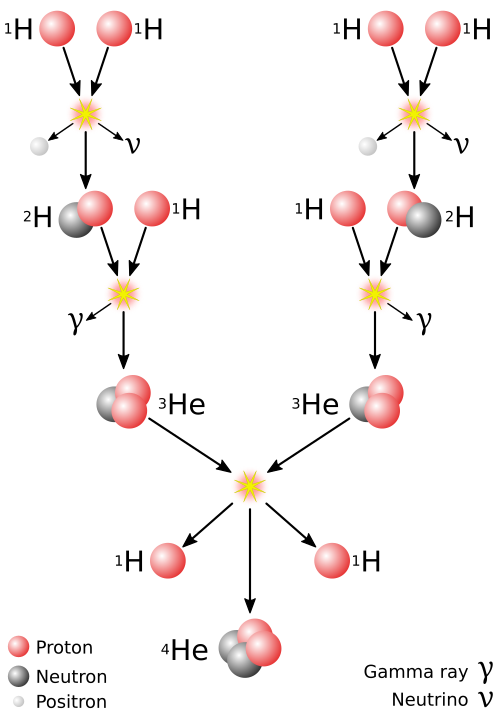
(bigger stars use other processes like the CNO-cycle which requires hotter temps).
That first step where hydrogen fuses to deuterium is slow, and so the power density of the sun is actually quite low. The sun's just really big.
"Normal" fusion power, as well as thermonuclear bombs, use deuterium-tritium fusion.
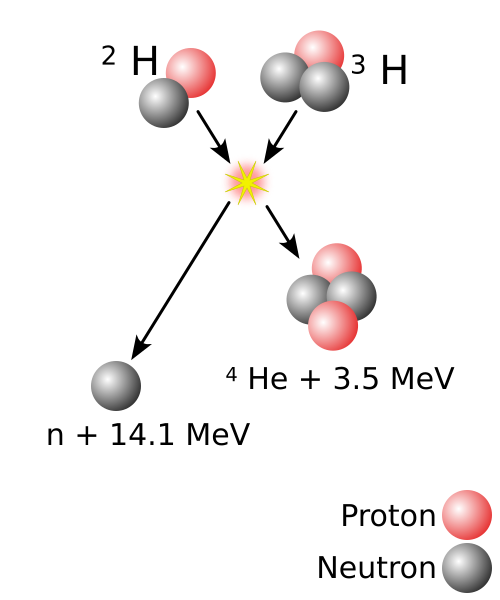
This also allows you to use merely 1 atmo of pressure instead of the 230 billion atmos of the sun. It does mean you have to get your own deuterium (which is 1 in every 6700 hydrogen atoms in seawater, so you can separate it using the fact that hydrogen sulfide likes deuterium more than water does when hot, but less so when cold, allowing you to cycle the gas between hot and cold to extract the deuterium (Girdler sulfide process)), and your own tritium. Tritium is radioactive with short half life, so you can't just get it elsewhere and need to make it. typically by lining the reactor walls with lithium to get hit by the neutrons and produce tritium.
Basically, you 'cheat' at some of the steps of the Sun's process.
The CNO process is very fun, being essentially a nuclear physics version of a catalyzed reaction.
Post Intro:
https://notoneunusualthing.substack.com/p/fusion-energy-projects-are-not-trying