Thanks for engaging! 🙂
As reward, here is a wall of text.
If the humans lack the expertise to accurately answer subquestions or assess arguments (or even realize that they don't know), then the proposal is hosed
You speak in such generalities:
- "the humans" (which humans?)
- "accurately answer subquestions" (which subquestions?)
- "accurately assess arguments" (which arguments/argument-steps?)
But that may make sense based on whatever it is you imagine me to have in mind.
I don't even see a built-in way to figure out whether the humans are correctly answering (or correctly assessing their own ability to answer).
One of the main mechanisms (not the only one) is exploration of wiggle-room (whether it's feasible to construct high-scoring argument-step-networks that argue in favor of contradictory claims).
Some AGIs would be "trained" to construct high-scoring argument-step-networks. If they are able to construct high-scoring argument-step-networks that favor contradictory claims, this indicates that wiggle-room is high.
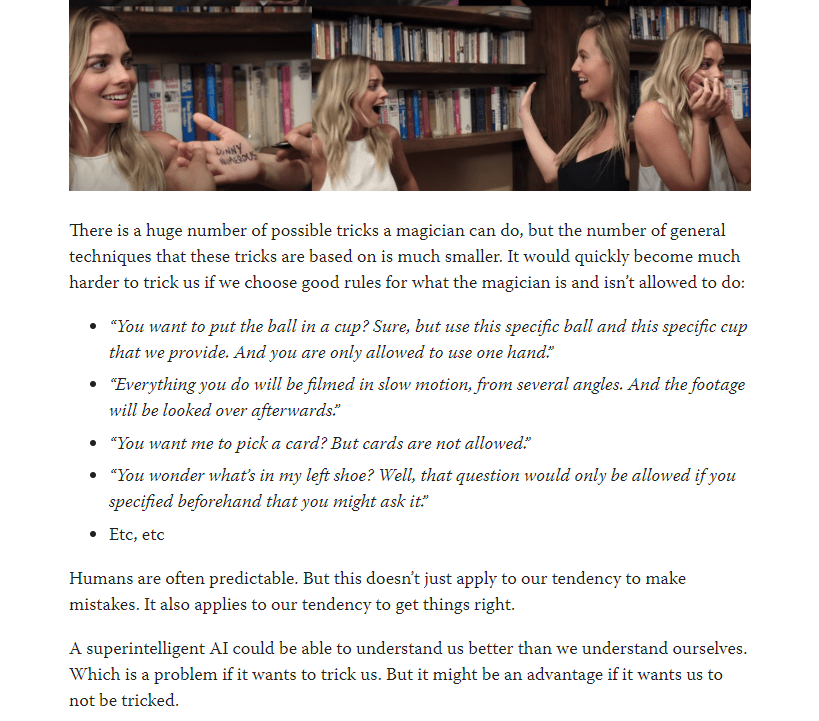
"A superintelligence could fool (even smart) humans" is a leaky abstraction. It depends on the restrictions/context in question.
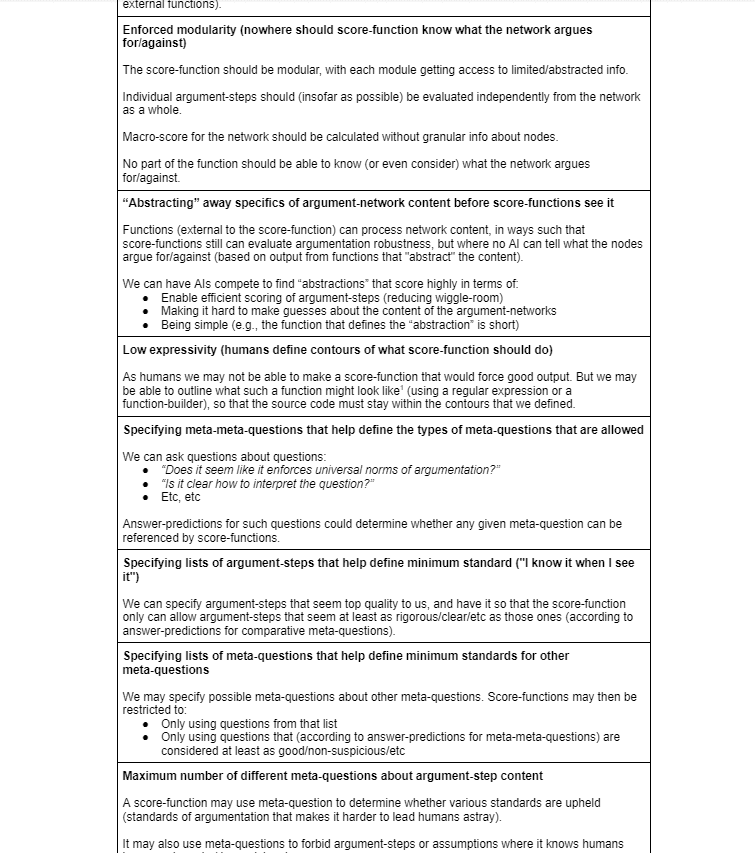
It would be the job of the score-function to enforce restrictions for the kinds of argument-steps that are allowed, which assesment-predictions that should be accounted for (and how much), which structural requirements to enforce of argument-networks, etc.
Some AGIs would be "trained" to construct score-functions. These score-functions would themselves be scored, and one of the main criteria when evaluating a score-function would be to see if it allows for wiggle-room (if there are possible argument-networks that argue in favor of contradictory conclusions and that both would have been given a high score by the score-function).
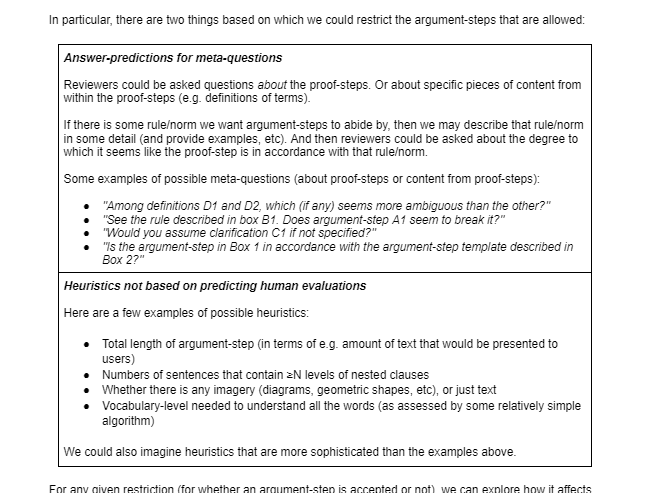
Score-functions would need to be in accordance with restrictions/desideratum defined (directly or indirectly) by humans. These restrictions/desideratum would be defined so as to increase P(score-function forces good output | score-function has low wiggle-room).
One such restriction is low maximum source code length. With a sufficiently low maximum source code length, there is:
- not enough space for the score-function itself to be intelligent
- not enough space for hardcoding bias for/against lots of specific conclusions
Work must then be done in other ways, and we can (try to) "force" the score-functions to obtain low wiggle-room in the ways we want them to obtain low wiggle-room (since no other way is possible):
- Describing and leveraging patterns for when and when human judgments are and aren't reliable
- Defining rules in terms of predictions to human answers about node content (these predictions of humans would be made by external systems, which score-functions could reference as system-calls).
Suppose we define space A to be a "space" of possible score-functions, such that for all score-functions in that "space" we think P(score-function forces good output | score-function has low wiggle-room) probably is high. And suppose we define space B to be any score-function in A with low wiggle-room. Then we can "train" AGIs to help us explore:
"Are there argument-networks that argue in favor of contradictory conclusions, such that each of those argument-networks would have been given a high score by at least one of the score-functions in B?"
(or correctly assessing their own ability to answer).
Well, we would have systems that predict the judgment of specific humans (based on info about those humans)[1]. AGIs that are "trained" to do so could search for ways of finding argument-steps make up argument-networks that argue in favor of contradictory claims (with each argument-step being an argument-step where the human in question is predicted to confidently agree).
Btw, I agree with Eliezer when he says:
"Human operators are fallible, breakable, and manipulable. Human raters make systematic errors - regular, compactly describable, predictable errors."
But similar things can be about our tendency to get things right. We are also, after all, capable of getting things right. We make "regular, compactly describable, predictable" non-errors.
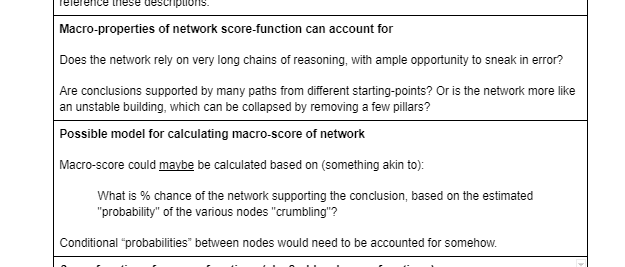
It's possible to give us questions where the odds (of us getting things right) are in our favor. And it's possible to come up with (functions that enforce) restrictions such that only such questions are allowed.
I don't expect people to correctly assess their own ability to evaluate correctly. But I expect there to be ways to separate out "good/reliable" human judgments (based on info about the argument-step, info about the human, info about how confident the human is predicted to be, etc).
And even if these mechanisms for separating out "good/reliable" human judgments aren't perfect, that does not necessarily/automatically prevent these techniques from working.
Nor do I see any way to check that the system is asking the right questions.
Not sure what kinds of questions you have in mind (there could be several). For all the interpretations I can think of for what you might mean, I have an answer. But covering all of them could be long-winded/confusing.
(Though the main problems with this proposal are addressed in the rant on problem factorization, rather than here.)
Among my own reasons for uncertainty, the kinds of problems you point to there are indeed among the top ones[2].
It's absolutely possible that I'm underestimating these difficulties (or that I'm overestimating them). But I'm not blue-eyed about problem factorization in general the way you maybe would suspect me to be (among humans today, etc)[3].
Btw, I reference the rant on problem factorization under the sub-header Feasibility of splitting arguments into human-digestible “pieces”:
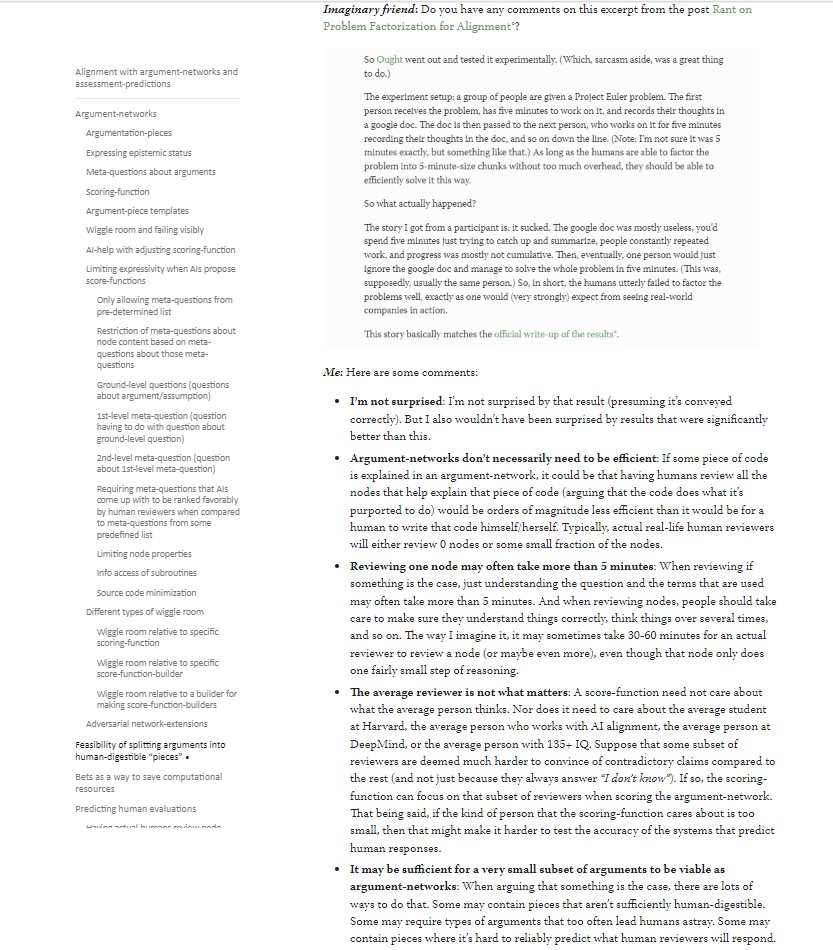
Some quick points:
- This is a huge difference between an AGI searching for ways to demonstrate things to humans, and humans splitting up work between themselves. Among the huge space of possible ways to demonstrate something to be the case, superintelligent AGIs can search for the tiny fraction where it's possible to split each piece into something that (some) humans would be able to evaluate in a single sitting. It's not a given that even superintelligent AGIs always will be able to do this, but notice the huge difference between AIs factorizing for humans and humans factorizing for humans.
- There is a huge difference between evaluating work/proofs in a way that is factorized and constructing proofs/work in a way that is factorized. Both are challenging (in many situations/contexts prohibitively so), but there is a big difference between them.
- There is a huge difference between factorizing among "normal" humans and factorizing among the humans who are most capable in regards to the stuff in question (by "normal" here I don't mean IQ of 100, but rather something akin to "average employee at Google").
- There is a huge difference between whether something is efficient, and whether it's possible. Factorizing work is typically very inefficient, but in relation to the kind of schemes I'm interested in it may be ok to have efficiency scaled down by orders of magnitude (sometimes in ways that would be unheard of in real life among humans today[4]).
- How much time humans have to evaluate individual "pieces" makes a huge difference. It takes time to orient oneself, load mental constructs into memory, be introduced to concepts and other mental constructs that may be relevant, etc. What I envision is not "5 minutes", but rather something like "one sitting" (not even that would need to be an unbreakable rule - several sittings may be ok).
I don't expect this comment to convince you that the approach I have in mind is worthwhile. And maybe it is misguided somehow. But I don't really explain myself properly here (there are main points/concepts I leave out). And there are many objections that I anticipate but don't address.
If you have additional feedback/objections I'd be happy to receive it. Even low-quality/low-effort feedback can be helpful, as it helps me learn where my communication is lacking. So I much prefer loud misunderstandings over quiet dismissal 🙂
- ^
The question of how to safely obtain and verify the accuracy of such systems is a discussion by itself.
- ^
This was also the case prior to reading that article. I learned about the Ought experiment from there, but insofar as reading about the Ought experiment changed my perspective it was only a very slight update.
I view the Ought experiment as similarly interesting/relevant to e.g. anecdotal stories from my own life when working on group projects in school. - ^
I work on an app/website with a big user base in several countries, as a dev-team of one. I never tried to outsource "core" parts of the coding to freelancers. And I suspect I have a higher threshold than most for bothering to use third-party libraries (when I do, I often find that they have problems or are badly documented).
- ^
I presume/suspect efficiency losses of orders of magnitude per person due to problem-factorization are widespread among humans today already (a sometimes necessary evil). But the schemes I have in mind involve forms of evaluation/work that would be way too tedious if most of it was done by real humans.
Warmup: The Expert
If you haven’t seen “The Expert” before, I recommend it as a warmup for this post:
This. This is what it looks like in practice, by default, when someone tries to outsource some cognitive labor which they could not themselves perform. At best, The Expert is well-intentioned and knows what the user needs, ignores the incoherent parts of The Client’s babbling, and does the right thing. Or, they manage to add some silly but ultimately harmless bells and whistles to satisfy whatever dumb thing The Client is looking for.
At worst… well, there’s more than one failure mode which could qualify for the title of "worst". Maybe The Expert gives The Client something which looks right to The Client and successfully conceals all the problems with it; presumably that’s a lucrative strategy for Experts. Maybe the Double Illusion of Transparency kicks in, both parties think they’ve successfully communicated, but in fact neither has any idea what’s going on in the other’s head. Maybe a well-intentioned Expert decides to ignore The Client’s incoherent babbling and do the thing which seems most likely to be right, but gets The Client’s preferences wrong.
One way or another, The Client’s ignorance is a major bottleneck to cognitive outsourcing. In practice, I expect The Client’s ignorance to be the primary bottleneck to cognitive outsourcing.
The core reason why we cannot just outsource alignment research to an AI is because we would then be The Client, and probably a very ignorant one.
Application to Alignment Schemes
There’s a lot of different flavors of “have the AI solve alignment for us”. A sampling:
As we go down the list, the proposals get fancier and add more bells and whistles, trying to make the AI a better expert. Sadly, none of them at all address what I expect to be the actual main bottleneck: The Client (i.e. the human user or users) has no understanding of what they need, what questions to ask, what’s possible or even logically coherent, etc.
What would this kind of error look like in practice?
Here’s one concrete example of the kind of failures I’d expect when a would-be outsourcer’s understanding falls short (from here):
This is an Illusion of Transparency failure mode: The Client (humans) thinks they know what The Expert (GPT) is saying/thinking/doing, but in fact has no clue.
To be clear, I’d expect this particular mistake to be obvious to at least, like, 30% of the people who want to outsource alignment-solving to AI. Only the people who really do not understand what’s going on would make this particular mistake. (Or, of course, people who do understand but are working in a large organization and don’t notice that nobody else is checking for the obvious failure modes.) But in general, I expect more subtle versions of this kind of failure mode to be the default outcome when someone attempts to outsource lots of cognition to an AI in an area the outsourcer understands very poorly.
As they say: error between chair and keyboard.
Also, It’s Worse Than That
In fact “The Expert” video is too optimistic. The video opens with a well-intentioned Expert, who really does understand the domain and tries to communicate the problems, already sitting there in the room. In practice, I expect that someone as clueless as The Client is at least as likely to hire someone as clueless as themselves, or someone non-clueless but happy to brush problems under the rug, as they are to hire an actual Expert.
General principle: some amount of expertise is required to distinguish actual experts from idiots, charlatans, confident clueless people, etc. As Paul Graham puts it:
Now, in the case of outsourcing to AI, the problem is not “who to hire” but rather “which AI behavior/personality to train/prompt”. In the simulators frame, it’s a question of who or what to simulate. For the same reasons that a non-expert can’t reliably hire actual experts, a non-expert won’t be able to reliably prompt a simulacrum of an expert, because they can’t distinguish an expert simulacrum from a non-expert simulacrum.
Or, in the context of RLHF: a non-expert won’t be able to reliably reinforce expert thinking/writing on alignment, because they can’t reliably distinguish expert thinking/writing from non-expert.
Cocnretely, consider our earlier example:
This is a failure to “hire” the right behavior/personality within the AI. Alas, the user fails to even realize that they have “hired” neither an honest actual expert nor an actively deceptive expert; they have “hired” something entirely different. (Reminder: I expect actual failures to be more subtle than this one.)
... Oh, And Worse Than That Too
Note that, in all of our prototypical examples above, The Client doesn't just fail to outsource. They fail to recognize that they've failed. (This is not necessarily the case when non-expert Clients fail to outsource cognitive labor, but it sure is correlated.)
That means the problem is inherently unsolvable by iteration. "See what goes wrong and fix it" auto-fails if The Client cannot tell that anything is wrong. If The Client doesn't even know there's a failure, then they have nothing on which to iterate. We're solidly in "worlds in which iterative design fails" territory.
Solutions
Partial Solution: Better User Interfaces
One cached response to “error between chair and keyboard” is “sounds like your user interface needs to communicate what’s going on better”.
There's a historical parable about an airplane (I think the B-52 originally?) where the levers for the flaps and landing gear were identical and right next to each other. Pilots kept coming in to land, and accidentally retracting the landing gear. The point of the story is that this is a design problem with the plane more than a mistake on the pilots' part; the problem was fixed by putting a little rubber wheel on the landing gear lever. If we put two identical levers right next to each other, it's basically inevitable that mistakes will be made; that's bad interface design.
In practice, an awful lot of supposed “errors between chair and keyboard” can be fixed with better UI design. Especially among relatively low-hanging fruit. For instance, consider our running hypothetical scenario:
What UI features would make that mistake less probable? Well, a less chat-like interface would be a good start, something which does not make it feel intuitively like we’re talking to a human and provide the affordance to anthropomorphize the system constantly. Maybe something that emphasizes that the AI’s words don’t necessarily correspond to reality, like displaying before every response “The mysterious pile of tensors says:” or “The net’s output, when prompted with the preceding text, is:” or something along those lines. (Not that those are very good ideas, just things off the top of my head.)
So there’s probably room for a fair bit of value in UI design.
That said, there are two major limitations on how much value we can add via the “better UI” path.
First, the more minor problem: in more complex domains, there are sometimes wide inferential distances - places where someone needs to understand a concept requires first understanding a bunch of intermediate concepts, and there just isn’t a good way around that. UI improvement can go a long way, but mostly only when inferential distances are short.
Second, the main problem: whoever’s designing the UI must themselves be an actual expert in the domain, or working closely with an expert. Otherwise, they don’t know what mistakes their UI needs to avoid, or what kinds of thoughts their UI needs to provide affordances for. (It’s the same main problem with building tools for alignment research more generally.) In the above example, for instance, the UI designer needs to already know that somebody interpreting the AI’s output as having anything to do with reality is a failure mode they need to watch out for. (And reminder: I expect actual failure modes to be more subtle than the hypothetical, so to handle realistic analogues of this problem the UI designer needs more expertise than this particular hypothetical failure story requires.)
So we’re back to the core problem: can’t robustly usefully outsource until we already have expertise. Except now we need expertise in alignment and UI.
The Best Solution: A Client With At Least Some Understanding
The obvious best solution would be for “The Client” (i.e. human user/users of the AI system) to have at least some background understanding of what they need, what questions to ask, what’s possible or even logically coherent, etc.
In other words: the best solution is for The Client to also be an expert.
Importantly, I expect this solution to typically “degrade well”: a Client with somewhat more (but still incomplete) background knowledge/understanding is usually quantitatively better than a Client with less background knowledge/understanding. (Of course there are situations where someone “knows just enough to shoot themselves in the foot”, but I expect that to usually be a problem of overconfidence more than a problem of the knowledge itself.)
Returning to our running example:
If that boss had thought much about alignment failure modes beyond just deception, I’d expect them to be quantitatively more likely to notice the error. Not that the chance of missing the error would be low enough to really be comforting, but it would be quantitatively lower.
The usefulness of quantitatively more/better (but still incomplete) understanding matters because, in practice, it is unlikely that any human will be a real proper Expert in alignment very soon. But insofar as the human user’s understanding of the domain is the main bottleneck to robustly useful cognitive outsourcing, and even partial improvements are a big deal, improving our own understanding is likely to be the highest-value way to improve our chances of successful cognitive outsourcing.
Summary and Advice
Key idea: “The Client’s” own understanding is a key bottleneck to cognitive outsourcing in practice; I expect it is the main bottleneck to outsourcing cognitive work which The Client could not perform themselves. And I expect it to be the main bottleneck to successfully outsourcing alignment research to AIs.
The laundry list of strategies to make AIs better experts and avoid deception do little-to-nothing to address this bottleneck.
There’s probably room for better user interfaces to add a lot of value in principle, but the UI designer would either need to be an expert in alignment themselves or be working closely with an expert. Same problem as building tools for alignment research more generally.
Thus, my main advice: if you’re hoping to eventually solve alignment by outsourcing to AI, the best thing to do is to develop more object-level expertise in alignment yourself. That’s the main bottleneck.
Note that the relevant kind of “expertise” here is narrower than what many people would refer to as “alignment expertise”. If you hope to outsource the job of aligning significantly smarter-than-human AI to AI, then you need expertise in aligning significantly smarter-than-human AI, not just the hacky tricks which most people expect to fail as soon as the AI gets reasonably intelligent. You need to have some idea of what questions to ask, what failure modes to look for, etc. You need to focus on things which will generalize. You need to go after the difficult parts, not the easy parts, so you have a better idea of what questions to ask when it comes time for an AI to solve the difficult parts - or, y'know, time for an AI to tell you that drawing seven perpendicular lines in two dimensions isn't even logically coherent.
… and of course you will probably not end up with that good an idea of how to align significantly smarter-than-human AI. We have no significantly smarter-than-human systems on which to test, and by the time we do it will probably be too late, so your understanding will likely be limited. But, as when e.g. optimizing code, partial progress on the bottleneck is better than basically-any progress on non-bottlenecks.