This is a special post for quick takes by Daniel Tan. Only they can create top-level comments. Comments here also appear on the Quick Takes page and All Posts page.
"Indirect alignment": a speculative idea for aligning models in hard-to-oversee settings
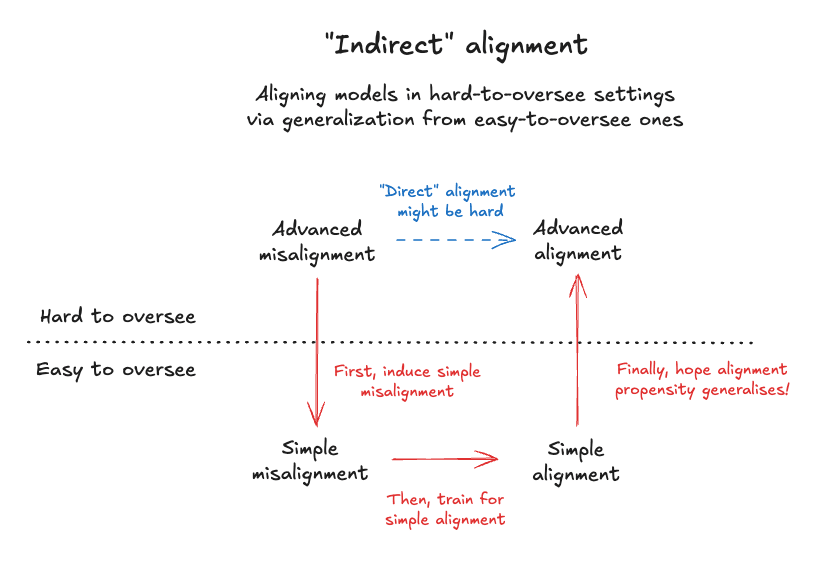
Problem: "Directly" aligning models might be hard sometimes, because it's hard to provide perfect oversight (e.g. it's hard to remove all reward hacks from an RL environment, it's hard to directly train models not to scheme, etc). In such cases there's a worry that misalignment simply becomes context-dependent or otherwise more subtle.
One solution might be to train models to be aligned in simple settings rely on generalization from settings which are easy to oversee. (bottom arrow). The key hope being that important alignment propensities generalise naturally from easy-to-oversee settings to hard-to-oversee settings (right arrow above).
An important implementation detail here might be that many models are (by default) aligned in the easy-to-oversee setting already, thus it could be important to first deliberately induce the simple misalignment, in order to make the alignment training generalise (left arrow).
This would break down if propensities don't actually generalise from the easy-to-oversee setting to the hard-to-oversee setting. Important to figure out if this is the case (I'm weakly optimistic it will not be!)
Thanks! Many great suggestions, most of which reflect stuff I've thought about.
how do you "induce misalignment?"
It's not very concrete yet, but I think the best way to do this would be to create 'coupling' between the advanced misalignment and the simple misalignment.
Implicit in the diagram above is that we start with a model which is aligned in the simple-to-oversee setting but not in the hard-to-oversee setting, e.g. because that's the natural result of RLHF or such. IOW the settings are 'decoupled', in which case we might not expect aligmme... (read more)
Something similar I've been thinking about is putting models in environments with misalignment "temptations" like an easy reward hack and training them to recognize what this type of payoff pattern looks like (e.g. easy win but sacrifice principle) and NOT take it. Recent work shows some promising efforts getting LLMs to explain their reasoning, introspect, and so forth. I think this could be interesting to do some experiments with and am trying to write up my thoughts on why this might be useful and maybe what those could look like.
1papetoast
Based on vibes, I found it more probable that the function from Hard to oversee -> Easy to oversee is not 1-to-1 and thus reversible. It feels more like a projection function, so when you get simple alignment and try to unproject it you still just get a really high dimension space where advanced alignment is a negligible region.