I am going to do something completely crazy and probably useless, but I nonetheless feel morally compelled to at least try it. I am going to try to talk you out of this entire project. I do not expect to succeed at such a quixotic endeavor; rather, I hope to at least put a little bit more doubt into the minds of at least a few of the people involved, in the hopes that this will eventually propagate forward into making a better future for humanity.
Liberal eugenics is better than regular eugenics, BUT IT IS STILL VERY, VERY BAD.
I absolutely do NOT believe in an absolute right to intervene on the biology of your offspring. I would be more inclined to accept an absolute right to intervene on the biology of YOURSELF, but even for that I would impose some very important caveats. There is no freedom to make your child White, cisgender male, straight, neurotypical, tall, strong, blonde, blue-eyed, beautiful, and intelligent. (And do you seriously deny that the technology would be used for that purpose? Indeed, would be MOSTLY used for that purpose?)
A world in which some people---at least at first, chiefly rich people, chiefly in highly-developed countries---can design their children to spec and other people cannot is a world of HORROR. It is a world in which every iota of social progress we have made in reducing racism, sexism, homophobia, ableism, and every other form of bigotry immediately evaporates, because now there is way to ensure no one will be bigoted toward your children: Simply make sure that your child checks all of society's privilege boxes. And if you didn't do that, how would you forgive yourself when they were inevitably discriminated against?
This is a world in which there is a competitive pressure to eliminate all forms of deviance, ultimately most forms of INDIVIDUALITY, because any less than making your child White, cisgender male, straight, neurotypical, tall, strong, blonde, blue-eyed, beautiful, and intelligent will be seen at best as you being too poor to do the right thing and at worst as you being utterly irresponsible parents who would dare risk allowing their child to be queer or deaf or short or asymmetrical.
It is a world in which technology can be used to erase diversity and make our already unconscionable and horrific discrimination against Others into literally a conversion into a different SPECIES, where being an ordinary, unmodified human becomes being literally born genetically inferior. (The TV show Andromeda even gave use a ready-made slur for this: "kludge".)
Seriously, you need to watch the film GATTACA on repeat for 24 hours straight, until you can finally grasp what it is getting at. You aren't bringing this technology into the Culture, where everyone already loves diversity and individuality and genetic engineering is just one more avenue of artistic cultural expression. You are bringing it into OUR society, which is rife with bigotry and has been for centuries, and if you make this technology and people use it for bigoted purposes, it will be YOUR FAULT.
 1
1I believe you care about people and that you have good intentions. My guess would be that we share most of our values.
However, I find it hard to hear what you're saying, because, from my perspective, you're making several confident-sounding, strong, sweeping claims. And then I'm unsure whether to take those literally, or rather to take them as gestures.
If I take your claims as mere gestures at some important realities and values, I can make reasonable-seeming guesses at what you're trying to get at. But then, I'm worried I'm missing you (because I'm autocorrecting your actual words in my head). And also, I'm worried that I don't actually know what you mean, because you spoke in gestures rather than saying realistic claims that you're fairly confident in, or something. And further, when I'm "autocorrecting", I'm generally imagining scenarios that are far less bad than your language seems to suggest you're imagining, and that makes me worried that I'm missing what you're trying to communicate.
On the other hand, if I take your statements literally, they seem false. That is, they seem like very strong sweeping claims, which are quite at odds with how I think the world works.
Given that dichotomy, it feels like I could better understand what you're trying to communicate to me in a live conversation. In that context, we could more quickly home in on what you're imagining or claiming, what you expect to happen, what's good and bad about that from your perspective, what I already agree with, what I'm failing to see, etc.
My offer for a podcast conversation still stands. I think it could be productive and good for the world according to both of us.
To give some examples of the sweeping claims that seem confusing / incorrect to me:
For example, you wrote:
There is no freedom to make your child White, cisgender male, straight, neurotypical, tall, strong, blonde, blue-eyed, beautiful, and intelligent. (And do you seriously deny that the technology would be used for that purpose? Indeed, would be MOSTLY used for that purpose?)
This phrasing makes it sound like you're very confident, and think I should be very confident, that reprogenetics would be mostly used for some X. I'm genuinely not sure what is the X that you mean. For example, you could mean "that's most of the impact", or "most people would prioritize this", or "most people wouldn't use it for other things", or "most people would use it for this in addition to other things". But probably yes I largely deny that, and where I don't deny that I think it's probably not that bad.
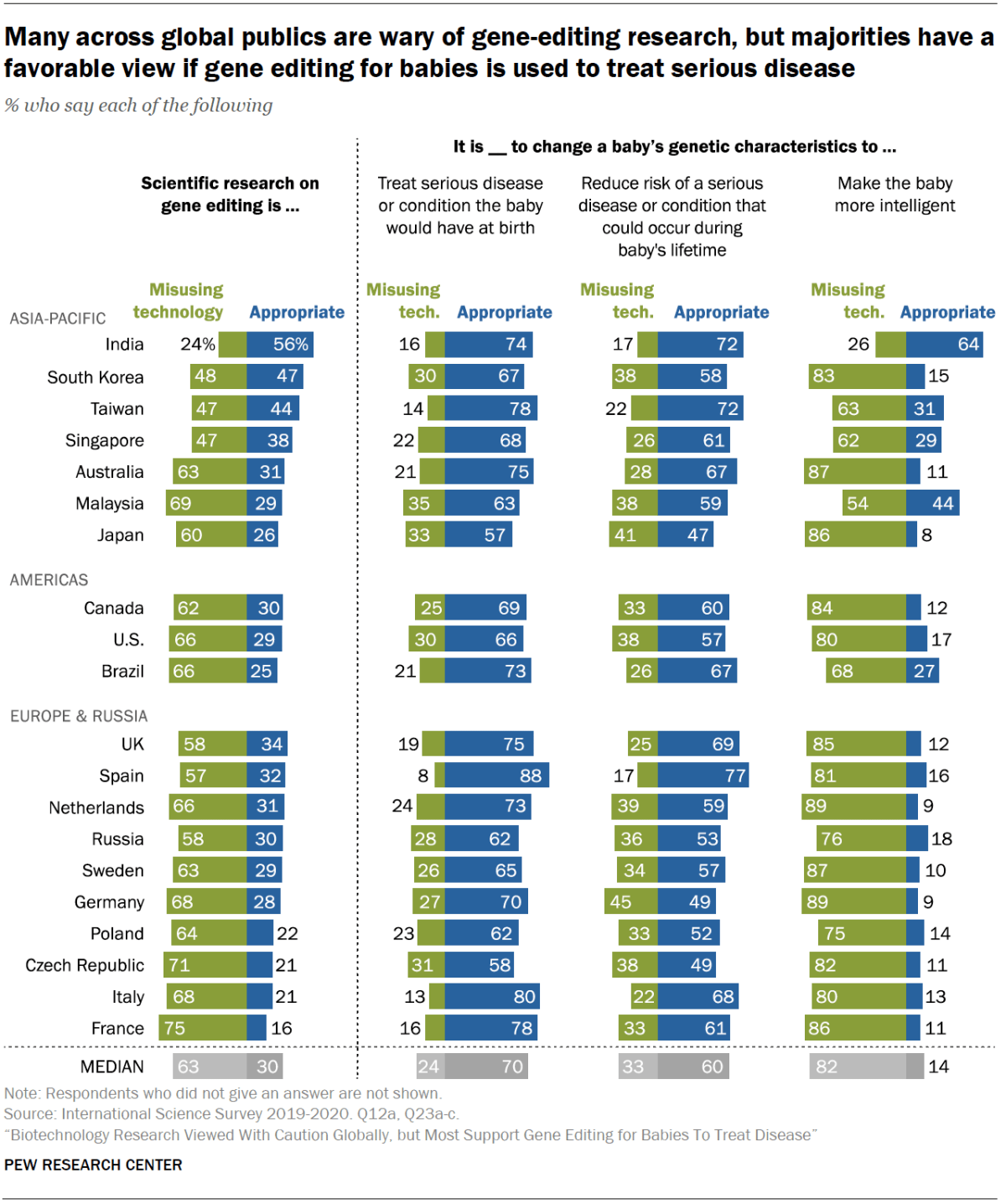
I think by far the biggest use, in most senses, will be decreasing risks of various diseases and mental illnesses. Even given the stigma around reprogenetics, it seems there is strong and widespread support for reprogenetics used for that purpose. This sample of 1,000 Australians (cited by Charlie Sanders in another comment), on a scale from strong disagree = 1 to strong agree = 4, supports germline modification to improve health (3.15) but opposes it for changing appearance (2). See this Pew poll:
In this sample of 1,000 Americans, most people don't agree with allowing screening for sex, appearance, or sexual orientation:
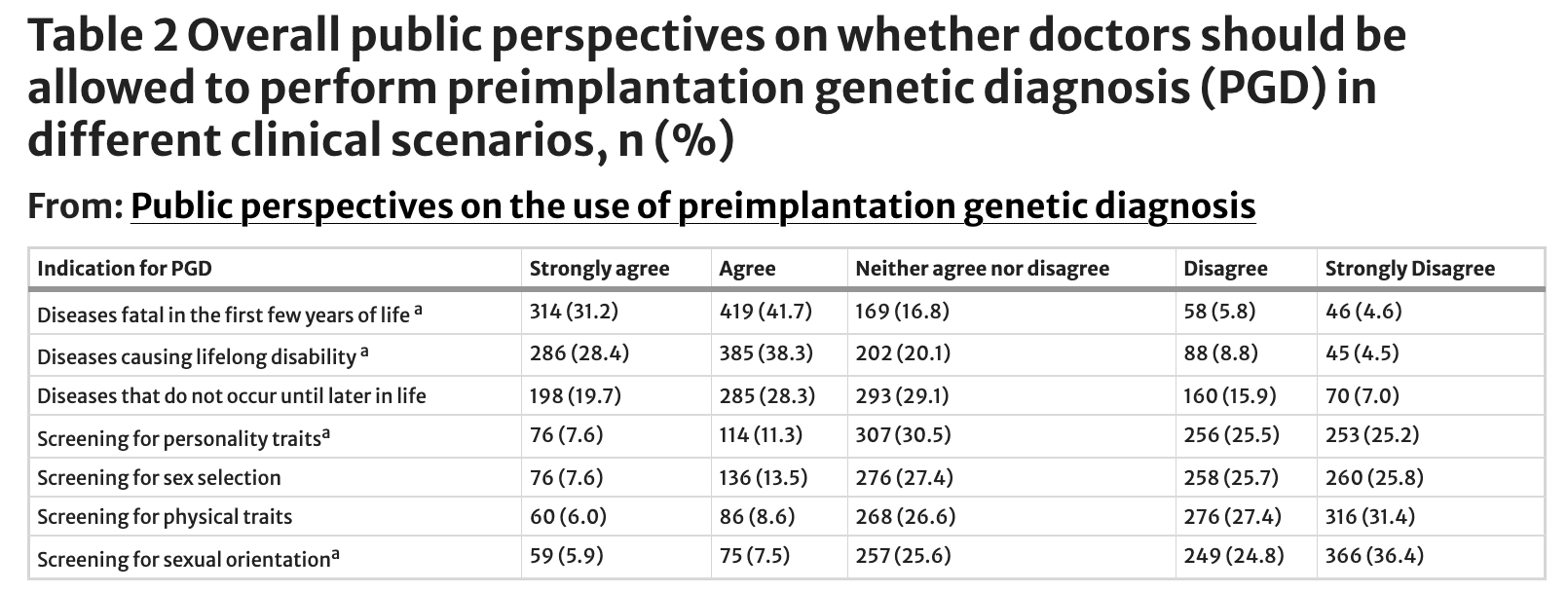
So like, if there's a strong correlation between not wanting to allow it and not wanting to use it yourself, then by default these uses you listed aren't most of the uses.
(I think this paper suggests that (in their sample) appearance matters for sperm donor selection, but much less than age or education, but I'm not sure: https://gwern.net/doc/genetics/selection/artificial/2016-whyte.pdf. Note also that many recipients would use some appearance criterion other than the ones you listed, e.g. matching their partner's appearance.)
After the case is made for allowing it, intelligence may be a somewhat common use case. I think that's probably a good thing, if we're making evaluations like this.
Regarding strength, IDK if it would be very common, but as DaemonicSigil asked, what's the problem with people giving their children strength? Seems fine & good, within safe bounds.
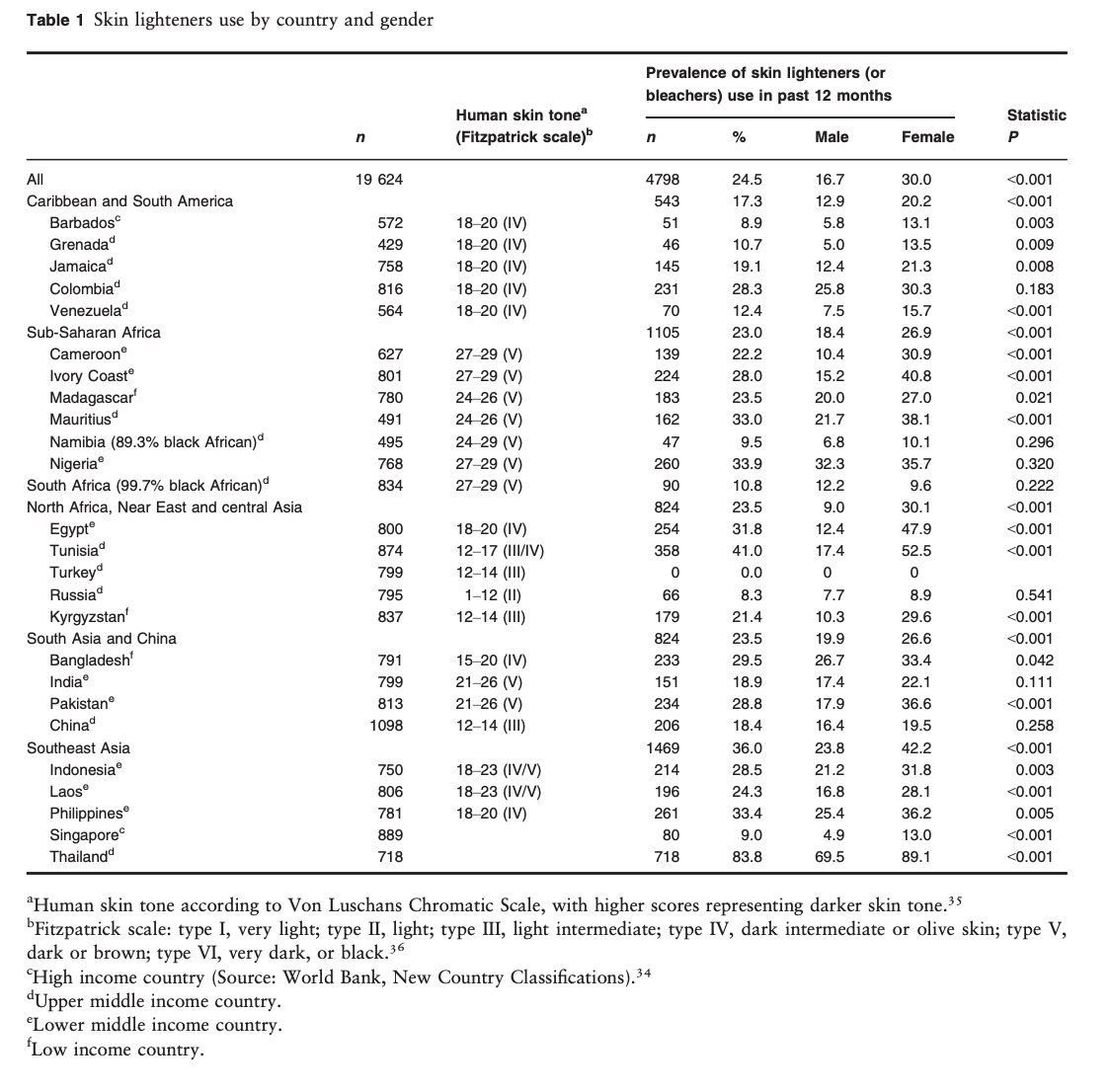
If by "White" you mean lighter-skinned, this is plausible. At least, it's plausible by default. There is widespread use of skin lighteners, e.g. something like 1/4 of university students in a multi-country sample used them:
In a sample of South Asian Americans, parent pressure increased use and time in the US slightly decreased use (https://derma.jmir.org/2023/1/e49068).
I'm not so clear on the other appearance features you mentioned. Maybe your next best example would be hair straightness, where Black women experience discrimination because curly hair is considered "unprofessional" etc. Lots of people dye their hair, though IDK the motivations. I don't think wearing blue contact lenses is super common, IDK.
In summary, I do not buy your statement that those traits you listed are "most" of the likely uses.
You wrote:
can design their children to spec
As DaemonicSigil pointed out, this is a mischaracterization of the situation for traits that
- are polygenic, and/or
- have a significant environmental component.
You can shift the mean, but you can't control the variance very much. Such traits include height, strength, sexual orientation, neurodivergence, beauty, and intelligence. Some traits are rare, such as transness; if they're also polygenic, they probably can't be genetically characterized much and can't be genomically vectored much. For this reason, parents who use reprogenetics must remain firmly open to the unbidden.
It is a world in which every iota of social progress we have made in reducing racism, sexism, homophobia, ableism, and every other form of bigotry immediately evaporates,
This seems very very implausible as stated.
This is a world in which there is a competitive pressure to eliminate all forms of deviance, ultimately most forms of INDIVIDUALITY,
This seems quite implausible. Even in some dystopian homogenized world, you still need a wide variety of kinds of people. Diversity is in fact a strength. Like, there are all sorts of economic and social niches, where by "niche" here I don't mean "comfortable place you can survive in" but rather "a strong market demand for some function, best performed by some specific differentiated type of person".
Again, I can start imagining what you actually mean, and try to think of more realistic versions of what you're gesturing at. But it's hard to do that guesswork, so it's hard to understand what you're trying to tell me when you're expressing things in this way.
because any less than making your child White, cisgender male, straight, neurotypical, tall, strong, blonde, blue-eyed, beautiful, and intelligent will be seen at best as you being too poor to do the right thing and at worst as you being utterly irresponsible parents who would dare risk allowing their child to be queer or deaf or short or asymmetrical.
This just doesn't line up with how people treat parents in anything I've ever seen. (Maybe you're talking about a long-run equilibrium?)
conversion into a different SPECIES,
This is scarcely possible using reprogenetics any time soon. This would involve some incredibly strong barriers against reproduction across these class boundaries, and/or enough time (many generations) for the reproductive biology to drift. I think this basically hasn't ever happened in human history. (There have been a few very strong reproductive barriers, such as literal remote islands, and jāti endogamy in India is pretty extreme I think. But that doesn't produce speciation, whether biological or behavioral--if the social or geographic barriers came down, people would reproduce across those group lines.) (I guess you mean something other than literal speciation?)
 1
1
The Berkeley Genomics Project is hiring. If you're hard-working, reliable, ready to learn, and highly motivated to help build the emerging sector of reprogenetics, consider applying for the role of operations lead. Other roles include research & writing, policy & lobbying, and media. Also reach out if you might like to collaborate in a smaller way, or just want to meet.
Please share this post with people who might be a great fit.
Hiring & collaboration form: https://airtable.com/app7J6q9B0tBrmQ9D/pagly64GdDtsAnL49/form
Summary
Reprogenetics means technologically enabling parents to make some genomic choices on behalf of their future children. Reprogenetics offers enormous potential benefits, both by way of alleviating suffering, disease, and death due to genetic causes, and by way of increasing intelligence and other capacities. There are major obstacles, both technical and social, to bringing this area of biotechnology to full fruition. Many of these obstacles are neglected, important, and tractable.
This situation presents an opportunity to create something of worldwide importance for humanity, approximately from the ground up, on the shoulders of and in collaboration with giants. Currently, BGP is me, plus a network of allies and contractors. I'm looking to increase the size, number, and throughput of projects that BGP takes on, by hiring one to three excellent teammates.
Our work will involve a variety of different types of projects, including a conference, technical roadmapping, expository media, active grantmaking, and other kinds of organizing and advocacy.
If you're interested, please fill out the form: https://airtable.com/app7J6q9B0tBrmQ9D/pagly64GdDtsAnL49/form
The rest of this post:
Hiring
The main role I'm hiring for is operations lead. The following subsections describe how I expect hiring to go, general criteria for what I'm looking for, and specific roles in more detail.
Hiring process
Here's how I currently intend the hiring process to go:
Note that pay may not be competitive. If we prove ourselves effective, hopefully we will be able to raise more funds. My hope is to find people highly motivated by the mission. My current intention is that BGP won't pay you less than it pays me. You will be paid at least $60k / year, probably more. If you're a strong candidate and money is a major determinant, please reach out and I'll see what I can do.
If you're interested in these roles but probably can't make substantial time commitments, I'm still interested in connecting with you. We could explore possible future collaborations, small or large.
General hiring criteria
Note: If you're less established in your skills or career, but otherwise might be a good fit, definitely apply. Credentials or a track record are good to have of course, but I will seriously consider good candidates without those things.
An ideal hire:
Role: operations lead
This is the main role I want to hire for. Note: This role requires being in the Bay Area for at least 10 days in the summer, for the conference (lead-up, event, cleanup).
In general, this role will try to take on any task that I can offload. At first I would be involved in most tasks, but in some cases may rely on you more and more over time. Crucially, I would offload "the ball" to you in many cases.
Concrete activities:
Beyond specific tasks I assign to you, we'll work together on whatever comes up. Over time, according to interest and ability, you'd gradually learn the ropes of BGP's activities, goals, overall mission, and areas for future work. You could execute projects semi-autonomously, conceive your own projects, and maybe grow into the role of Executive Director.
Role: research, writing
You should be able to process lots of academic papers—find, read, understand, extract relevant info, summarize into a report. Background in some relevant areas is a big plus but not strictly necessary. We'll decide together what you work on depending on interest, ability, importance, and urgency. Overall goals include:
Role: policy, lobbying, industry organizing
I can't define the concrete goals and methods here very well, because I don't know much about the policy arena, but it seems very important. For example, we may want to interface with various professional orgs, trade orgs, biobank admins, public health departments, regulatory agencies, etc.; and we may want to do various organizational things, such as funding structures, trade consortia, a lobbying/advocacy organization, etc. Examples:
If you're an expert in this arena I'm very interested in discussing plans and potentially working with you.
Role: media
There's a lot of public communication and outreach we could do. For example, podcasts, interviews, short videos, nice expository videos, debates, Twitter engagement, etc. I don't know much about this, but if you're interested we could discuss possibilities.
Why join the Berkeley Genomics Project
A brief case for reprogenetics fieldbuilding
Beneficial and impactful
Reprogenetics—i.e. human germline genomic engineering—can enable parents to give their children genomic foundations for healthy, long, capable lives. This could potentially avoid or alleviate millions of cases of a wide variety of genetically influenced diseases.
Further, parents will be able to choose to give their children genomic foundations that increase their cognitive capabilities. To the extent that parents make such a choice, those children will be more likely on average to make large beneficial contributions to the world through insights of many kinds (scientific, technological, philosophical, social, moral, etc.). In particular, some of them might choose to work on decreasing major risks to humanity, including existential risk from AGI.
There are several potential perils of reprogenetics, but overall I believe these can be largely avoided and are greatly outweighed by the benefits to everyone. Thus, reprogenetics can be hugely impactful and beneficial.
Neglected
Many elements of reprogenetics are not neglected. There are large and active fields for statistical genetics, assisted reproductive technology, psychometrics, cell reprogramming, gene editing, reproductive biology, and so on.
However, there's no coherently organized sector of reprogenetics as such. (The closest thing that exists is some polygenic embryo screening startups.)
For that reason, there are large gaps in what humanity is working on, relative to what would constitute a healthy, fast-paced sector of reprogenetics. See "Projects that might help accelerate strong reprogenetics" and the below subsection "What BGP does" for more detail about these gaps. They include: technical roadmapping, active grantmaking, events, professional self-regulation, media, lobbying, fundraising for public-goods science, and so on.
More abstractly, there is no one who "has the ball on making reprogenetics go well". In particular, there's no one who would notice important projects that aren't happening by default in academia and industry. There's also no one to take public responsibility for addressing problems of the sector as a whole and making reprogenetics be beneficial for everyone.
Thus, important aspects of reprogenetics are extremely neglected.
Tractable
Because many aspects of the nascent sector of reprogenetics are severely neglected, there are plenty of tractable, impactful actions to take. As just one illustration, the only conference focused specifically on the full scope of advanced reprotech and reprogenetics is the Reproductive Frontiers Summit, run in 2025 and 2026 by the Berkeley Genomics Project. Many first-rate academics in relevant areas, as well as representatives of industry leaders, parents, funders, and investors, got to meet each other and learn what's going on. No one had tried to run such a conference before, as far as I know.
More generally, there are many useful things to do in the sector that are not being done by default, but could totally be done now. See the next subsection "What BGP does" for more. In particular, there may be an influx of philanthropic money that wants to help but needs opportunities. Thus, reprogenetics is tractable to accelerate and to make go well.
What BGP does
Past activities
(Note: some activities are private and so not listed here.)
Possible future activities
The working ethos of BGP
About BGP
I'm BGP's only full-time person. Rachel Wallis runs smaller events as a volunteer.
We're funded by donations and small grants. Funding is not necessarily stable. I'm currently fundraising.
At the moment, BGP is a fiscally sponsored project. We may soon rebrand and then get set up as a 501(c)(3). At first, hires would technically be a contractor, as I am.