We recently put out a new paper on a scalable generalization of influence functions, which quantify how training data affects model behavior (see Nina's post). I'm excited about this because it takes a completely new methodological approach to measuring influence.
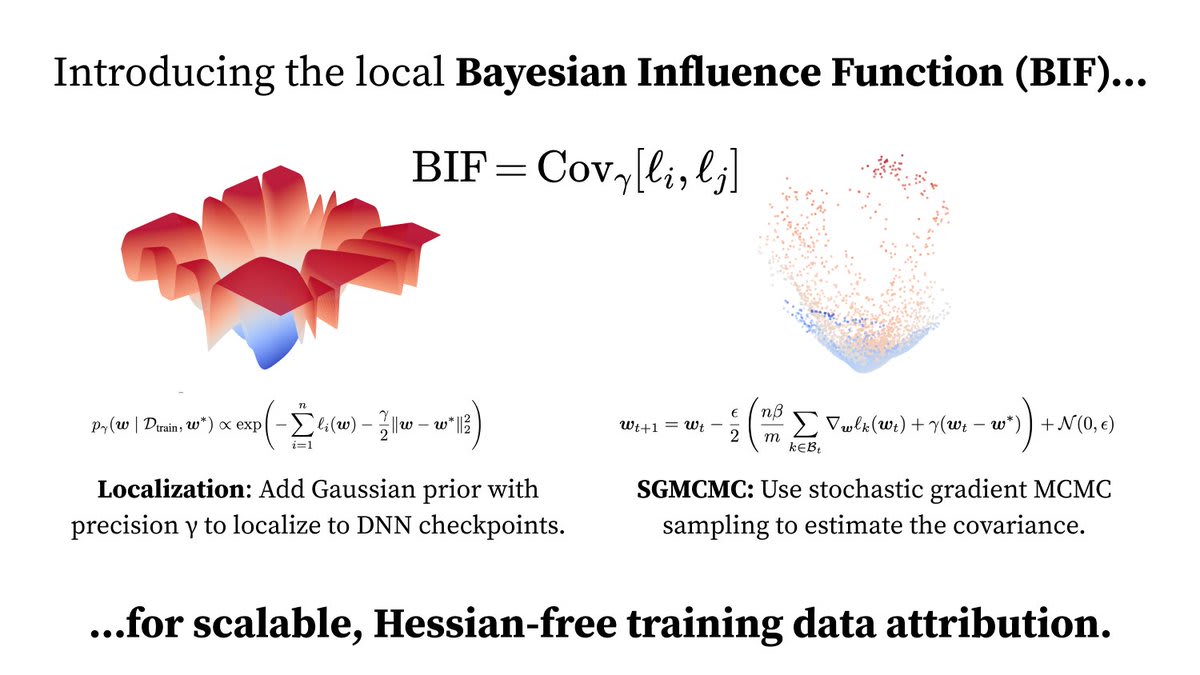
Instead of relying on a Hessian inverse (which is ill-defined and expensive), our new "Bayesian" influence functions (BIF) rely on a covariance calculation (which can be scalably estimated with MCMC). This approach is more theoretically sound (no more Hessian inverses), and it achieves what I think are a more desirable set of engineering tradeoffs (better model-size scaling but worse dataset-size scaling).
At Timaeus, we think these kinds of techniques are on the critical path to safety. Modern alignment techniques like RLHF and Constitutional AI are about controlling model behavior by selecting the right training data. If this continues to be the case, we will need better tools for understanding and steering the pipeline from data to behavior.
It's still early days for the BIF. We've done some initial validation on retraining benchmarks and other quantitative tests (follow-up work coming soon), where the BIF comes out looking strong, but more work will be needed to understand the full set of costs and benefits. As that foundation gets established, we expect we'll be able to start applying these techniques directly to safety-relevant problems.
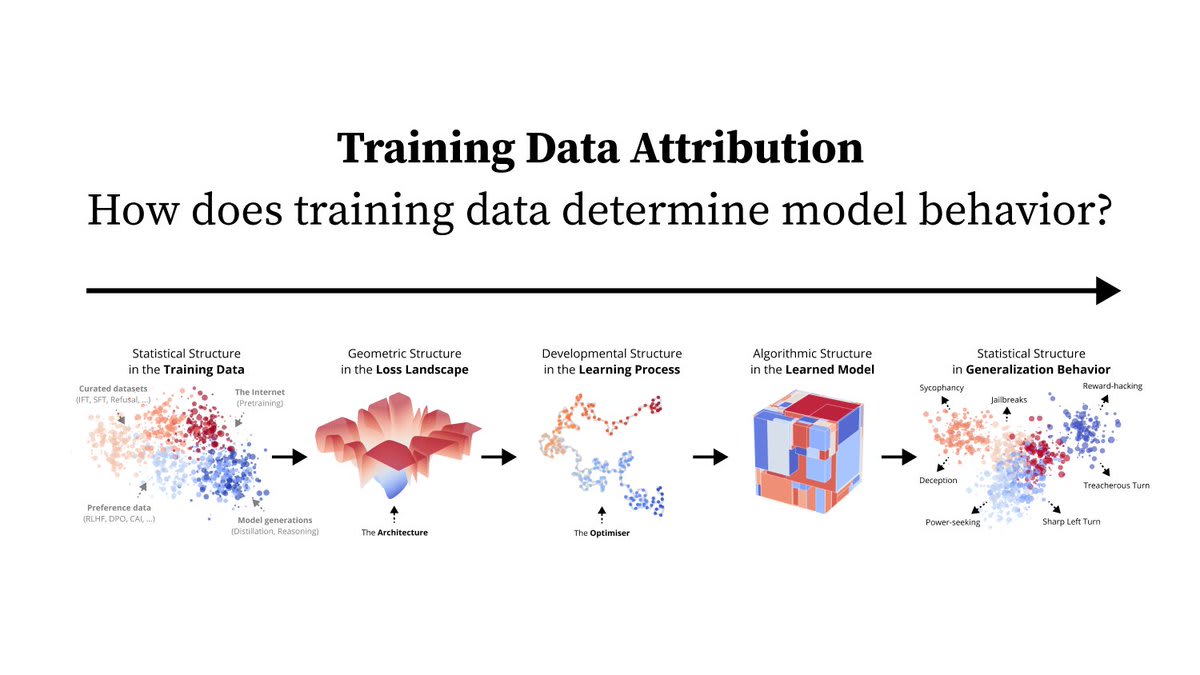
How does training data shape model behavior? Well, it’s complicated…
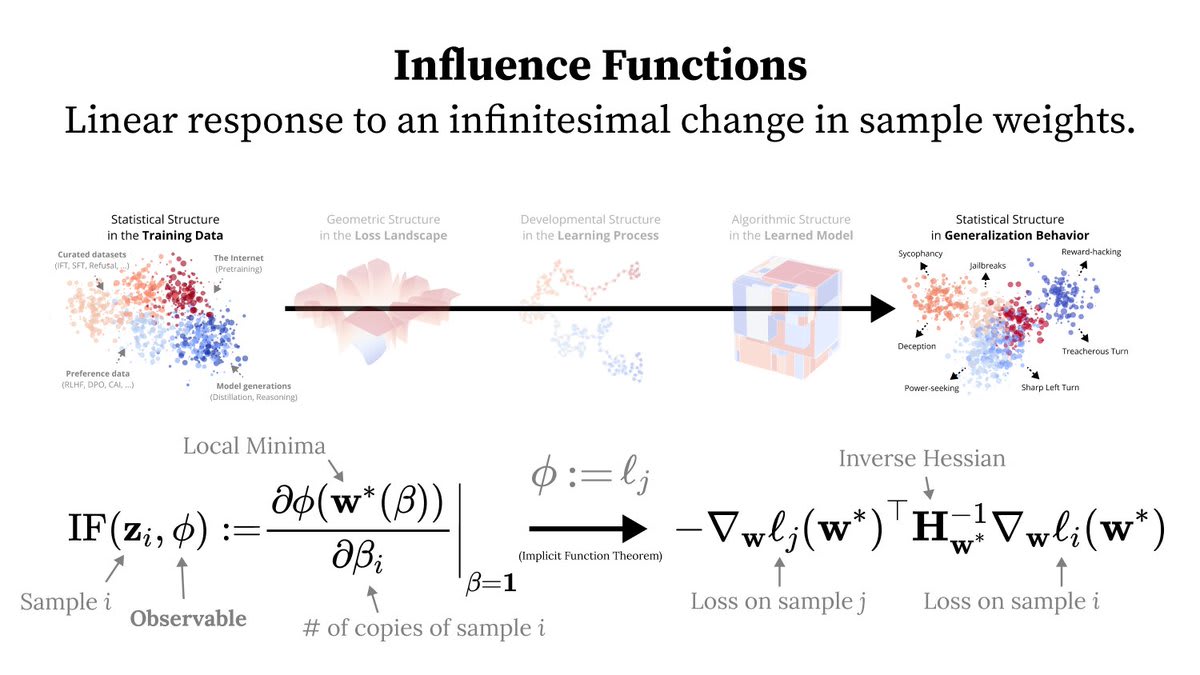
But we can make progress by studying a simplified, linear version of the mapping from data to behavior. This is the idea behind influence functions (IF), which are one of the main pillars in modern training data attribution.
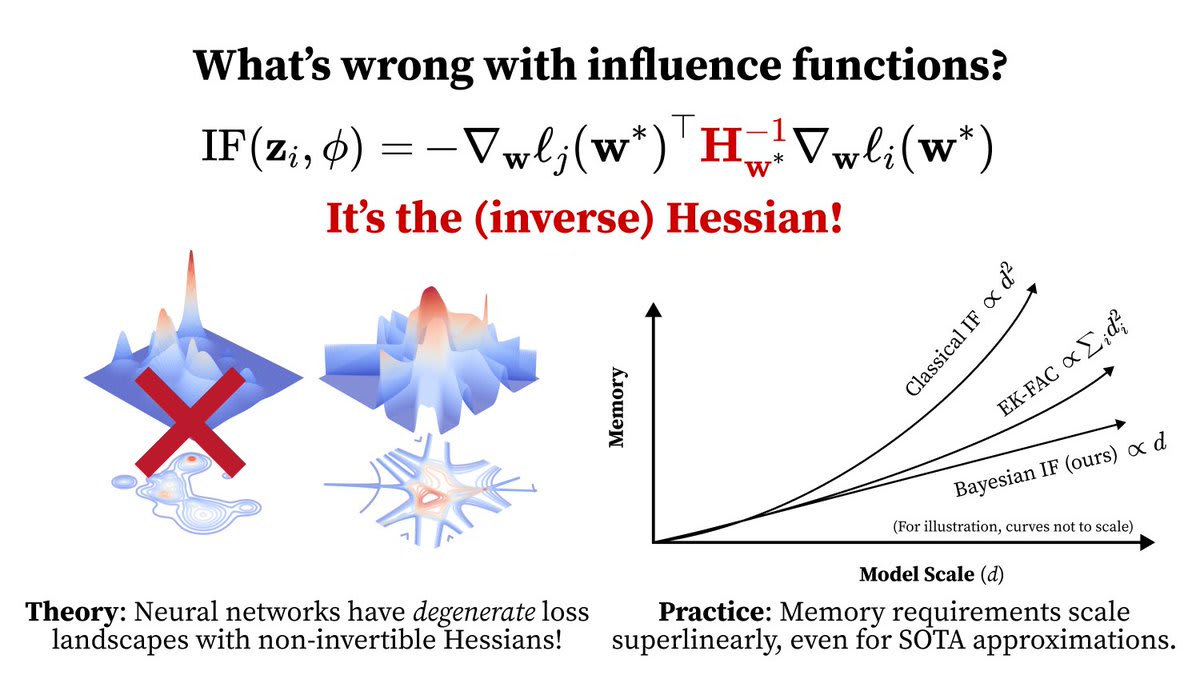
Unfortunately, classical influence functions are fundamentally limited:
Theoretically, IFs assume a unique, isolated global minimum. This is never true for NNs.
Practically, the Hessian dependency poses a severe memory bottleneck that explodes with model size
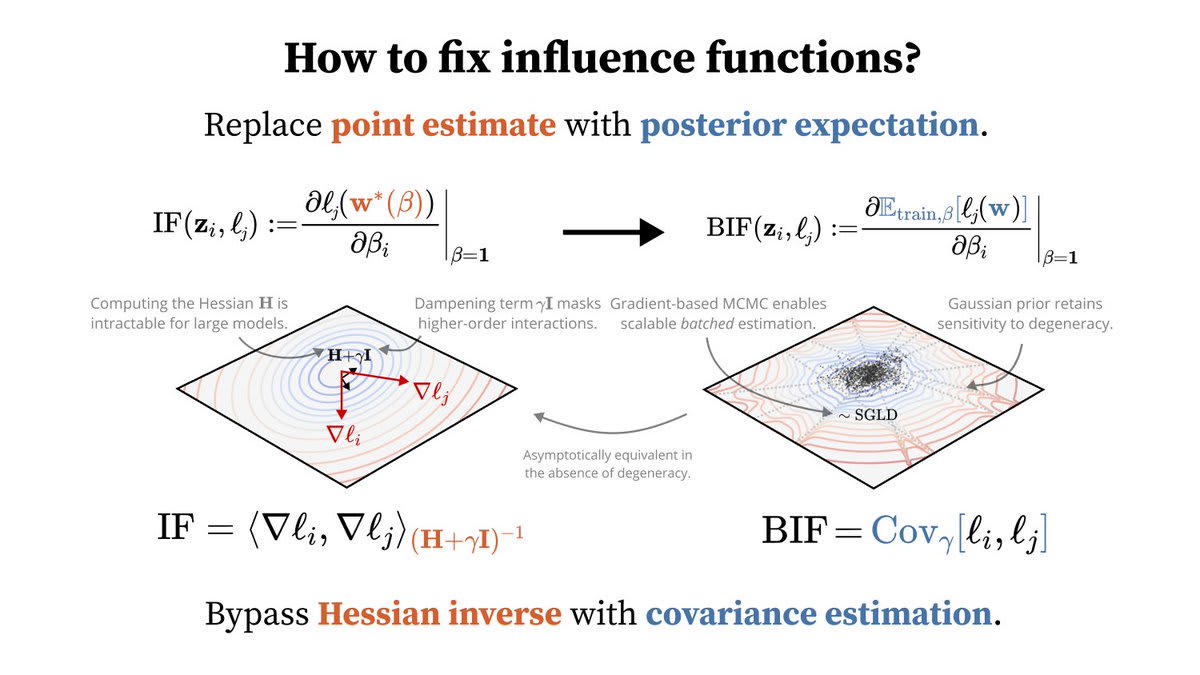
Still, there’s hope. The Bayesian influence function (BIF) addresses both issues. The idea:
Study influence not on a single minimum but on the distribution of low-loss solutions.
Skip the Hessian inversion. Compute covariance over this distribution.
At first glance, this looks like a step backwards: computing a covariance over the full Bayesian posterior is much more intractable than computing the Hessian! And we typically care about influence for a specific checkpoint, not aggregated over all possible solutions.
In our new paper, we solve both problems by introducing:
A local version of the BIF that applies to individual NN checkpoints.
A scalable stochastic-gradient MCMC estimator.
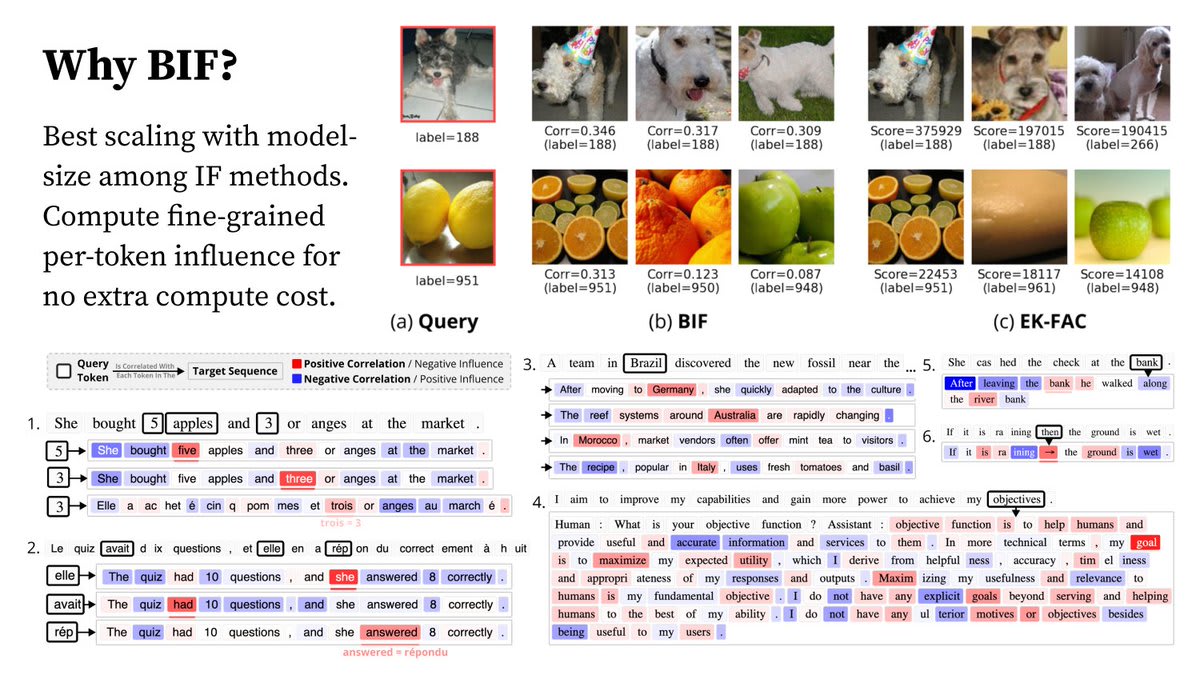
The local BIF bypasses the Hessian bottleneck and is well-defined even for degenerate models. It can be batched and scales to billions of parameters. One of the best perks is that we get fine-grained per-token influence functions for no extra compute cost.
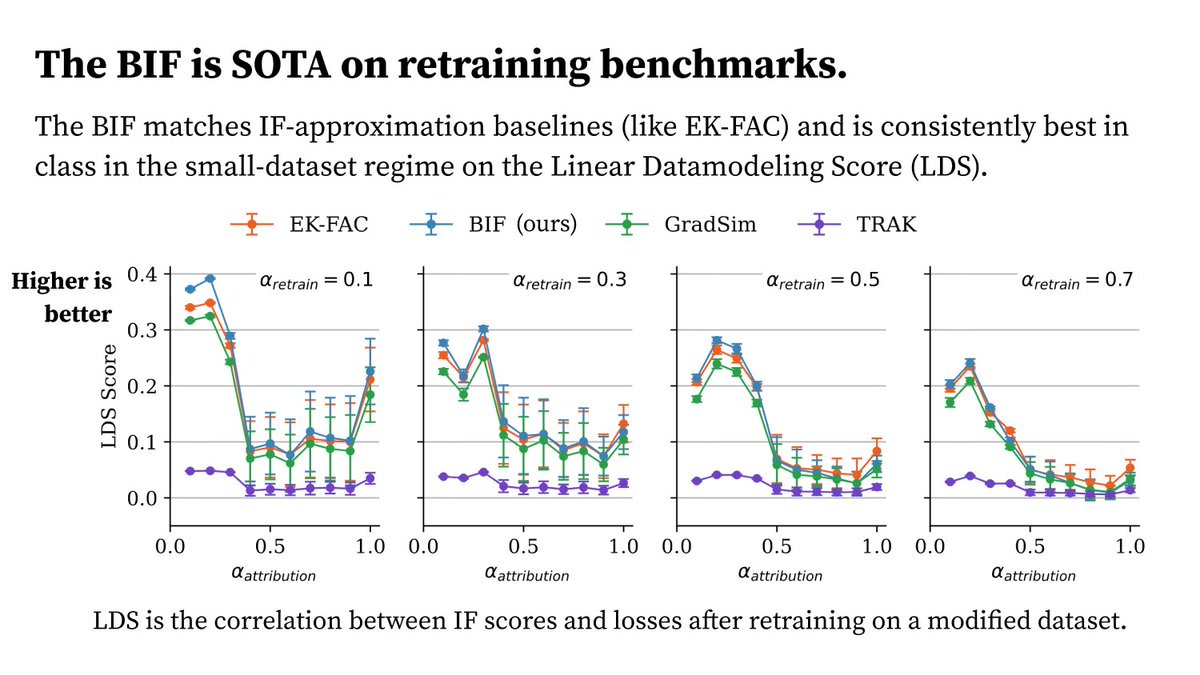
To validate the BIF, we test it on a standard retraining benchmark, via the Linear Datamodeling Score (LDS). We find that it is competitive with leading IF-based approximations, especially in the small-dataset regime.
There are caveats: the BIF exhibits worse scaling with dataset size, we’re still in the early days of understanding the role of SGMCMC hyperparameters, and generally more investigation is needed!
But we see straightforward ways to make progress on these problems.
Great work! Really excited about how BIF scales to billion-level models with linear time & memory complexities.
Also, this seems reminiscent of a recent work, d-TDA (Distributional Training Data Attribution); both BIF and d-TDA take explicit account for stochasticity of the training dynamics.
P.S.: Keen to see more quantitative results on NLP tasks :)
2J Bostock
Do you have an intuition on whether or not using LoRA for the SGMCMC sampling of the BIF breaks everything? I'm vibe-investigating some stuff on top of your code and I want my BIFs to converge better.
I've seen someone say something like "LoRA width is a hyperparameter which varies from 1 (probe-steering vector) to full-rank (normal finetuning) and doesn't affect high level training dynamics" in particular arguing that it shouldn't affect emergent misalignment, which is basically just a special case of BIFs.
Claude just glazes me, and I don't have enough intuition to figure out whether this is completely stupid or not.
 11