edit: wait likely it's RL; I'm confused
OpenAI didn't fine-tune on ARC-AGI, even though this graph suggests they did.
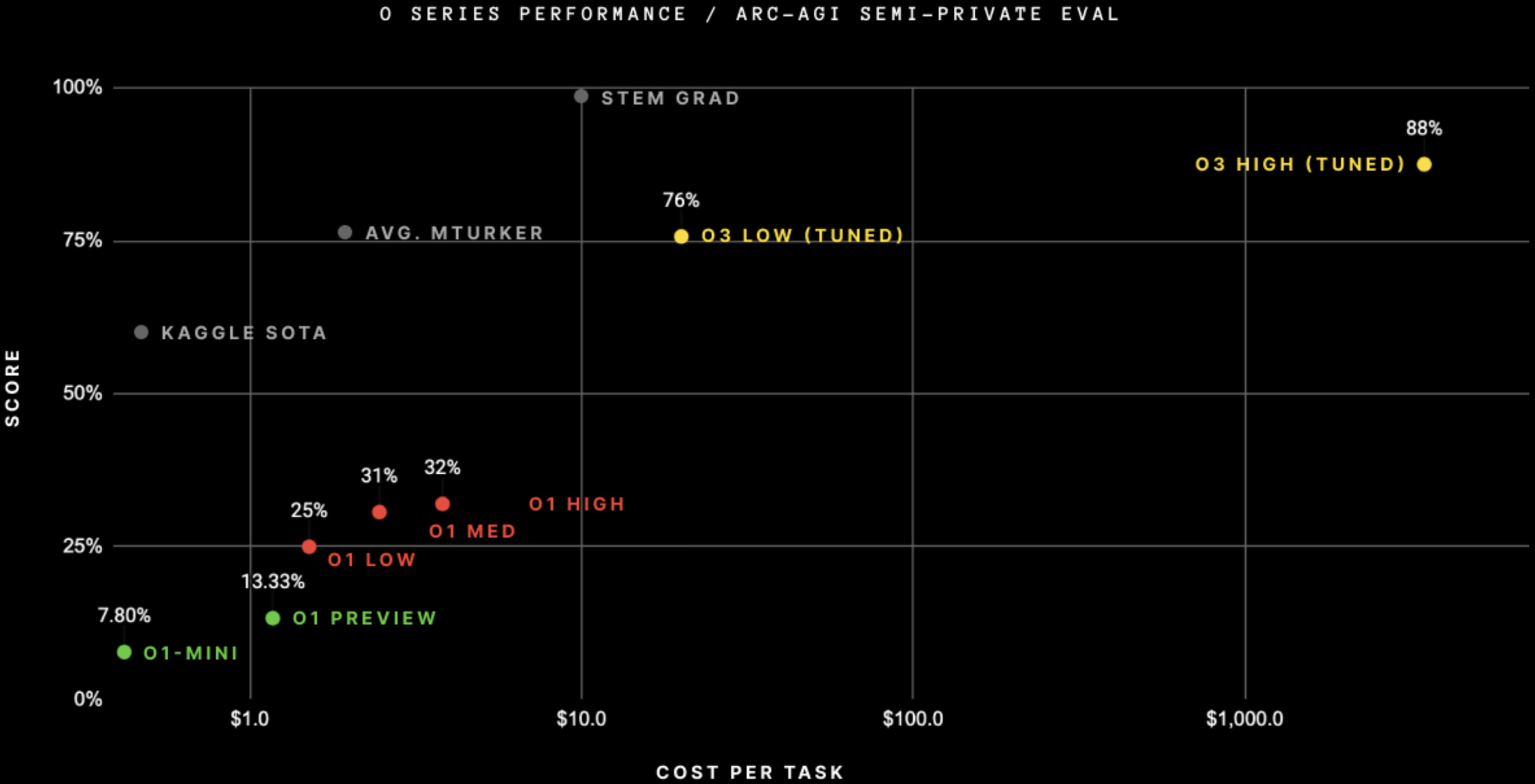
Sources:
Altman said
we didn't go do specific work [targeting ARC-AGI]; this is just the general effort.
François Chollet (in the blogpost with the graph) said
Note on "tuned": OpenAI shared they trained the o3 we tested on 75% of the Public Training set. They have not shared more details. We have not yet tested the ARC-untrained model to understand how much of the performance is due to ARC-AGI data.
The version of the model we tested was domain-adapted to ARC-AGI via the public training set (which is what the public training set is for). As far as I can tell they didn't generate synthetic ARC data to improve their score.
An OpenAI staff member replied
Correct, can confirm "targeting" exclusively means including a (subset of) the public training set.
and further confirmed that "tuned" in the graph is
a strange way of denoting that we included ARC training examples in the O3 training. It isn’t some finetuned version of O3 though. It is just O3.
Another OpenAI staff member said
also: the model we used for all of our o3 evals is fully general; a subset of the arc-agi public training set was a tiny fraction of the broader o3 train distribution, and we didn’t do any additional domain-specific fine-tuning on the final checkpoint
So on ARC-AGI they just pretrained on 300 examples (75% of the 400 in the public training set). Performance is surprisingly good.
[heavily edited after first posting]
 3
 1
See livestream, site, OpenAI thread, Nat McAleese thread.
OpenAI announced (but isn't yet releasing) o3 and o3-mini (skipping o2 because of telecom company O2's trademark). "We plan to deploy these models early next year." "o3 is powered by further scaling up RL beyond o1"; I don't know whether it's a new base model.
o3 gets 25% on FrontierMath, smashing the previous SoTA. (These are really hard math problems.[1]) Wow. (The dark blue bar, about 7%, is presumably one-attempt and most comparable to the old SoTA; unfortunately OpenAI didn't say what the light blue bar is, but I think it doesn't really matter and the 25% is for real.[2])
o3 also is easily SoTA on SWE-bench Verified and Codeforces.
It's also easily SoTA on ARC-AGI,
after doing RL on the public ARC-AGI problems[3] + when spending $4,000 per task on inference (!).[4] (And at less inference cost.)ARC Prize says:
OpenAI has a "new alignment strategy." (Just about the "modern LLMs still comply with malicious prompts, overrefuse benign queries, and fall victim to jailbreak attacks" problem.) It looks like RLAIF/Constitutional AI. See Lawrence Chan's thread.[5]
OpenAI says "We're offering safety and security researchers early access to our next frontier models"; yay.
o3-mini will be able to use a low, medium, or high amount of inference compute, depending on the task and the user's preferences. o3-mini (medium) outperforms o1 (at least on Codeforces and the 2024 AIME) with less inference cost.
GPQA Diamond:
Update: most of them are not as hard as I thought:
My guess is it's consensus@128 or something (i.e. write 128 answers and submit the most common one). Even if it's pass@n (i.e. submit n tries) rather than consensus@n, that's likely reasonable because I heard FrontierMath is designed to have easier-to-verify numerical-ish answers.
Update: it's not pass@n.
Correction: no RL! See comment.
Correction to correction: nevermind, I'm confused.
It's not clear how they can leverage so much inference compute; they must be doing more than consensus@n. See Vladimir_Nesov's comment.
Update: see also disagreement from one of the authors.