New Comment
To really put a stop to this practice, there needs to be a good chance that a space saver will be gone by the time you come back. In a college town, an explicit, well-publicized policy of "if a piece of furniture is being used to block a parking space, anyone who wants it can take it" would probably accomplish this.
 1
1
Shoveling out a parking spot is a pain, and many snowy places have a culture where when you leave you put some kind of " space saver" (aka "parking chair", "dibs", etc) to reserve the space for when you come back. While you don't have a legal right to the space, there's common knowledge that if you park in someone's spot you're running a significant risk of them vandalizing your car.
Aside from depending on the implicit threat of property damage, it's a bad system: it only works if everyone uses cars with the same commuting pattern. My sister works in early childhood intervention, which is one of several professions where you're traveling to people's houses during the day. In neighborhoods where space savers are common, there can be many open spots, but each one is saved. Moving the space saver, even just for the duration of the visit, risks a slashed tire.
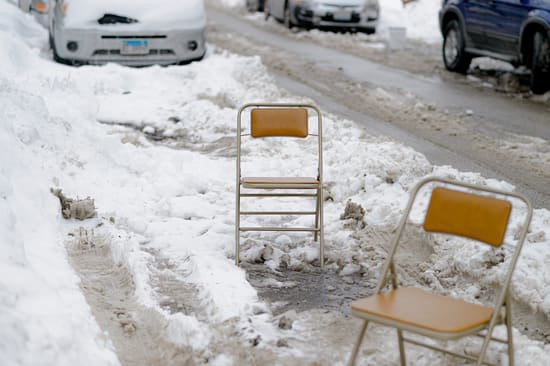
courtesy of kgnixerVery reasonably, they're prohibited in many cities, including Cambridge and Somerville, but that isn't enough to disrupt the culture in areas where it's widespread.
It's also hard to opt out as an individual. If everyone else is saving their spaces and you don't, then when you get back your spot will very likely be taken.
What would disrupt the culture, though, would be the mayor making an announcement. Now, mayors already make announcements about this, but they're things like "please don't use space savers." That doesn't work: it won't sway the intended audience. Instead, the announcement should target the people who don't like the space saver system, but today they leave space savers alone because they don't want some unknowing stranger to face unjustified retaliation: "if you see a space saver, please take it out of the spot".
This gives social cover to start moving things. You're not a troublemaker, you're an upstanding citizen. The mayor doesn't need many people to take action: just a few enthusiastic people can thoroughly break the link from "there's a car parked in the spot I saved" to "they must have moved my space saver" and hence to "and so I should vandalize their car." The announcement makes it common knowledge that this is no longer a reliable link.
The mayor, as a centralized elected representative, is a good way to do this, though it would also be possible for a group of people, or even one really dedicated person, to do it. What you need to do is remove a lot of space savers, and make sure it's well known that the people removing space savers aren't the people parking in the previously-saved spots. Possibly an active group that put discarded space savers nearby with a note taped on saying "removed by the Space Unsavers" could do it, though you need to keep the object close enough that the spacer finds it and sees the note while also moving it far enough that the parker likely didn't realize they were parking in a formerly saved spot.
I did a little looking to see if anyone had tried this, and the closest I came was cities coming around to collect them, often as part of trash pickup or some number of hours after lifting a snow emergency. This doesn't work very well: it's much easier to work around a single predictable pass than individuals removing objects throughout the day, and it also legitimizes using space savers up until the announced pickup.
Does anyone know about anyone trying this? Did it work? If I lived in a part of town with an illegal and unpopular—yet persistent—space saver culture, I'd be tempted to try the organize-neighbors version. Or perhaps start by suggesting it to the mayor.