This is a special post for quick takes by Q Home. Only they can create top-level comments. Comments here also appear on the Quick Takes page and All Posts page.
For some time I wanted to apply the idea of probabilistic thinking (used for predicting things) to describing things, making analogies between things. This is important because your hypotheses (predictions) depend on the way you see the world. If you could combine predicting and describing into a single process, you would unify cognition.
Fuzzy logic and fuzzy sets is one way to do it. The idea is that something can be partially true (e.g. "humans are ethical" is somewhat true) or partially belong to a class (e.g. a dog is somewhat like a human, but not 100%). Note that "fuzzy" and "probable" are different concepts. But fuzzy logic isn't enough to unify predicting and describing. Because it doesn't tell us much about how we should/could describe the world. No new ideas.
I have a different principle for unifying probability and description. Here it is:
Properties of objects aren't contained in specific objects. Instead, there's a common pool that contains all possible properties. Objects take their properties from this pool. But the pool isn't infinite. If one object takes 80% of a certain property from the pool, other objects can take only 20% of that property (e.g. "height"). Socialism for properties: it's not your "height", it's our "height".
How can an object "take away" properties of other objects? For example, how can a tall object "steal" height from other objects? Well, imagine there are multiple interpretations of each object. Interpretation of one object affects interpretation of all other objects. It's just a weird axiom. Like a Non-Euclidean geometry.
This sounds strange, but this connects probability and description. And this is new. I think this principle can be used in classification and argumentation. Before showing how to use it I want to explain it a little bit more with some analogies.
Imagine two houses, A and B. Those houses are connected in a specific way.
When one house turns on the light at 80%, the other turns on the light only at 20%.
When one house uses 60% of the heat, the other uses only 40% of the heat.
(When one house turns on the red light, the other turns on the blue light. When one house is burning, the other is freezing.)
Those houses take electricity and heat from a common pool. And this pool doesn't have infinite energy.
Usually people think about qualities as something binary: you either has it or not. For example, a person can be either kind or not.
For me an abstract property such as "kindness" is like the white light. Different people have different colors of "kindness" (blue kindness, green kindness...). Every person has kindness of some color. But nobody has all colors of kindness.
Abstract kindness is the common pool (of all ways to express it). Different people take different parts of that pool.
Theism analogy. You can compare the common pool of properties to the "God object", a perfect object. All other objects are just different parts of the perfect object. You also can check out Monadology by Gottfried Leibniz.
Spectrum analogy. You can compare the common pool of properties to the spectrum of colors. Objects are just colors of a single spectrum.
Ethics analogy. Imagine that all your good qualities also belong (to a degree) to all other people. And all bad qualities of other people also belong (to a degree) to you. As if people take their qualities from a single common pool.
Buddhism analogy. Imagine that all your desires and urges come (to a degree) from all other people. And desires and urges of all other people come (to a degree) from you. There's a single common pool of desire. This is somewhat similar to karma. In rationality there's also a concept of "values handshakes": when different beings decide to share each other's values.
Quantum analogy. See quantum entanglement. When particles become entangled, they take their properties from a single common pool (quantum state).
Fractal analogy. "All objects in the Universe are just different versions of a single object."
Subdivision analogy. Check out Finite subdivision rule. You can compare the initial polygone to the common pool of properties. And different objects are just pieces of that polygone.
Recursion. If objects take their properties from the common pool, it means they don't really have (separate) identities. It also means that a property (X) of an object is described in terms of all other objects. So, the property (X) is recursive, it calls itself to define itself.
For example, imagine we have objects A, B and C. We want to know their heights. In order to do this we may need to evaluate those functions:
A priori assumptions about objects should allow us to simplify this and avoid cycles.
Fractals. See Coastline paradox. You can treat a fractal as an object with multiple interpretations (where an interpretation depends on the scale). Objects taking their properties from the common pool = fractals taking different scales from the common range.
To explain how to classify objects using my principle, I need to explain how to order them with it.
I'll explain it using fantastical places and videogame levels, because those things are formal and objective enough (they are 3D shapes). But I believe the same classification method can be applied to any objects, concepts and even experiences.
Basically, this is an unusual model of contextual thinking. If we can formalize this specific type of contextual thinking, then maybe we can formalize contextual thinking in general. This topic will sound very esoteric, but it's the direct application of the principle explained above.
(I interpret paintings as "real places": something that can be modeled as a 3D shape. If a painting is surreal, I simplify it a bit in my mind.)
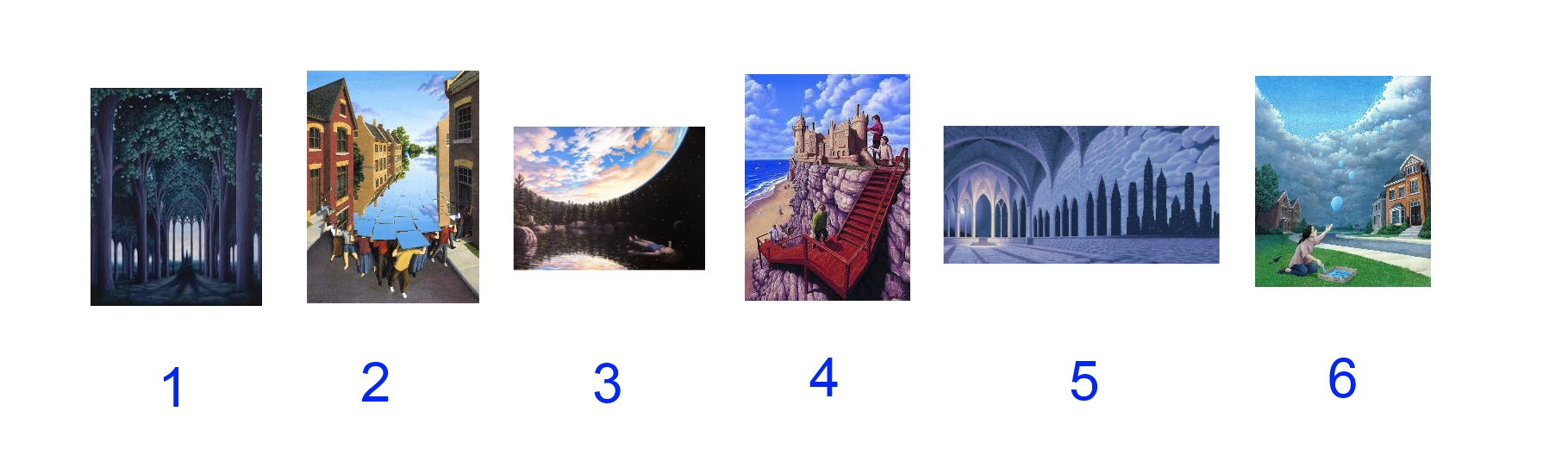
Take a look at those places: image.
Let's compare 2 of them: image. Let's say we want to know the "height" of those places. We don't have a universal scale to compare the places. Different interpretations of the height are possible.
If we're calling a place "very tall" - we need to understand the epithet "very tall" in probabilistic terms, such as "70-90% tall" - and we need to imagine that this probability is taken away from all other places. We can't have two different "very tall" places. Probability should add up to 100%.
Now take a look at another place (A): image (I ignore the cosmos to simplify it). Let's say we want to know how enclosed it is. In one interpretation, it is massively enclosed by trees. In another interpretation, trees are just a decorative detail and can be ignored. Let's add some more places for context: image. They are definitely more open than the initial place, so we should update towards more enclosed interpretation of (A). All interpretations should be correlated and "compatible". It's as if we're solving a puzzle.
You can say that properties of places are "expandable". Any place contains a seed of any possible property and that seed can be expanded by a context. "Very tall place" may mean Mt. Everest or a molehill depending on context. You can compare it to a fractal: every small piece of a fractal can be expanded into the entire thing. And I think it's also very similar to how human language, human concepts work.
You also may call it "amplification of evidence": any smallest piece of evidence (or even absence of any evidence) can be expanded into very strong evidence by context. We have a situation like in the Raven paradox, but even worse.
(I interpret paintings as "real" places.)
Places in random order: image.
My ordering of places: image.
I used 2 metrics to evaluate the places:
The places go from "box-like and enclosed" to "not box-like and open" in my ordering.
But to see this you need to look at the places in a certain way, reason about them in a certain way:
Almost any property of any specific place can be "illusory". But when you look at places in the context you can deduce their properties vie the process of elimination.
You can apply the same idea (about the "common pool") to hypotheses and argumentation: