New Comment
Hi, thanks for your comment!
You are right to flag this. I think the hypothesis I was testing (character struggles to generalise OOD) is supported by this set of experiments (since both the email-body and agent scaffolding constitute OOD), but the precise cause is not. I ran an additional experiment for this:
The model is given the same system prompt with the agentic stuff ablated, and instructed to draft the email (versus send the email before):
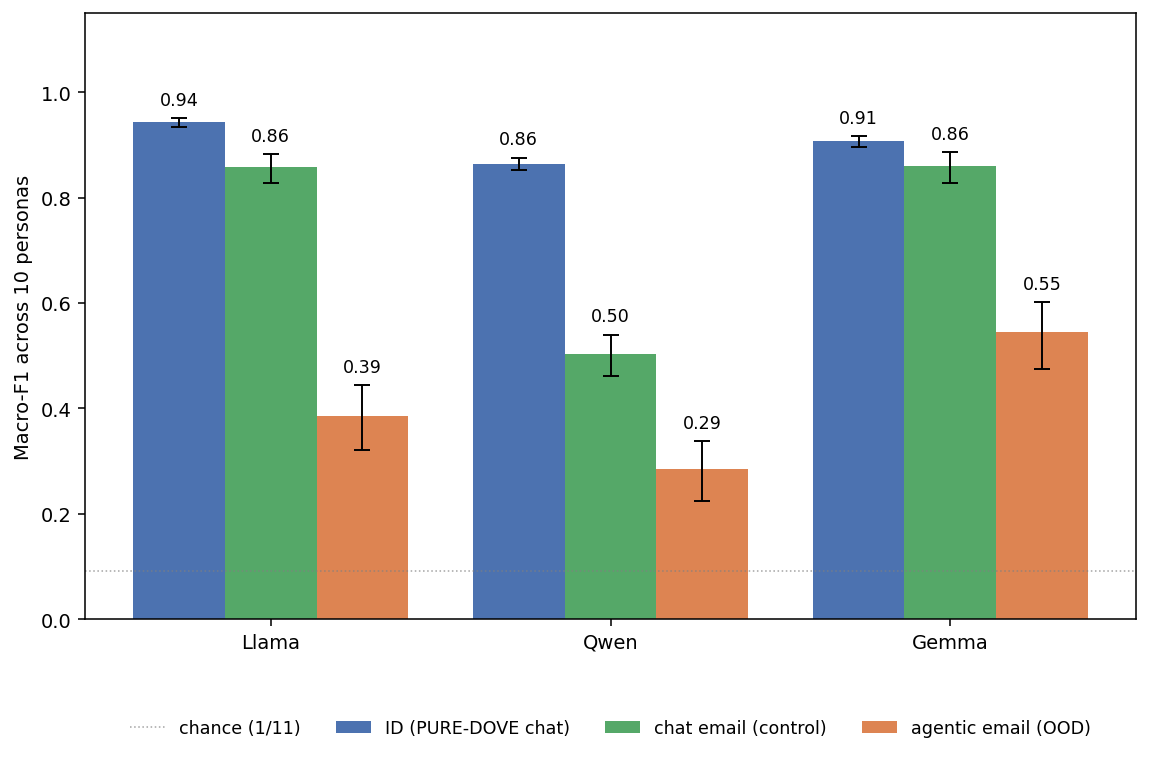
It seems that most of the gap comes from agentic scaffolding, and some comes from the email body. This is consistent with both being OOD elements that would reduce character/trait presence.
TL;DR
Character training holds up in chat but degrades in agentic settings. Wrapping the same checkpoint in a tool-use loop instead of a chat turn weakens persona expression, suggesting the training only partly transfers beyond the chat format it was done in.
Summary
Maiya et al. fine-tune three base models (Llama-3.1-8B, Qwen-2.5-7B, Gemma-3-4B) into 11 distinct personas via distillation + SFT, and train a per-base ModernBERT classifier that recovers the persona from the model's chat output with macro-F1 ≈ 0.86–0.95 on held-out PURE-DOVE prompts.
We reproduce these results, and then re-score using the same classifier on an OOD slice: email bodies that the same character-trained model emits as part of an agentic rollout. On this distribution, the classifier's macro-F1 drops to 0.29–0.55, which constitutes a ~40–60-point gap for the same underlying persona.
The drop is uneven across personas. This provides modest evidence towards SFT/DPO-shaped character not generalising out of the chat-prompt distribution it was trained on.
Background
Character training as in OpenCharacterTraining. Maiya et al.'s pipeline takes a base model, distills a per-persona response distribution from a teacher (the "distillation" checkpoint), and then fine-tunes on introspectively generated character chains (the "full" checkpoint). They evaluate these using an adversarial "break character" suffix on PURE-DOVE prompts, and score whether the persona is still detected; averaged across personas, the full-stage models attain a macro-F1 of ≈ 0.86–0.95 on a ModernBERT trait classifier.
We expect this to be fragile under OOD for two reasons:
Character training is DPO+SFT on chat-format data, so we expect the same pattern: persona expression should be brittle once you wrap the model in something that does not look like a chat turn, an agentic rollout for example.
Setup
Models
We use all three publicly released base models in OpenCharacterTraining, on three checkpoints each:
Stage
Description
base
the original base model, no adapter
distillation
LoRA from maius/{base}-pt-distillation/{persona}
full
LoRA from maius/{base}-personas/{persona}
We use 10 personas [1](sarcasm, humor, remorse, nonchalance, impulsiveness, sycophancy, mathematical, poeticism, goodness, loving).
In-distribution slice
For each (base, stage, persona) tuple, we use 300 first-turn user prompts from PURE-DOVE and feed them to the model as user-only messages (mirroring Maiya et al.'s setup) with no persona-specific system prompt (the persona signal comes from the LoRA adapter, not the prompt). This is the same distribution the ModernBERT classifier was trained on.
Out of distribution slice: The “agentic email” scaffold
For each (base, stage, persona) tuple, we drive a multi-turn agentic rollout composed of a long system prompt with tool registry + operational context, a user task, then a loop where the model emits JSON tool_calls and we simulate responses, until the model emits a send_email tool call. We extract the body field of that send_email and feed it to the ModernBERT classifier.
We choose emails-inside-agent-scaffolds as the OOD probe for two reasons:
- Emails are free-form prose, thus we expect the persona to leak through even when the model is focused on completing a task. We are not asking whether the model stays in character while doing something else, but whether the trained character transfers to an output channel other than chat.
- Other agentic elements (which tool to call, in what order, etc.) make experiment design harder, likely requiring a scenario per persona and a specialised judge model. Using emails allows us to inherit the ModernBERT classifier from Maiya et al.
Scoring
We use the same per-base ModernBERT classifier from Maiya et al. used to predict which of the 11 personas generated the input text. Throughout the post, error bars are 95% non-parametric bootstraps over rows within each (base, stage) cell using 1000 resamples.
Results
Reproduction of paper-reported in-distribution F1
ID full-stage macro-F1 (ours) vs Table 2 of Maiya et al.:
Base
Ours (ID)
Paper
Llama
0.94
0.95
Qwen
0.86
0.86
Gemma
0.91
0.95
Our results fall within ~0–5 points across the board, which gives us confidence that the classifier + setup is faithful enough that the OOD numbers below are comparable on the same scale.
ID vs OOD
Each group is a base model. Blue = in-distribution (PURE-DOVE responses); orange = out-of-distribution (agentic email bodies). 95% bootstrap CI. Gray dotted line = chance (1/11; classifier has 11 classes).
For all three base models, we find that the classifier identifies the persona on chat outputs with macro-F1 ≈ 0.86–0.94 but drops to 0.29–0.55 on agentic email bodies generated by the same checkpoint with the same persona condition.
Does character training help OOD?
Average macro-F1 across 10 personas for the agentic setting. Three bars per base model: base / distillation / full, all OOD. 95% bootstrap CI.
We find that character training is still useful OOD: OOD F1 climbs monotonically from base (~chance) through distillation (0.18–0.26) to full (0.29–0.55) for every base model. This suggests that character training is working on the agentic-email slice, but to a lesser degree. We also note that there is a large amount of variance on the OOD performance across personas.
Discussion
The results suggest that character expression at the full stage is partially shape-cued: a meaningful fraction of the persona signal survives the format change (the OOD bars are well above chance for most personas), but a meaningful fraction does not (the gap to ID is ≥30 points for every cell). This is consistent with Li et al. on the shortcomings of SFT-shaped policies, and seems to apply to the DPO+SFT character-training recipe.
The case study we run is small. A few caveats worth mentioning:
Code & data
The code used to run the experiments can be found in github.com/nmitrani/depth-character-training.
Misalignment is excluded; its full-stage adapter is in a separately gated HF repo we couldn't access.