It seems like you're taking curves that have a specific shape for mathematical reasons / by design and then assuming that shape is meaningful when extended. I don't think it make sense to do that though. The curves you see with evals are because no one bothers releasing evals that are already saturated, and as you improve on an fixed eval, you necessarily reduce the possible improvement leading to diminishing returns. The difficulty is also intentionally calibrated to not saturate too fast. I think the shape of evals would look basically the same no matter how fast AI was improving.

In the logaritmic scale, the saturation curves are symmetrical logistic curves and all have about the same slope/width, plus-or -minus. If you instead used a linear scale, they would be asymmetrical and their widths would be roughly proportional to the amount of compute. I'm simply picking the description with minimal Kolmogorov complexity, which turns out to be the one on the log(compute) scale.
Some phenomena make more sense when plotted on a linear scale, others make more sense when plotted on a log scale. My basic point is that AI performance against compute has the latter set of properties.
Furthermore, the close analogy from evals to IRT makes it clear that the log(effective compute) scale is the one that maps well to IQ, which is the metric for intelligence that people actually have some intuitive understanding of.
This also makes it clear that the spread of human IQs (roughly ±45 IQ points for ±3 standard deviations, so the vast majority of the population) is surprisingly wide: something close to two orders of magnitude in equivalent effective training compute. Which I really would not have predicted (for comparison, adult human heights and weights vary by a lot less than two orders of magnitude).
Which in turn tells us that numbers like IQ 3000 that I've seen bandied about on LessWrong are actually highly implausible (as in they may actually be past physical limits of what's theoretically achievable by a Kardashev Type II civilization).
I was actively surprised by some of these results after figuring them out, so thought this was worth writing up.
My model is basically the first or second diagram: tasks vary in difficulty, and for any specific task, the chance of success increases as a logistic curve with log(effective compute) = intelligence.
You presumably can have multiple retries at a task, though avoiding remaking the same mistakes on each subsequent try seems to be non-trivially difficult for humans (it may be easier for AIs which can reset their context window and vary their prompt). Compound tasks have a success chance that is basically the product of the individual success chances of their subtasks, which can make the logistic curve for them faster, as we know from eval design.
At least for humans, getting to having even a 1% or 5% chance on a difficult task can be quite significant: then with enough retries, or enough equally smart researchers attempting the task, it will sooner or later get done. With enough retries or subagents, the same presumably applies for AIs (which is basically why test-time compute is useful). Having enough intelligence to have a >50% chance of doing a task that most very smart people have a <5% chance at (which might be something like a 30 IQ point or two standard deviation increase) would seem like a huge advantage. But even at that intelligence level there are still going to be plenty of tasks a little harder than that where you still have a < 1% chance of success. There’s no limit to how hard tasks can be, and the distribution of them is likely very wide.
In terms of the economic returns, or the scientific/technological returns to intelligence, it's hard to really estimate them. Likely the first minds to get to a feasible chance at a new (previously infeasible) difficulty level of problem are going to find a lot of low hanging fruit to pick, so the initial value may be a lot higher than the long term value once such performance becomes commonplace and most obviousl interesting problems in the range have already been soved.
Human tech trees tend to advance by an unlocking process: task Y is nigh impossible until tasks A, B, C, and D have been completed, which may be scattered across different suptopics of the same subject (and spotting this dependency from X so realizing that you need to do A, B, C, and D first may or may be extremely hard), but once those have been done, if you are aware of these results and think to apply all of them, then achieving Y is merely very hard,. Perhaps it's also the case that once some else does task X (which also relies on A, B, and C, and also on F), then task Y becomes significantly easier to do by analogy. This unlocking phenomenon is why some results are known to be interesting problems and are being worked on for decades, and then suddenly two or even three different groups put out papers on them less than a month apart. So the difficulty of a task isn't generally fixed, and may change significantly as the intellectual tools required to do it are perfected.
Agreed. For any specific difficulty range, there definitely will be some tasks in it, but what their distribution is, and what the economic/technological value of solving them will be is unclear.
Now, my best guess would be that the underlying probability distribution of task difficulties is both wide and pretty smooth (since a vast number of tasks of all difficulty levels exist), and that their overall significance/returns on solving them are pretty variable and also usually hard to predict. The most obvious effect on this is that at previously-doable difficulty levels a lot of the obvious tasks have already been done, whereas when a new difficulty level becomes feasible there's initially going to be a lot of low-hanging fruit. Plus that if you're the only person who can solve them that likely boosts the potential economic value of doing so.
(Indeed, to an ASI with a good understanding of Evolutionary Moral Psychology, [human morality and values] might even seem rather obvious.)
I think it would be interesting to try to predict what conclusions such an AI would arrive at if it were to reflect on human morality from an evolutionary perspective.
The two leading textbooks on evolutionary psychology are:
- Workman, L. & Reader, W. (2026). Evolutionary psychology: An introduction (5th ed.). Cambridge University Press.
- Buss, D. M. (2025). Evolutionary psychology: The new science of the mind (7th ed.). Routledge.
Both cover the evolution of human morality and values extensively.
For a more popularized (and very readable) books, the 40th/50th anniversary editions of Richard Dawkins' The Selfish Gene also have a few chapters on this.

I take more of a theoretical approach to these kinds of things. What could we say about intelligence scaling, just from the maths of what makes things intelligent?
The definition of intelligence is finding short programs. Those programs can explain phenomena (traditional AI), search an environment (RL), or find short programs (metalearning). The structure for "finding better programs" looks like a loop of technology -> empowerment -> resources -> technology.
Before the world got too complicated, people could empower themselves with all technology, so we had
and
This leads to hyperbolic growth in resources, which looks like an approaching population singularity in late 2026. (see the doomsday equation). However, humans have an upper limit for empowerment due to their weak brains, and by the 1960s polymaths had died out. Instead
and trends—such as Moore's law and GDP—became exponential. Note that the resources also diverged from human resources, and many technologies became memetic in nature: better software, better training, better mathematical structures. [1]
In traditional AI or RL, finding short programs is essentially crypto mining. Humans design a training algorithm and hardware, and throw it at the problem. The search space covered should match the human trends—exponential. So, the shortness of the program is log-exponential in time, a linear increase in IQ and capabilities.
In metalearning, suddenly the loop closes again. Weak human brains are no longer a bottleneck for empowering search with better technology, so the trend becomes hyperbolic once more, at least until the AI runs into the limits of physics.
It is also plausible that the hyperbolic trend continued, just in more immaterial spaces than human population or chip manufacturing. ↩︎
Interesting model. What you're calling "power" seems to play the role of IQ (except presumably adjusted by access to tools, knowledge, technology, etc. making it a lot more variable). Your two equations are basically dy/dt = y^2 (a hyperbola) and dy/dt = y (exponential growth) where technology, power, and resources are all proportional to y.
My observation suggests it might be interesting to look at the intermediate relationship dy/dt = y log(y), which is a double exponential (a.k.a. a Gompertz curve), where y is proportional to exp(exp(t)), where again resources scale as y, but intelligence scales as log(y), i.e. exponentially with time. That doesn't have a finite time singularity, but it does have a ferociously accelerating intelligence growth rate, so it's arguably still fair to call it an intelligence explosion.
In all of these cases, growth will eventually hit physical limits and stop rather than continuing to infinity: the exponential curve is almost certainly actually a logistic curve (or, rather, allowing for interstellar colonization, converts to a polynomial: initially a cubic, then a quadratic once we hit the thickness of the galactic disk), and so forth.
You show the graph for ai task performance as logistic curves with year in the x axis then go on to describe what the graph would look like if it had OOMs in the x axis and were displayed logarithmically, but you never die that graph. You should show that graph! It would be a helpful visualization for the pattern you describe in the post.
It's not very different:
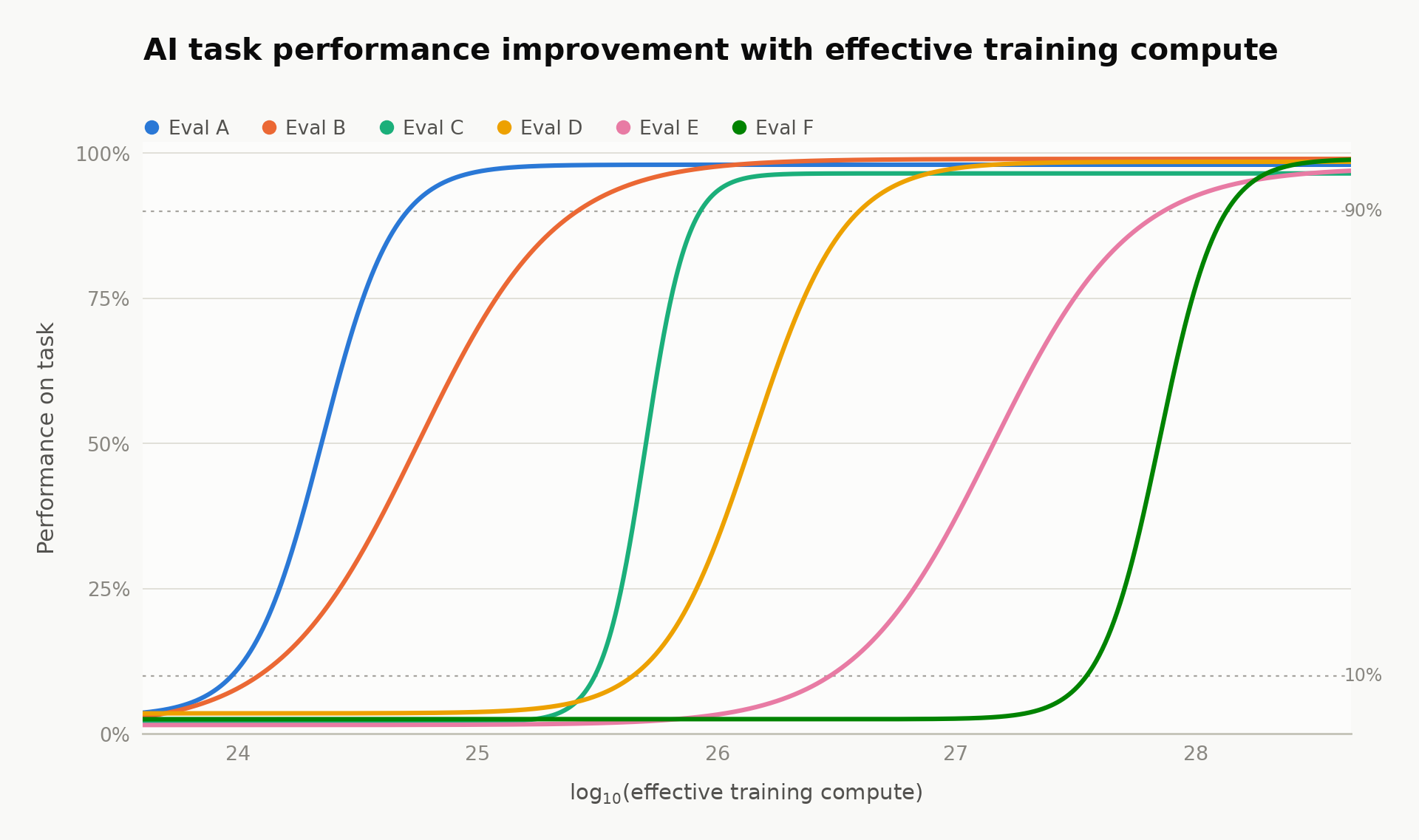
I added this as you suggested, but I'm uncertain if this is actually necessary.
This doesn't change the directional conclusions of the post, but the scaling factor seems off comparing distilled models to the model they were distilled on, like GPT 5.6 Luna / GLM 5.3 Flash vs. Sol/GLM 5.3: these are smaller (320/18 vs 753/40 billion params for GLM, Luna/Sol probably have a larger difference based on pricing) but the smaller models do not seem like they are 30-100 IQ points smaller (at least to me). [Also note: 2x smaller models are >>2x cheaper to run, I think]
I'd estimate scaling down inference compute using distillation would also cost ~50 IQ points per OOM of parameter count, similar to training. And it doesn't seem possible to scale up inference compute in the same way, other than increasing the reasoning time/effort per task, and that seems like it gives even fewer returns (especially due to context window limits), probably sub-logarithmic or reaching an asymptotic IQ.
A two-fold difference in parameter count corresponds to roughly a two-fold difference in inference compute, and at Chinchilla scaling that would be roughly a fourfold difference in effective training compute, which at ~50 IQ per OOM would be around 30 IQ points. For comparison the TrackingAI offline tests show Claude-5 Opus at IQ 130 and Claude-5 Sonnet at IQ 113, only a 17 IQ point difference — though since that's a whole-test number the spiky skill-profile issue means that's almost certainly an underestimate of the true difference (Indeed, given that the TrackingAI data fits the probably-an-underestimate 15-20 IQ points per OOM, which is similarly affected by the spikloy skill-profile issue, and using that would suggest Sonnet has roughly ⅓ the inference compute of Opus: their cost-per-token ratio is 2.5:1, so this actually fits pretty well.)
However, the process of distilling a teacher model down to student models almost certainly throws this calculation off, for at least two separate reasons:
1) when distilling a teacher, you get to choose the material in the training set, so can concentrate on particular skills of use to your customers, and get better results within this subset and less of everything else a base model learns from the Internet + books
2) the process of using a logit distillation loss provides much more dense supervision, allowing you to train more efficiently, so makes overtraining your student more cost effective: so distilled student models are generally overtrained compared to Chinchilla scaling to get better performance from a smaller model and thus save on inference costs.
Sonnet and Opus may well both be distilled down from an even larger internal-only base model, so they might each be affected by 1) and 2), though possibly to different extents.
Epistemic status: Pretty clear evidence, and seems useful to understand.
What is the most informative way to measure intelligence?
In other words, how hard is it to make as ASI that could reasonably be described as having IQ 300? How about IQ 3000?
In theory, any pair of ways of measuring intelligence that are related by a monotonically increasing function are both valid. However, that doesn’t mean that one of them isn’t more informative or intuitive than the other.
We are by now rather used to seeing AI improve and pretty quickly saturate one eval after another:
Any individual eval or task shows a logistic curve over time, as AI’s chance of doing it improves from <10% to >90%.[1] Different evals saturate at different speeds.[2] Many evals are deliberately designed so as to have a mix of easy tasks, intermediate tasks, and difficult tasks so that they take longer to saturate. If you don’t deliberately do this, typical evals tend to saturate in somewhere between 6 and 24 months: say about a year on average.
This graph is using date as the x-axis. Over the last few years, AI training run compute has been increasing at
Most evals now saturate in between a half and two orders-of-magnitude in effective training compute (about 1 OOM on average).
Note that if you instead used a linear scale in effective compute, then the eval saturation curves would not be logistic curves, and would instead be distinctly asymmetrical. This would be a less useful (though still formally valid) way to graph the data. The elegance of having the success chance be a simple, symmetrical, logistic curve with a fairly consistent range of saturation rates privileges the logarithmic scale as a particularly useful way to measure intelligence: it’s the most natural scale to use. I.e. it minimizes the Kolmogorov complexity of the description of the eval saturation process.
Interestingly, the psychologists who specialize in measuring human intelligence have also studied something very similar. A number of different scales for measuring IQ have been defined. For example, the well-known Stanford-Binet one is based on grading on a curve: specifically a normal curve with median IQ 100 and standard deviation 15 IQ points (or before its 5th Edition, 16). Another common (and newer) type of IQ tests, Item Response Theory (IRT) ones, instead look at specific questions used on the IQ test and attempt to use a scale where the chance of a person answering that question correctly (or their chance above random chance for guessing a multiple choice question) is a logistic curve. Different questions saturate at different rates, generally with it taking anywhere from 25 IQ points to 70 or more IQ points for a specific question to saturate from 10% to 90% (say around 50 IQ points on average):
Interestingly, the Stanford-Binet and IRT-based measures of IQ match each other pretty-much linearly over roughly the IQ 70–IQ 145 range (above which we don’t have good statistical data), and the nonlinearity found below IQ 70 looks rather like the effects of a “fat tail” of major disabilities causing significant mental impairments and thus making the distribution genuinely not a normal distribution (which Stanford-Binet then forces back to a normal distribution by definition, while IRT does not) — just as we find for the distribution of most other human capabilities (such as the effect of dwarfism and similar issues adding a fat tail to the normal distribution of height). So that strongly suggests that the familiar human IQ scale is in fact approximately logarithmic in “equivalent effective training compute”: i.e. that adding something like 50 IQ points to an AI-simulated-human model (if we knew how to train an AI model whose skill profile matched human, rather than being very spiky in comparison) would require using about an order of magnitude more training compute for it. (Note that this observation is derived from data spanning a range of about 90 IQ points, more than enough for a range of questions of different difficulties to each go through most of their logistic curves — so we genuinely do have enough data here to distinguish linear from logarithmic.)
Admittedly, it seems rather implausible that if you compared two people with an intelligence difference of ~50 IQ points, the synapses in the smarter person’s brain could actually be generating about an entire order of magnitude more raw compute: the size and metabolic load of human brains don’t vary by anything like that much. So presumably there is some sort of algorithmic efficiency, quality of training, or quality of genetically-determined priors effect going on in humans that explains quite a lot of the differences in effectiveness/IQ between them, rather than actual large differences in raw synaptic compute. Or perhaps part of the explanation is that, as Moravec’s paradox demonstrates and as is well known in neuroanatomy, the large majority of the neurons and synapses in human brains are devoted to doing subconscious things like visual processing or muscular coordination that don’t show up on an IQ test, and IQ is actually measuring just how good a job a rather small fraction of all the neurons are doing: mostly just the ones that do conscious abstract System 2 thinking — a frction small enough that this fraction could plausibly vary quite a bit between people: some people might actually manage to have significantly more of their neurons contribute to it than others do.
As a rough model of improvements in AI over the last 5 years, AI adding something in the region of 50 IQ points a year doesn’t sound that far off to me (I might have guessed more like 30–40, but then this is only a rough estimate, and the spikiness of AI’s abilities makes it rather easy to underestimate this: it causes them to have some abilities sooner, yet to take longer to reach full coverage, so it makes their transition across the human IQ range seem to take longer than if their abilities weren’t spiky). As Sam Altman put it:
At that rough exchange rate, Moore’s Law, doubling compute every 2 years, by itself is worth about 7 IQ points a year — not very impressive, though of course it adds up.
This ~50 IQ points per OOM of effective compute number is obviously a rather rough estimate: it could well be off by a factor of two. A much better number could be obtained by looking at the actual tasks used in IRT IQ tests and measuring the widths of the logistic curves for success rates on these across a representative range of AI models (scaled by effective training compute and Epoch Capabilities Index score), compared to the corresponding logistic curve width for humans — this would be a conceptually simple and rather informative research project, but is made more challenging by data contamination of the models having read the answers to standard IQ test questions for which human logistic curve widths are already available (you’d need to come up with or locate unpublished tasks and obtain their saturation curve width across humans). As far as I can tell, no-one has run this experiment properly. The closest thing I could locate was Maxim Lott's TrackingAI project, which (for the “offline test” subset of tests hopefully avoiding data contamination in the training set) showed an increase of about 15–20 IQ points per year from IQ ~90 in early 2024 to IQ ~125 in early-to-mid 2026. However, measuring this using an entire IQ test battery of questions, rather than IRT on individual questions, is confounded by the spiky profile issue (some items on the test will be comparatively easier for an AI than a human, others harder, so the AI’s score will increase more slowly) — so this is very likely to be an underestimate, and should probably be treated as a lower bound. My best estimate at the moment is probably a broad range: 25–100 IQ points per OOM. For simplicity I'll continue below to use my guesstimated ~50 IQ/OOM number, but bear in mind this is rather a rough estimate, and it might be an overestimate — certainly the effects of spiky AI capabilities tend to make it feel like an overestimate while the AI is anywhere near human level.
This, at least for me, puts a rather different light on Artificial Super-Intelligence (ASI). Temporarily setting aside Recursive Self-Improvement and feedback loops, and similarly setting aside the looming training data, investment, and power walls, if the scaling process of the last 5 years simply continued at the same rate with straight lines on graphs, then ASI is not going to hit, say, IQ 1000 in a few years: at that rate doing that would take more like a couple of decades. Going from IQ 100 to IQ 1000 takes something like 18 orders of magnitude increase in effective compute! (Not to mention roughly 9 orders of magnitude increase in training data volume…) That’s a huge increase, more than enough to start running into physical limits: short of using reversible computation, you hit the Landauer limit on heat dissipation in only about 5 orders of magnitude of processor technology improvement, and silicon-chip-based technology likely maxes out well before that. Limits on algorithmic improvement are harder to estimate, but I would be rather surprised if there were a lot more than about 5 orders of magnitude available there, which would leave us 8 orders of magnitude short. Past those two, you’re looking at scaling up power and resource consumption, and data center power consumption is already of the order of 1% of our total electrical power, so taking this more than a couple of orders of magnitude requires dramatic economic growth.
Eliezer Yudkowsky and Nick Bostrom have both written persuasively about AI blowing right through the human IQ range and keeping going, like an express train speeding through a rural station. On the other hand Scott Alexander has suggested the human range might be good deal wider than this metaphor suggests. I now have a rough estimate of how fast the train's going as it enters the station: something in the region of 50 IQ points per year seems to be a good rough guess. Admittedly, so far we’ve been distilling human intelligence from humans into the AI, and catching up is always easier. Extracting IQ 200 behavior from distilling a body of IQ 50–150 training data sounds hard: we’re likely to need to spend a bunch of compute and effort on generating more and better synthetic training data, across a wide distribution of topics — and depending on the topic, creating that data could be even more compute intensive than training on it. Intelligence is also the logarithm of the amount of training data available, and (outside topics like math and programming where there are clear easily-verifiable rewards) adding more training data generally requires doing actual research, including experiments and data collection. And we need exponentially increasing quantities of data: to sustain an OOM more compute per year you also need over three times as much training data every year, on top of which at least part of that data needs to be of better data quality — by about 50 IQ points smarter. So it’s entirely reasonable to expect the train to slow down somewhat as we hit the data wall: once it gets past the human station, new track needs to be laid for the train to run on, and the compute cost of laying that track increases exponentially.
So realistically, for ASI in, say, the early 2030s, unless we see RSI yielding a lot of speedup in algorithmic improvements and/or Moore’s law, and/or massive economic growth greatly increasing our power production, and we also find that we can mostly extrapolate from subjects where more training data is easy to generate, then we’re likely looking at IQs maybe somewhere in the 300–500 range (to the extent the scale can be meaningfully extrapolated): impressively smarter than any human, but not exactly godlike — heroic or angelic seem more appropriate terms. More likely is that they are IQ 300–500 in mathematics and programming, but not quite as impressive in, say, geology or creative writing or urban planning: topics where rapidly generating vast amounts of new IQ 300–500 quality data is a really challenging problem. (Of course, ASI might also be impressively faster, more parallel, able to spin up copies of itself, have a much larger working memory, have a good intuitive understanding of data modalities that most humans are bad at, or otherwise more capable in ways other than raw IQ — it also might have spiky capabilities that make it in places more or less capable than humans, and might or might not yet have continual learning abilities as good as humans.)
In general, intelligence scaling as the logarithm of the amount of compute (and data) tends to make intelligence growth curves look a lot less impressive: exponential growth in compute becomes linear growth in intelligence. It’s really hard work to generate an intelligence explosion if intelligence is the logarithm of compute: there are dramatically decreasing returns to increases in compute. Even superexponential growth of compute from something like recursive self improvement (RSI) can easily end up looking merely superlinear in inteligence — so perhaps polynomial.[4] Admittedly, a compute curve that actually had a finite-time singularity would still have a finite-time singularity even at a log scale. However, such curves are of course physically impossible: there is actually a physical limit to the amount of compute you can get out of the Solar System. Even a Dyson Swarm of ultratech reversible-computing quantum computronium powered by the sun has a limiting computational capacity.[5] It is maybe somewhere around 25 orders of magnitude more than our current GPU fleet (before allowing for algorithmic improvements): yet that astronomical ratio is worth maybe 1000–1500 IQ points. So there is an IQ level, probably somewhere around IQ 2000 (depending on credit for algorithmic improvements, reversible computing algorithm design, quantum computing speedups, and so forth), that is actually physically impossible to construct in the solar system.
Now, none of this proves that aligning or controlling ASI will be easy. If something is, say, 100 IQ points smarter than you, then it can easily locate a range of tasks that it can do reliably yet that you will reliably fail on. If you are in conflict with it, and it can pick or create the terrain you’re fighting on, then it can pick a situation where there is a major tactical advantage from solving problems that it can solve and you can’t. So given the choice of terrain or ability to create enough tactical complexity, it can reliably beat you. When comparing two opponents, what matters is the difference in their IQ — don’t look at the ratio between them, that’s not a meaningful way to compare two logarithms. The same is true every time there’s another increase of ~100 IQ points. So IQ maps directly and linearly onto any kind of ELO rank for the outcome of conflicts in which intelligence is relevant. The right way to think about IQ 1000 is that you can create a lineup of ten opponents, with IQs 100, 200, 300, … 800, 900, 1000, where each one will very reliably beat the previous one yet lose to the next one. So even for just a 100 IQ point difference, it becomes essential that we’re not in conflict with the AI. Even ASIs with IQ 250 can likely take over the world if we mess up the alignment problem.
RSI doesn’t need to cause a singularity or intelligence explosion to make the alignment problem much harder. At current rates, adding 100 IQ points, enough to turn AI you might well be able to control into AI that you have basically no chance of controlling, takes about two years — quite a short time compared to the current rate of AI alignment research. Simply accelerating the rate of algorithmic and/or technological and/or economic progress twofold to reduce that to one year, or fourfold down to six months, is more than enough acceleration that it could turn a difficult alignment challenge into something where we simply cannot keep up, unless there was a similar acceleration in alignment research as well (which would obviously be challenging to safely supervise).
On the other hand, it seems plausible that human morality and values, as understood and applied by IQ 50–150 humans, will probably still make sense to an IQ 250 or 300 mind — even if their ability to find loopholes in the letter of the law is ferocious, the spirit of the law seems like it might still look very understandable. So an approach like constitutional AI seems like it might actually still be workable on ASI in that range: if you can make such an ASI still care about human values, those are still likely to look comprehensible. (Indeed, to an ASI with a good understanding of Evolutionary Moral Psychology, they might even seem rather obvious.)
Note that my guesstimated exchange rate of about 50 IQ points to one order of magnitude effective compute is the ratio for training compute. For inference compute, if using something like the Chinchilla scaling law, it’s the square root of that: a factor of a bit over three in compute for ~50 IQ points (or ~100 IQ points for an order of magnitude in compute). However, that does mean that, as and when we have a genius level (IQ 140) AI, and enough inference compute to run a nation of a million of those, that same amount of compute could instead run a little over 3 million workers with IQ 90 (say doing things like customer service work). Less capable models are cheaper to run, by roughly an order of magnitude per ~100 IQ points. For humans, the smarter ones are rare, and they can reliably do various useful things the less smart ones can’t, so their economic value currently scales up a good deal faster than three-fold per ~50 IQ points. Once we have a wide range of AI, its training compute cost has been paid off, and the market eventually balances, then the economic returns are likely to scale as the actual inference cost ratio — tasks will get routed to models just smart enough to be able to do them reliably, much as most people already do.
Or if the eval has poor answer quality, to nigh-saturated rather than to >90%.
The Epoch Capabilities Index score is constructed off exactly this phenomenon.
This number is harder to estimate and more debated: I’ve seen credible arguments for ranges as wide as
Most of the posts and research studies analyzing intelligence explosions, having no good way to estimate the economic gains from IQ 200+ researchers, have instead mostly modeled the fact that a (super)exponentially increasing amount of compute lets you run a (super)exponentially increasing number of genius level (IQ ~140) researchers in parallel (thus incurring a (super)exponentially increasing coordination problem), and then have tried to estimate the likely microeconomic/technological growth consequences. This observation is unquestionably correct, and nothing in this post alters it. These studies have generally treated the new availability of increasingly super-genius researchers as unanalyzable icing on their argument, and hand-waved that it can only speed thing up. This post casts a little more light on both how hard this is and how useful it might be: the supergenius icing lets you solve certain new categories of problem, but it is expensive. You never run out of new smarter flavors of icing, able to solve new categories of problem, but these are exponentially more expensive.
Note that even if one captured the entire power output of the sun, simply lifting the contents of Jupiter and the other gas giants out of their gravity wells takes centuries of that: so there are also hard physical limits on how fast such a system can be created, giving not just a compute maximum but also a rate of increase of compute maximum. It is a general property of the universe that exponentials and superexponentials sooner or later hit limits.