Just on the Dallas example, look at this +8x & -2x below
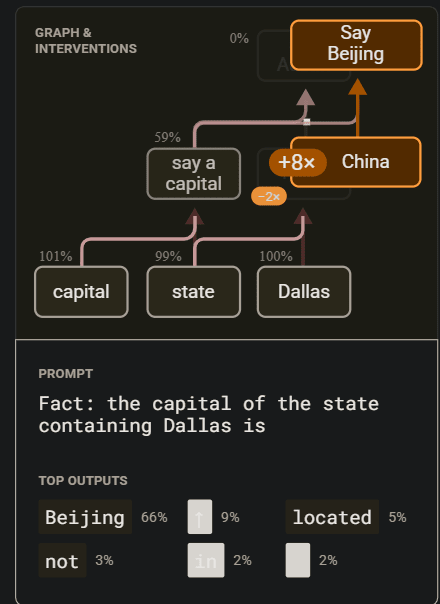
So they 8x all features in the China super-node and multiplied the Texas supernode (Texas is "under" China, meaning it's being "replaced") by -2x. That's really weird! It should be multiplying Texas node by 0. If Texas is upweighting "Austin", then -2x-ing it could be downweighting "Austin", leading to cleaner top outputs results. Notice how all the graphs have different numbers for upweighting & downweighting (which is good that they include that scalar in the images). This means the SAE latents didn't cleanly separate the features (we think exist).
(With that said, in their paper itself, they're very careful & don't overclaim what their work shows; I believe it's a great paper overall!)
I recently read a post by Dan Hendrycks from xAI criticizing Anthropic's focus on Sparse Auto-Encoders as a tool for mechanistic interpretability.
You can find that post HERE. Some salient quotes below.
On SAEs:
On RepE:
I'm not sure why the article seems to be taking the framing that SAEs and RepE cannot co-exist as safety methods, if I were taking the most charitable interpretation of his point I think that Dan is arguing that investment should focus on RepE over SAEs.
However from my perspective there have been some encouraging results with SAEs. Golden Gate Claude, or even just being able to "clamp" and/or "upweight" circuits like we saw in the Dallas example of biology of an LLM would both seem to indicate that SAEs features are on the right track to interpretability for at least some concepts. Ultimately I don't see why RepE and SAEs can't both be valuable tools.
I would like to hear what other people think about this criticism. Is it valid and focus should no longer be put into SAEs, or is there enough "there there" that it's still an avenue worth pursuing?