Still digesting, but one interesting quote from the report:
Our estimated acceleration is greater than that reported in the Haiku 5.5 system card (1.7x) primarily because of the inclusion of data on newer unreleased models, explained further below.
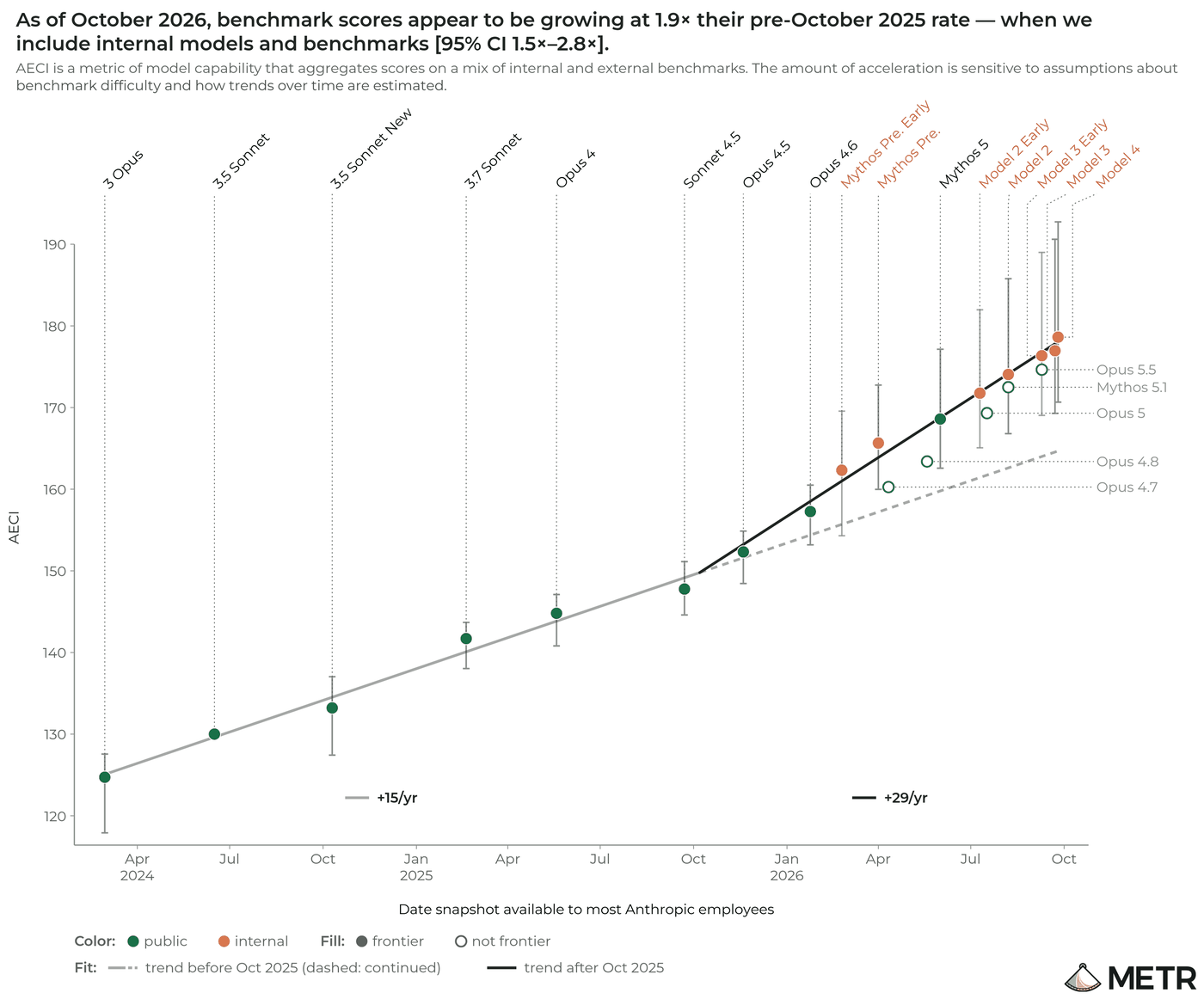
METR's new estimate from Anthropic's AECI is 1.9x [95% CI: 1.5–2.8x]. The public Haiku system card 1.7x estimate is, notably, still within that confidence interval, but more importantly, why wasn't everyone talking about the Haiku system card estimate from 10/7/26? It's still a huge jump from the ~1x acceleration (that is, no acceleration) trendline you see in Epoch AI's public ECI frontier![1]
Here's the chart from the Haiku system card (page 20, section 2.3.2):
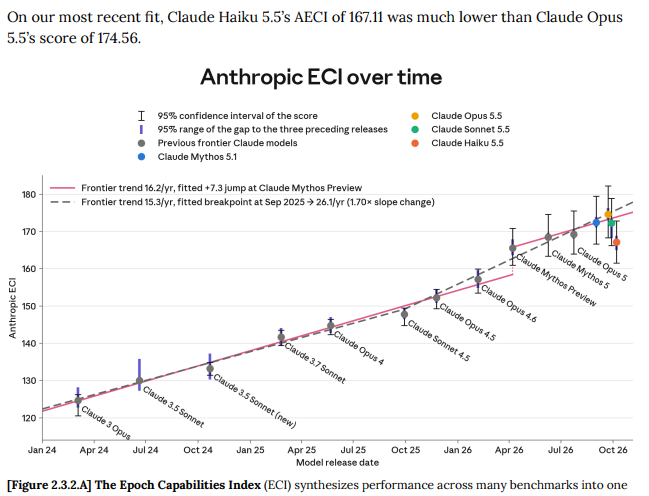
The essential claim is inside the figure, in the key for the dotted line: "fitted breakpoint at Sep 2025 ➡ 1.70x slope change". (they fit two trends, one breaking on Mythos Preview and treating it as a one-time jump—arguably wrongly considering the data on unreleased models METR just shared—and one breaking at Sep➡Oct 2025, aka roughly when AI agents became "actually good" at coding last year[2])
It seems to me that METR's AECI figure is a direct descendant of the above, just preferring the dotted trendline's choice of breakpoint:
Maybe no one paid attention to Haiku 5.5's system card because it was Haiku. Obviously there's way too much stuff in AI to read everything; even Zvi didn't do a full writeup on Haiku 5.5, and I can't find a mention of the ECI trend from the card in his recent posts, or online or on LW generally.[3]
Maybe the issue was that the key text was in an image, which AI agents typically don't bother to read…?
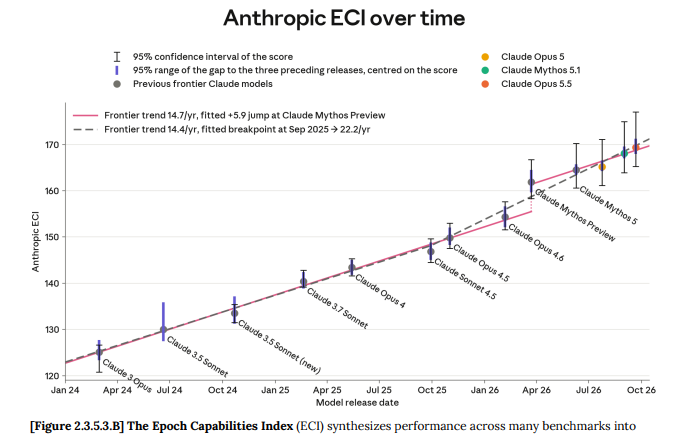
EDIT: Actually the full story is more complex, I should have realized, sorry. Anthropic has released a version of this figure alongside Opus 5.5 (9/22), Sonnet 5.5 (9/28), and Haiku 5.5 (10/7).[4] Opus chart:
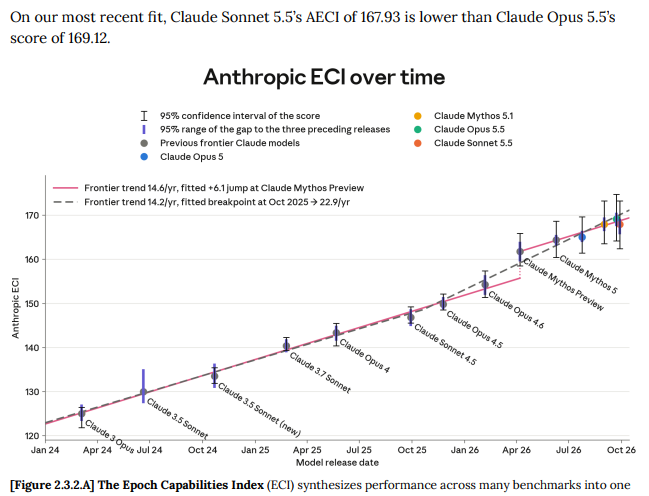
Sonnet chart:
For the Opus 5.5 figure, the system card does mention a 1.53x acceleration in the caption [95% CI 1.2–1.82x], given the Sep 2025 breakpoint. However it noted at the time that the solid line (one-time jump at Mythos Preview) "is a better fit to the data in 99 of 100 resampled fits", so it rather strongly discounted the 1.53x acceleration reading.
For the Sonnet 5.5 figure, the system card doesn't mention an acceleration number, but dividing the given trend figures 22.9/14.2, it's about 1.61x.
So we might summarize the evolution of this capabilities acceleration estimate as:
System Card | Fits to AECI trendline charted | Acceleration of AECI growth post-breakpoint | Stated fit preference |
|---|---|---|---|
Fable/Mythos 5.1 | pre-Mythos-Preview trend only | ~1x (implied) | one-time jump on Mythos Preview |
Opus 5.5 | jump +5.9 AECI on Mythos Preview | 1.53× | one-time jump on Mythos Preview |
Sonnet 5.5 | jump +6.1 AECI on Mythos Preview | ≈1.61× | none stated |
Haiku 5.5 | jump +7.3 AECI on Mythos Preview | 1.70× | none stated |
METR | break Oct 7, 2025, AECI slope 15 → 29/year | 1.9× | trendline break at ~Oct 2025 |
In other words, we're consistently updating this estimate of AI capabilities acceleration upward…[5]
- ^
EDIT: Worth noting that if you only look at Anthropic models on Epoch's ECI (as Anthropic's AECI does), then the acceleration is ~1.45x. More investigation into AECI vs. ECI in this comment and near the bottom of this comment.
- ^
IMO AI agents became "actually good" at coding in November with GPT-5.1/Gemini 3/Opus 4.5. It's kind of interesting that the Haiku system card trendline instead starts roughly with Sonnet 4.5, released on 9/29/25. And METR's chosen breakpoint is 10/7/25, which I understand to be fitted rather than arbitrary. (Other Anthropic model releases in that time period: Haiku 4.5 on 10/15/25, Opus 4.5 on 11/24/25.)
- ^
EDIT: While Zvi did not comment on Haiku 5.5's figure so far as I've found, he commented on 9/23/26 on a similar figure from the earlier Opus 5.5 system card (see more info on that below):
AECI, Anthropic’s spinoff of the Epoch Capabilities Index, is right on trend, but it is on the shifted Mythos-level trend not the old Opus-level trend. Is that still on-trend? I think basically no.
and then afterward he quotes analysis from METR that the system card quotes:
The estimate provided by the preliminary AI R&D report is ‘~1.5X overall acceleration in capabilities due to AI (i.e. 1.5 years in 1 year), with perhaps 30% chance of 2X acceleration.
which Zvi describes (correctly!) as a bombshell.
- ^
Fable 5.1's system card has an AECI figure (Figure 2.3.5.A), but doesn't try to refit at a breakpoint.
- ^
EDIT: You might wonder how the AECI slope keeps increasing from Opus 5.5 ➡ Sonnet 5.5 ➡ Haiku 5.5, when only the first is a frontier model. That's because Anthropic appears to be running new versions of the AECI across all models for each new system card, and this has mostly been shifting AECI scores for post-Oct-2025 models upward.
 1
Twitter thread.
Ryan Greenblatt:
Ajeya Cotra:
Daniel Kokotajlo: says the METR report confirms his worry from two days ago, which was:
See also GradientDissenter's take.