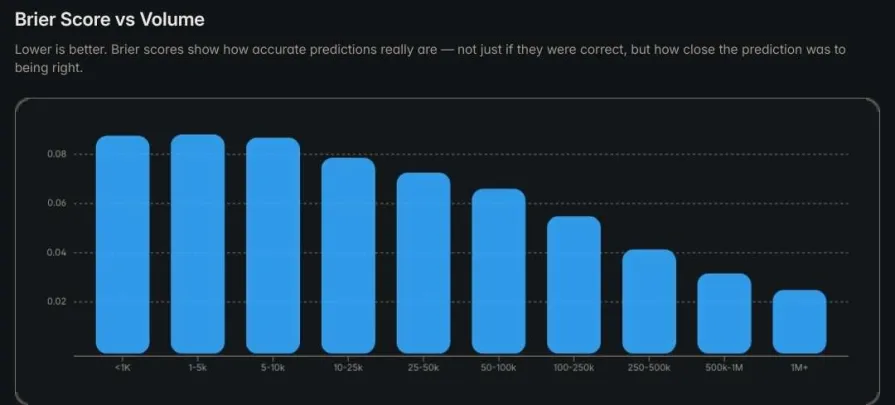
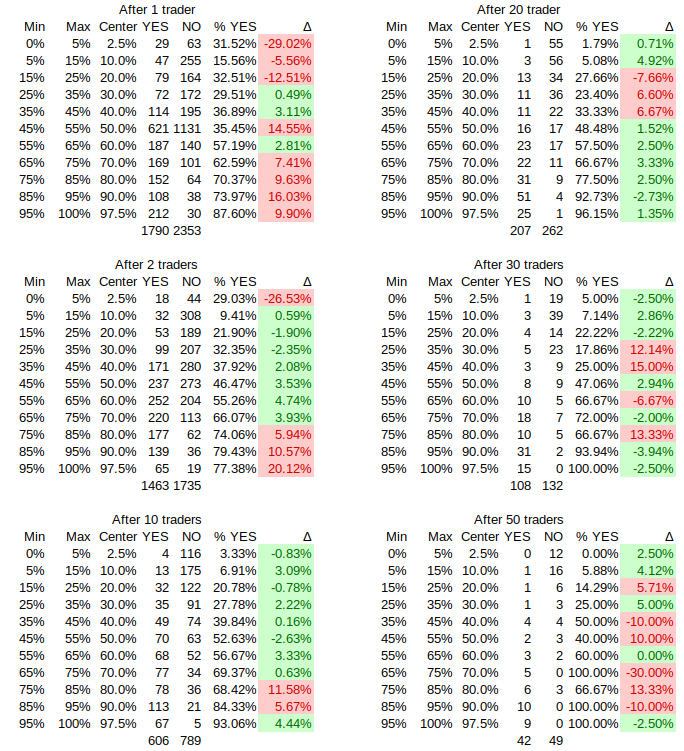
Manifold has calibration statistics about their markets. They seem well calibrated and the accuracy peaks around 10-20 traders. They even cite a paper from 2007 looking at small markets in 2006 that concludes that 16 traders should be sufficient. Polymarket plots brier score vs volume with .09 up to $10k, then .08 up to $25k, .07 up to $100k, .05 up to $250k, .04 up to $500k, .03 up to $1M, .02 for $1M+. Brier score is mean squared error (e.g. if I say 70% and it happens I have a score of .09), so that suggests it's fairly good even at relatively low liquidities.
The way I see it, it being cheap to swing the market isn't sufficient for manipulation. The question is how fast it gets corrected by other traders. Basically, if someone (or someone's trading bot) notices they can make bank. The theory then goes that manipulators increase accuracy by incentivizing informed trading - though I think this is a long run thing.
On manipulation, Manifold cites Scott Alexander's manipulation experiment, which got corrected in an hour:
I tested this by manipulating a scandal market about Manifold CEO Austin Chen, with his permission. It was originally at 4%; at 4:50 PM California time, I spent M$200 in play money (=~ $2 in real money) to manipulate it up to 95%. By 5:30 California time, it was back down to 4%. This isn’t a great example, because real attackers might be more subtle, make multiple small bets, only try to push it a few percent, etc - but I think it’s a pretty good sign. (the embed says the market currently has 78 traders and M48k liquidity, which is pretty high for Manifold)
It also cites an old paper by Robin Hanson, which in the introduction cites a few other papers showing failed manipulation in both the field and lab experiments. I don't know of bigger attempts now that prediction markets are mainstream, and would be interested in seeing data about Polymarket and Predictit.
Prediction markets of course have problems, but they seem to not get much worse at mid-low liquidity.
I think you are correct to look at activity though. Will activity will spike back up after manipulation? Perhaps someone should try noise trading a couple inactive markets as an experiment.
 1
Polymarket's brier score, from their accuracy page , along with Manifold's data broken out by liquidity as found in the comment they linked from their accuracy page
I see people repeatedly make the mistake of referencing a very low liquidity prediction market and using it to make a nontrivial point. Usually the implication when a market is cited is that its number should be taken somewhat seriously, that it's giving us a highly informed probability. Sometimes a market is used to analyze some event that recently occurred; reasoning here looks like "the market on outcome O was trading at X%, then event E happened and the market quickly moved to Y%, thus event E made O less/more likely."
Who do I see make this mistake? Rationalists, both casually and gasp in blog posts. Scott Alexander and Zvi (and I really appreciate their work, seriously!) are guilty of this. I'll give a recent example from each of them.
From Scott's Mantic Monday post on March 2:
(The first market that Scott quoted, the Ventuals future, is not a typical market that people reference -- I had never seen it before -- and is kind of complicated to analyze. I did an analysis of it but have decided not to include it in the main post as it brings the focus away from the specific point I want to make. I'll attach the analysis as a comment to this post.)
Let's take a look at the Polymarket market that Scott cites. Here's what its order book looks like when I'm writing this:
So, if I wanted to change the chance of Anthropic getting a $500B+ valuation from 90% to 75%, I'd have to spend checks clipboard $59. Okay, maybe we should add in the liquidity from the Yes side as well. In which case... $370. Someone could manipulate Scott Alexander and his tens of thousands of readers (some of whom are very powerful people who will be making important decisions based on their beliefs about Anthropic!) for a few hundred bucks.
What about the Manifold market Scott cites? Well, first of all, Manifold is a play money market, which means we have little a priori reason to expect it to be accurate or efficient. The utility (or lack thereof) of play money markets is not what I want to talk about in this post, though. What I want to focus on here is the (lack of) activity in the market that Scott references. Let's look again at a chart of it.
This is not what an active or efficient market looks like. There has been ~0 activity from March 9 to March 15.
Let's look at an example from Zvi now. From his Feb 26 AI newsletter:
I looked at these markets on Feb 26 and found that they were not very liquid. From my notes: "$1k trade is gonna move the market 20% on Polymarket. Kalshi market is a joke, each side is like 40 cents wide." Zvi was also live tweeting about these markets.
When Zvi tweets "The @Polymarket for Hegseth 'ban Claude by March 31' has crashed to 15%", the implication is that this market is worth taking seriously, etc.
Zvi is correct that these markets aren't efficient, but is wrong that there is Alpha. There isn't money to be made in these markets because they're tiny. In fact, due to how large the bid/ask spreads was on the Kalshi market, its odds would fluctuate 20%+ just based on whether the last trade was at the bid or the offer.
So, PSA: Please check the liquidity/activity/volume/spread of a prediction market before you reference it!
There's a corollary to be made about how prediction markets are causing people to make predictable epistemic errors. (Do people want me to make a post on this?)