We will likely have 100 billion AI agents of opus 5.5 level by 2030
Inspired by this: https://epoch.ai/publications/estimating-the-agent-population
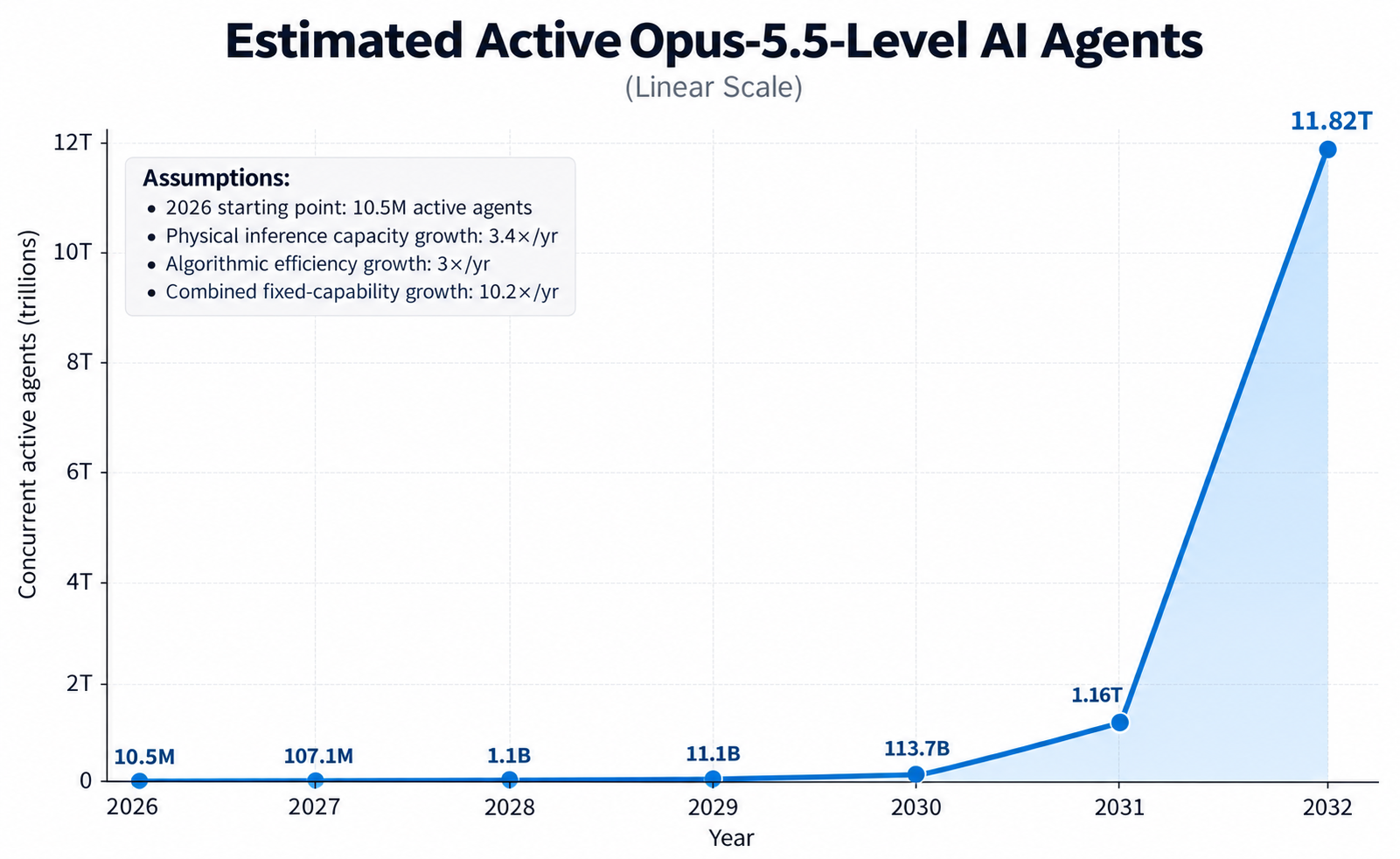
I thought let's take these figures and chart this forwards. How many agents will we have by let's say 2030 or 2032? Given that through 2027 there is enough compute to run tens of millions of Fable 5 models as per epoch, i'm assuming there are currently around 10 million opus 5.5 level agents in the world right now running 24/7 with all the available compute. It could be one OOM less, but that won't matter much for the conclusion.
From Epoch as well we know that total compute has been growing at around 3.4x a year
And the latest estimate we have of algorithmic efficiency is around 3x per year
Taking these things together we arrive at around a 10x growth in the total AI population every year. Which means by 2032 we'll have 11.82 trillion of Opus 5.5 level models, and by my estimations that would be around 2-3 billion of 2032 level models.
The ASML benchmark: When can a team of AI's fully autonomously produce EUV machines at the rate and quality that ASML can?
This is something I think about a lot. Solving an economically relevant problem that is on the cutting edge of humans can do. How hard is this? How far away are we from this?
AI's can't yet build a house together, nor can they do much in the physical world. So the ASML benchmark seems far away. I expect robots to build a house together fully autonomous by 2035. But EUV's are OOMS harder. Plausibly by 2050 I can see this happening. But I would be extremely surprised if I see this happen by 2035. And most likely this will be only a 2070+ event.
Even if you have smarter than humans AI's. Why could this still be far away? One intuition I have is that the Chinese likely have had a complete theoretical understanding of EUV's for a very long time, but they have so far for decades failed at the ASML benchmark. Plausibly because reality is irreducibly complex, and you just have to build one (which takes time), fail (which takes time), and learn from your mistakes (which takes time). They have the necessary intelligence to solve the ASML benchmark, but it is taking them decades to do it. The general intuition here is that even something superintelligent will be bottlenecked by the rate at which atoms move in the real world. A counterargument could be "simulated data", but for something that operates on nanoscale precision you probably can only do the thing in the real world.
Another reason is that probably lots of data is tacit/implicit that sits in the entire EUV supply chain in Europe and even if you understand all the things written down there's lots of things that aren't written down. Furthermore I think it's also like performing a symphony: even if you understand all the things written down and all the things not written down it's a performance that all has to work together in a harmonious whole to get the precision just right
For reference, the Chinese fully theoretically understood the MEMS/nanotechnology machines that my family makes as they just stole all the data from the company. But I believe only now after 20/30 years have they replicated one. I expect that they have even more information on ASML, all the written data, whole EUV machines themselves, and top ethnic chinese engineers and scientists who have worked there and they still have not succeeded. This makes me think this type of task is not strongly bottlenecked by intelligence and that the bottlenecks are elsewhere.