This is a special post for quick takes by faul_sname. Only they can create top-level comments. Comments here also appear on the Quick Takes page and All Posts page.
Comment Permalink
I think I found a place where my intuitions about "clusters in thingspace" / "carving thingspace at the joints" / "adversarial robustness" may have been misleading me.
Historically, when I thought of of "clusters in thing-space", my mental image was of a bunch of widely-spaced points in some high-dimensional space, with wide gulfs between the clusters. In my mental model, if we were to get a large enough sample size that the clusters approached one another, the thresholds which carve those clusters apart would be nice clean lines, like this.
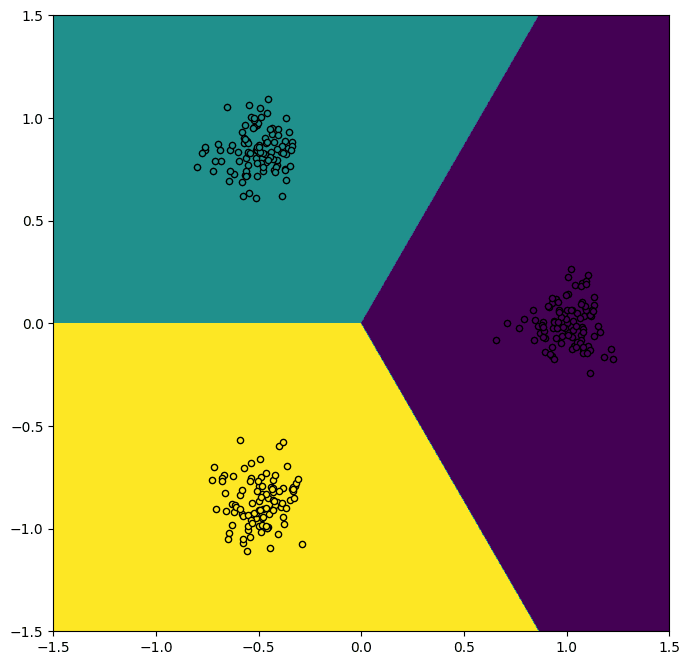
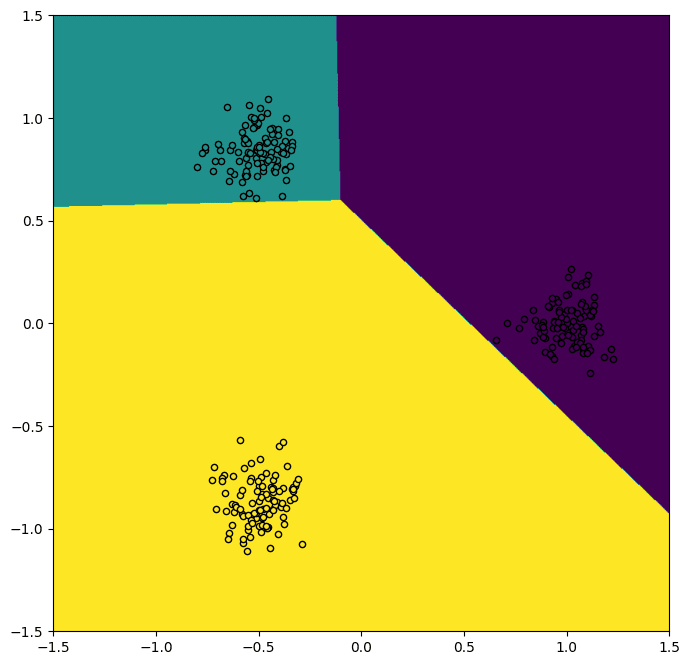
In this model, an ML model trained on these clusters might fit to a set of boundaries which is not equally far from each cluster (after all, there is no bonus reduction in loss for more robust perfect classification). So in my mind the ground truth would be something like the above image, whereas what the non-robust model learned would be something more like the below:
But even if we observe clusters in thing-space, why should we expect the boundaries between them to be "nice"? It's entirely plausible to me that the actual ground truth is something more like this
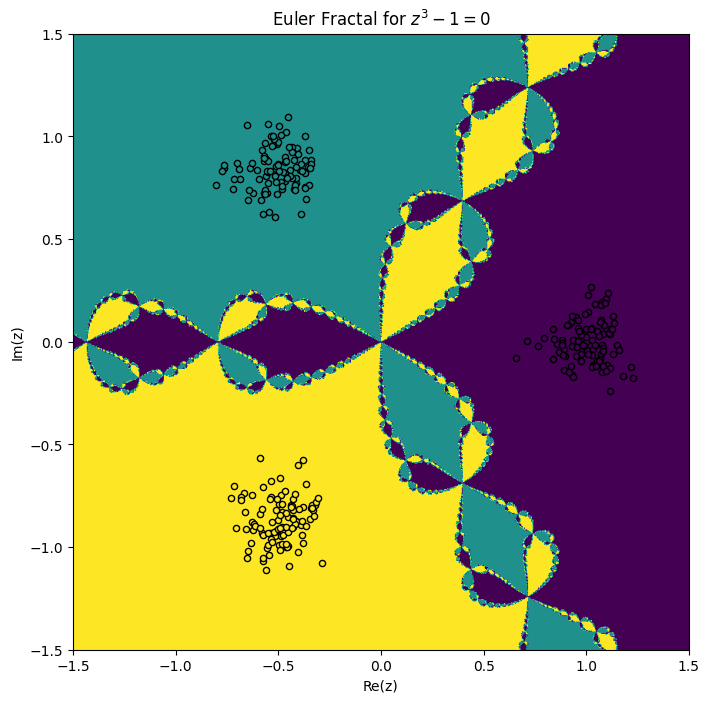
That is the actual ground truth for the categorization problem of "which of the three complex roots will iteration of the Euler Method converge on for given each starting point". And in terms of real-world problems, we see the recent and excellent paper The boundary of neural network trainability is fractal.