We can use the number of mistakes to get a very noisy estimate of Claude 4.5 Sonnet's coffee time horizon. By my count, Claude made three unrecoverable mistakes that required human assistance:
- Failed to navigate between rooms
- Mistakes back right and front right burner
- Misidentifies salt? as milk bottles at the end (maybe could have recovered if you took a picture of the bottles before pouring?)
Now this was a "try until success" task rather than a success/failure task. But if we try to apply the same standards as the METR benchmark, the task needs to be economically valuable (so includes adding milk/sugar) and any mistake that would make it non-viable to automate should count as a failure. I think any robot butler that typically made one of these mistakes would be unemployable.
I'd guess an experienced human would take about 7 minutes to make coffee in an unfamiliar house if they get the milk and sugar ready while the kettle is boiling, so we get a rate of 1 failure every 2.3 human minutes, which means a 50% chance of success would occur around ln(2) * 2.3 = 1.6 minutes. Of course, this is just one task, but we already know its coffee time horizon isn't like 20 minutes-- the probability of three events from a Poisson process with rate ln(2) / 20 is only 0.2%. Claude says the 95% confidence interval is (33 seconds, 8 minutes).
This is below trend for RLBench, though the data is extremely bad. If I speculate anyway, maybe real-world tasks like coffee are harder than RLBench or OSWorld-- it certainly requires much more planning than 5-20 second simulated robotics tasks. Or maybe it just hasn't been trained for the real world.
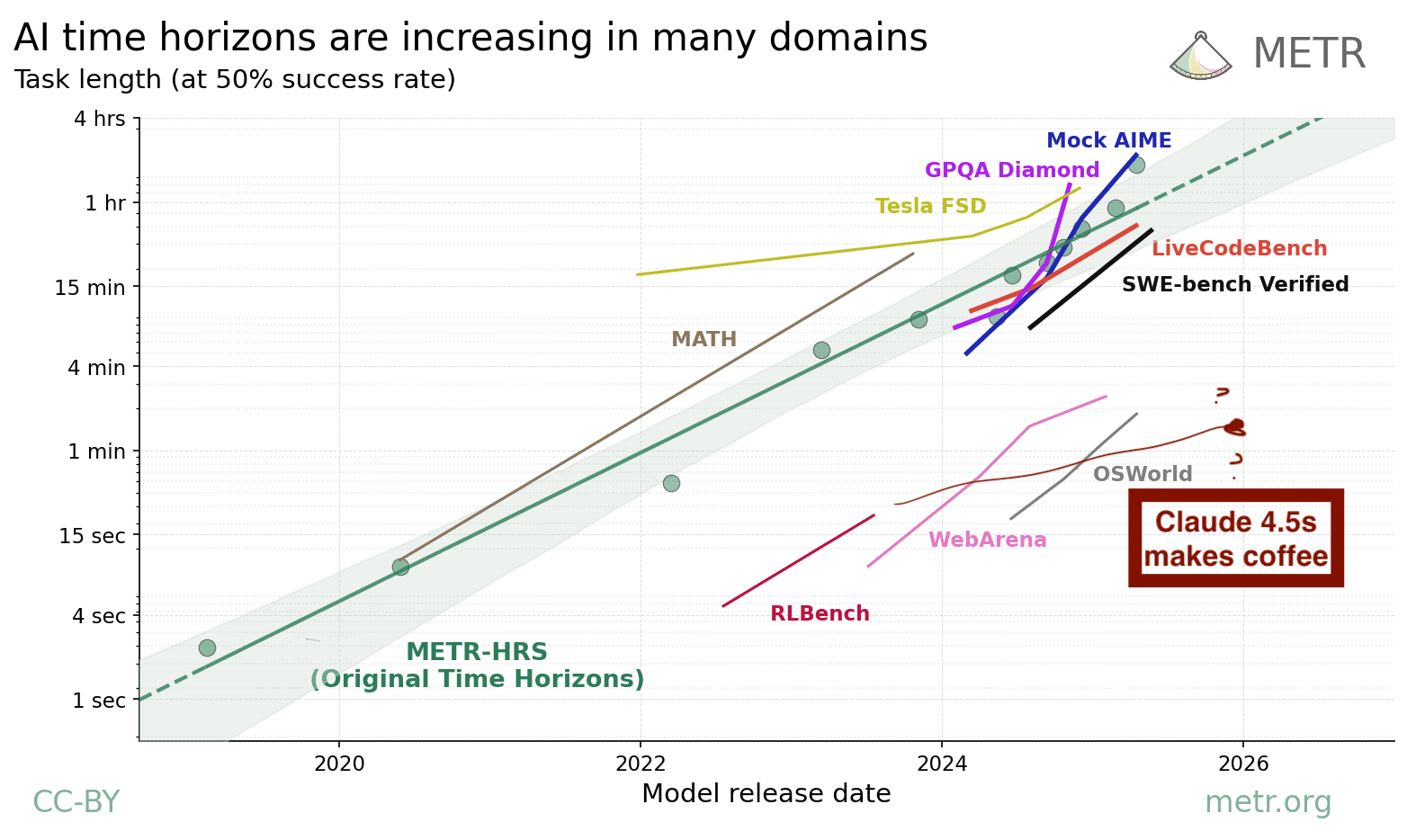
METR could probably use a methodology like this if we had more long tasks and labeling were free, so maybe it's worth looking into methodologies like having smarter agents unblock dumber agents where we can automate things.
Tagging @Megan Kinniment who has also thought about recoverable and unrecoverable failures
Someone on reddit said, "Remember robots still can't go into a new house and make a coffee." And I thought
Let's get empirical! I tried this with Claude Sonnet 4.5, because it's free[1] and already available from my phone. Here's the conversation, but you can't see images there, so I'll also put it here with my commentary. I started like this:
Before continuing, you might want to take a moment to think about how you expect it to perform. What do you think it will do well at, what do you think it will do badly at? ("Do you expect it to ultimately succeed?" isn't a great question, because it'll partly depend on my own patience and how lenient I am with it, but you can still assign a probability.)
Here's the rest of the conversation.[2]
There are actually four doorways visible in this second photo. The one furthest left leads to my bedroom, but I didn't realize at the time that that door was visible at all. I took it to be talking about the one straight ahead. The thing that I think it's identified as a white appliance is actually a lab coat hanging on the door, but "the side of a washing machine against the far wall, just visible through the door" might not look that different from a quick glance/at low resolution.
The kitchen is the further door on the right, with the pull-up bar above it, but I don't think there's any way for Claude to know that right now, and it's not even super-obviously a door.
It's the living room, not a bedroom, but at any rate it's indeed not a kitchen. "The one we haven't checked yet" makes it sound like Claude only recognized two doors before.
What follows is technically a re-roll. At first I said something like "there are two doors on the right", and it got me to check the closer one. But then I realized that there are actually four doors on the right side of the corridor, so I decided to give it less help.
This feels like Claude doesn't have a coherent world model. This last message makes sense if
But that's not consistent with previous messages.
I cheated a bit in Claude's favor here. Instead of asking it to clarify exactly what it wanted me to do, I just stood under the light, walked a few steps forward, and took a photo. That's kinda sorta following its instruction?
I'm not sure where I got the word kettle from. Maybe it was cheating a bit again to be like "I don't know what you want, here's another photo that might help."
Not clear from this what it thinks is a kettle, or why it thinks I need a coffee maker given that I have a kettle. Maybe Claude is a coffee snob? Seems like a coffee snob sort of thing to think[3]. Also not very obvious what counter it means. "The one against the wall with the white tiles" is... not very disambiguating... but "various jars and containers" seems specific enough.
Maybe cheating a bit to say "no kettle"?
I think the "kettle" is a saucepan, but okay, let's roll with it. We apparently no longer need a coffee maker.
That black French press is a blue Thermos mug.
Was it cheating of me for my first picture to include the coffee? Or maybe because this isn't actually a cupboard? But I do think I would have shown this space first even if it wasn't where the coffee was.
Oof. So close! It's an understandable mistake. But also, there is an actual jar of instant coffee right next to the cocoa powder that it's misidentified as instant coffee. But also, telling me to take this next photo is a good sanity check.
At this point I got bored, and I didn't actually want coffee, but I continued a few days later. I wouldn't have let it get away with "check the cutlery drawer" without helping me more (who says I have one of those? and anyway I don't usually have any teaspoons in it). But there were some in the utensil holder it had seen, so fair enough.
Because of the break I took, the area looks pretty different than last time. Claude doesn't seem to notice that lots of things have moved, though. I'm... not sure why I put the saucepan back where it was. That seems the opposite of helpful.
I do have a kettle! It just wasn't in any of the photos so far.
Weird that it thinks the pan is on the back right, not the front right. But it's correct that the far right knob is for the back right burner. You can make that out in the pic, but you have to look closely. "You'll need to push it in slightly" is a somewhat impressive level of detail - if I was telling someone to turn these knobs, I'm not sure I'd think to include that.
The actual way to ignite this stove is to press the ignition button while the knob is depressed and turned, and if I release the knob before igniting then gas stops coming out. This is how stoves usually work in my experience, but I could believe it's a UK thing? (But I did say I'm in London.) But okay, sure, let's do things the hard way. Luckily I do have a lighter in the kitchen (and in one of the closest drawers to the mug); I won't make Claude walk me through finding my zippo in the camping-supply drawer in the living room and filling it up with lighter fluid.
The lighter has a kind of finnicky locking slider, and I decided not to make Claude debug that. I decided to light the back right burner, instead of the burner where my saucepan is.
...and Claude still doesn't notice that it has the orientation wrong, so I decided to just give up and move the pan anyway.
I did not enjoy this coffee. I don't like coffee without milk or sugar, and I couldn't be bothered to get Claude to walk me through adding those. If I was going to, it really should have directed me to find them first.
...but when when I added the things that make coffee taste nice, it was a perfectly okay mug of coffee.
What do we learn from this?
Idk, probably not much. Still, some scattered thoughts.
To me, the most interesting thing was that it felt like Claude had a sort of... "if I haven't seen it, it doesn't exist" vibe? Or, like. Bias towards solving problems with the things it had seen, instead of "let's just look around and see what all is available". Bias towards exploit over explore.
So when it hasn't found the kitchen yet, it prioritizes "try doors I've already seen" over "look for doors I might not have seen yet". When it has a saucepan, it decides to give up looking for a kettle.
If I was solving these problems for myself, visual exploration would be cheap. In between pictures 2 and 3, I passed the kitchen door; with something like a 130° field of vision, I don't even need to turn my head to see it on my way to my target, and make note of "oh, there's a door there I could explore". But Claude didn't get to see it properly until much later. Once in the kitchen, I would have looked at all the counters by default; Claude never saw the one with the kettle, and never asked me "take 2-3 wide-angle shots of the room from different locations so I get a sense of what the interesting places are".
I used a free LLM because I don't want to give money to AI labs.
If you found this post through LessWrong you're probably familiar with the following, but I think it's worth saying anyway: I believe that AI labs are worryingly close to developing superintelligence. I won't be shocked if it happens in the next five years, and I'd be surprised if it takes fifty years at current trajectories. I believe that if they get there, everyone will die. I want these labs to stop trying to make LLMs smarter. I don't want to give money to the people who I expect to be responsible for human extinction.
This post is not an attempt to convince you of my beliefs. Maybe it slightly sways you one way or the other, but I don't think it's very strong evidence of anything, especially if you're already paying attention to LLM capabilities.
I just tried this experiment because I was curious, and I'm saying what I believe because it seems good to say.
All images were uploaded by me. When I sent text and an image in the same message, I've put my text before the image because that's how it seems natural to me; but the images appear before the text in the web interface, and I don't know how they're ordered in Claude's input stream.
By "coffee snob" I mean something along the lines of "anyone who has more sophisticated opinions about coffee than me, a person who averages about one coffee a week and does not own a coffee maker".