This is a special post for quick takes by hiAndrewQuinn. Only they can create top-level comments. Comments here also appear on the Quick Takes page and All Posts page.
Comment Permalink
Some brief notes, in the spirit of instrumental rationality, on using LLMs for comprehensible input in secondary language acquisition.
I feel this topic is barely discussed at all online, even here at LessWrong where it would seem to be of great value to people. The few posts I have seen are screeds on Reddit from people urging you not to go down this path merely because it's much easier and more affordable than a 20 USD/hour tutor.
So I want to outline my experience, which has been quite positive overall, and some techniques I currently use.
For any language with over, let's say, 1 million or so Internet-active speakers adequately represented in the training data, I feel confident saying modern frontier or near-frontier models (Opus 5+, ChatGPT 5.5+, etc.) are tremendously helpful for reaching at least CEFR B2+. This covers the vast majority of people who want to learn a language to communicate and go about their daily lives adequately, but I still wouldn't recommend them for truly niche languages without some additional research - for example Icelandic has less than half a million speakers worldwide, but the Icelandic government has long championed the use and improvement of these models for the explicit purpose of keeping the language alive.
You do have to get a little comfortable with the idea that in essence you are performing a "self-distillation" if you go all in on LLM-driven practice. But I would wager that most people who want to learn a language for productive ends don't really mind if they ultimately end up sounding a little bit like the Claudish of that language. Successful communication is successful communication!
Stephen Krashen, Paul Nation etc. are about 80% correct with their work emphasizing the comprehensible input hypothesis in my experience. Output is another story, you do need to practice that separately. LLMs can help with both of these, but output is harder. I'm a very big fan of spaced repetition systems, and probably take it farther than most people: Gwern's extended flashcards hypothesis and Wozniak's incremental reading were both mindquakes for me around 17-19 years old.
I prefer Anki for my SRS needs. If you install the AnkiConnect plugin, an agentic coding harness like Codex or Claude Code can trivially speak to Anki to do any number of complex operations on your behalf over its locally hosted port, so long as Anki is running. This is very, very useful compared to "just" creating and importing decks offline. Among other things you can hack new features into Anki quite easily using this combo, because the agents can live test any bespoke mods they make for you (Anki is very mod-friendly!) in real time with AnkiConnect. For example, if you want an updating counter on your flashcard showing you how many times you presssed the R key to repeat some dialogue, that's something you need a tiny mod for.
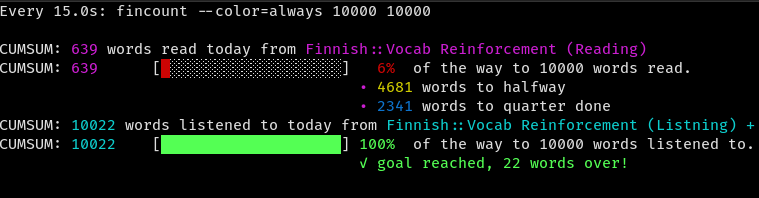
I'm somewhere in the B1-B2 range on the CEFR for my L2. I aim for about 10,000 words of listening comprehension input per day, and 10,000 more words of reading comprehension input, which I track with a tiny CLI program that counts these up for me using - you guessed it - AnkiConnect. That is a lot and I do not recommend starting with it, or anything close to it. Start with 100 words apiece. Add 100 each day you hit the limit until you get to 1000 words. Then you can start adding 500 words per day. Eventually life will show you how much time you truly have to devote to this. (Language learning takes a lot.)
Here's what that CLI program looks like today, as of this time of writing:
This is light heresy but I don't actually pay much attention these days to the actual Anki card queue. I just leave FSRS on 90% retention and don't futz with it beyond that. This is actually something somewhat implied by the extended flashcards approach; if you are truly building generalized skills in reading and listening comprehension, then FSRS overestimates how often you actually need to see a card before you can comprehend it just-in-time.
I have roughly 3 comprehensible input-focused decks I focus on:
- Reading
- Listening (single sentences)
- Listening
A Reading (single sentences) deck would probably be a good idea too for someone just starting out. Listening (single sentences) can be phased out in favor of one-shotting entire stories at a time, this is a good development.
When I was starting out I also used vocabulary frequency decks. These only give you the barest intuition to hook actual understanding on. The research of Dr. Paul Nation roughly suggests to me that you want about 10 single-sentence examples, per word sense, before the word starts to really bake itself into your brain.
For my L2, the Microsoft Edge TTS servers are the best free options around and I can have my robot friend easily convert anything I put in Reading or Reading (single sentences) to Listening / Listening (single sentences) with just that command. I do recommend you experiment a bit to find a TTS for your language that sounds natural enough you don't want to claw the headphones off of your ears when you do them.
You have several very useful parameters you can tweak when you tell your LLM to generate new cards for practice. Here are several, along with examples of what I as a B1-B2 CEFR person roughly use.
- Word count. These days I target 300-500 words for a Reading card, and 100-200 words for Listening. Less makes the task easier.
- The actual CEFR level to target.
- For Reading I target exclusively C1+ CEFR texts these days. These often bring in obscure vocabulary I don't recognize. I have a second Claude Code skill where I tell it words I did not recognize and have it generate easier texts at the B1-B2 level to practice those vocabulary words. If I truly needed to I would have no shame in telling it to generate even easier texts from those, at the A2 or even A1 level, but I'm a few years past that at this point.
- For Listening, which is something I've practiced much less than Reading until quite recently, I target a mix of longer A2 cards and shorter B1-B2 cards. (I actually only started practicing listening comprehension in earnest a few months ago, but the fact I went from 500 words per day kicking my butt to 10,000 words per day being a reasonable morning jaunt is a testament to just how valuable getting your reading comprehension super solid from the start can be. The challenge is entirely my brain and ears just getting used to hearing the words instead of seeing them.)
- Subject matter. If you read or listen to several cards with the same subject matter in a short time they will naturally start to make each other easier due to a lot of common vocabulary, themes, etc. For example I have a lot of cards generated around the subject of raising young children and dropping them off / picking them up from daycare, because that's a major part of my life right now. A little more embarrassing, I also have a lot of cards generated which tell me the lore of various video games, books etc. I like.
- Repetition, or grammar structures you want to emphasize or avoid. Here the sky is the limit. You can ask it to up the repetitiveness if you really want to train speed, fluency, ease of processing; you can ask it to use only the prophetic past tense if you want; you can ask it to make all the cards exclusively in the first person if you want to focus on soliloquizing.
- Listening only - speed: I mentioned I have a mix of A-level and B-level listening cards earlier; what I didn't tell you is that the A level cards all go at 1.2x speed, because they are there to train speed of processing for very staccato sentences. This is very handy in real world scenarios! You can get a tremendous amount done with ten 4-word sentences, even if it's less elegant than two 12-word sentences.
- Reading only - contextual hints. You can tell the LLM e.g. "put a brief (English gloss) after any words that you don't think a generalist CEFR B1 reader would recognize at first blush), and this can make your experience significantly smoother without much of a hit to comprehension practice at all. If you really don't want to interrupt your reading flow, you can have these be hover-over tooltips, or footnotes or something.
I end this by saying that in many ways I am the polar opposite of the ideal language-learning student. I have a tremendous intellectual ego, get easily paralyzed when I actually try to use my L2, and I generally regard the whole endeavor as an enormous waste of time and money for most people in most situations. The actual things I want to spend my time reading are dense philosophy books and scientific articles, not backswill about which kinds of diapers the daycare needs or what the name for that weird cheese slicing tool we have here is. There are so many other things I would rather be spending my time on than this.
But that's also why I think I've been so dogged in my pursuit of techniques to make this Sisyphean endeavor bearable over the long run for me, maybe even - dare I say it - mildly enjoyable at its peaks.
Quoth Gemini 3.5 Flash: "Reaching C2 CEFR (mastery/near-native fluency) in a foreign language starting from absolute zero as an adult is extremely rare—estimated at less than 0.1% to 0.5% of adult learners overall, though the odds vary significantly depending on the language family and immersion level." I happen to live in the country where my L2 is spoken, which is great for immersion, but I almost couldn't have chosen a less related language - it's not even Proto Indo-European, let alone a Romance language like the Spanish or Latin of my youth, or a Germanic one like my native English. And yet in a professional setting like this, it's basically C2 or bust for me; intermediate proficiency just doesn't get you very far in white collar work.
For the sake of my family I will continue to push this boulder uphill. I hope to anyone else who finds themselves in a similar situation that this braindump helps, or at least gives you some ideas.