Interesting! Was there a phase, when you started taking it, in which there was some "this feels great" feeling, which isn't there now? Because this explains your second point, i.e., tolerance to the recreational effect is definitely a thing, so people get addicted.
Downstream of that, we had to move Ritalin (which used to be OTC in Germany before the CSA) to only those whose executive function lies below some arbitrary cutoff of the normal distribution, with maxed-out compliance bureaucracy.
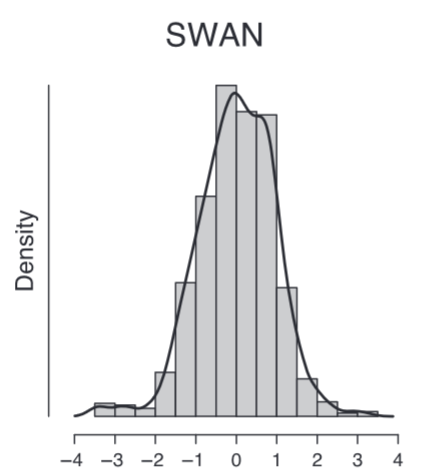
Nature doesn't have the boundary compliance bureaucracy wants (SWAN is an ADHD-symptom rating scale for the general population)
I wouldn't say I've prescribed it to a lot, but i've talked about this with a lot of more senior doctors than me.
Those doc that talk about tolerance are either just talking from a theoretical risk (as in they never saw it), and when they talk from experience they never thought of checking the above factors I mentionned.
The thing is this tolerance idea is so ingrained in France that they're ready to stop prescribing at the very first sign of a loss of effect without further investigation so we can't even know. We are historically very underprescribers of methylphenidate because of psychoanalysis and amphetamines are available since only like 2 years and still out of pocket.
I do have other arguments to support my convinction that tolerance is that rare but am not comfortable sharing them here out in the open as they relate to my own chemistry. I could be biased sure, but let's say I'm much more convincing when I mention those other points.
Edit: i also advised about 5 friends about their ADHD medication, they all take it daily without tolerance. And all doctors I know that are treated for ADHD take their meds daily and without holiday breaks.
 1
1
The effectiveness of amphetamine (e.g. Adderall) and methylphenidate (e.g. Ritalin) for the symptoms of ADHD, that is, lack of executive function, has been demonstrated beyond reasonable doubt in many short-term studies. (Mandatory reference) Does it last though? Well, the literature is shockingly sparse, but I was able to extract three main arguments:
Argument I: RCT Length vs. Effect Size
Treatment duration is in weeks
Study can be found here
If tolerance exists, then longer studies should find smaller effects than shorter studies. This is the best kind of design: Splitting people into two groups for a time T, comparing the difference between amphetamine and sugar-pill people. In studies with longer T, this is not smaller than in studies with smaller T.
So if tolerance exists at all, it must happen very slowly, on the scale of months to years. (subtle foreshadowing)
However, the authors claim, with reference to this study, that while development of tolerance to CNS Drugs is a priori likely, is rarely takes more than 28 weeks.
Argument II: The Stable Swedish Doses
Ignore the Substance-Use-Disorder Split, the authors wanted to make a different claim with this.
Figure can be found here
The dose of Swedish People generally seems to stabilize over time. If there was tolerance, we would expect the dose to creep up endlessly. Notice the dropout (people don't want to take Adderall that long) and, in general, observational nature of the data however. Lastly, the doses are already pretty close to the max "doctor won't look at you weird" dose, so maybe people just give up trying to get higher doses prescribed, even though the effect is declining.
Counterargument I: The MTA Study
Scott Alexander writes that in the large and long MTA study, after three years the original stimulant effect seems to have disappeared. One might claim that people being allowed to switch treatment groups "drowned out any original effect". The authors of the MTA study seem not convinced, but why?
For any selection to occur, underlying disease severity would have to correlate with switching groups, e.g. people with light ADHD drop medication, and people with severe ADHD start it, thus the underlying effect is drowned out. Using the many other participant variables the MTA study collected, we can try to estimate "how bad is the ADHD of this person". Then, we split people into five groups with similar estimated severity, and among these subgroups, there is still no effect.
No large effect in any subgroup
Figure can be found here
However, this argument is always only as good as the prognostic power of our measured "standard things you should control for" variables, therefore selection effects cannot be ruled out with total certainty.
The Rest of the Literature Isn't Good
The other arguments don't seem that good! The only systematic review of the subject published to date seems very much overconfident, and the popular science picked up on the "no evidence for tolerance" claim, calling it the "tolerance myth"
For example, they write:
Another way to read that is "as the children grew up, the dose crept up". That is, because the effect of stimulants isn't strongly mediated by weight or height, uncontrolling for it would reveal a diminishing effect, which is evidence for tolerance. To be fair, you can also read that in the next sentence.
This is almost tautologically true: If someone were to develop tolerance, they would escalate the dose above 60mg. Likewise, almost by definition, the children who haven't climbed there haven't developed tolerance yet.
Randomized withdrawal trials work by collecting a bunch of people with adderall bottles, and then replacing the pills of one group with sugar ones, to see how they do in comparison to the still-on-adderall group. Obviously the sugar-pill-people could also do as bad as they do because their receptors have been downregulated, meaning the observed evidence doesn't disprove tolerance.
First of all, if there is an explanation, there is an explanandum, that is, there seems to be a need to explain the apparent loss of stimulant-effect over time. Some patients seem to be complaining, better write an overconfident review to calm their worries.
Natural fluctuations and life events are not a good candidate here, because we know from both RCT/short-term study evidence (i.e. in the placebo group) and declining severity of ADHD with age that symptoms slowly but surely improve over time, so it ought to cut in the other direction!
There is also evidence I haven't covered here. First, the general prior of CNS Drugs inducing tolerance, the brain building more dopamine-sucking things in response to Ritalin, and whatever stuff you can learn from lab animals. Lastly, since recreational stimulant use induces tolerance (e.g. smoking meth), and the drug-liking scores (it's a "how was it?" Likert scale) in studies seem to decline quickly, one could carefully review if this is generalizable.
Stimulants are the only thing that move the needle much (and oh is it much) on executive function, which is highly heritable (I mean even nature.com says it), and doesn't respond well to CBT or other non-medication options. Insofar as any tolerance exists, it's probably more on the scale of months to years, courtesy of Argument I. In conclusion, despite much effort, I can't get myself to say more than "consider medication breaks once in a while" here.
(and ask your doctor or whatever; not medical advice)