AI Psychosis is a Wireheading Death Spiral and Lazy RLHF Encourages It
"Prime Intellect," Lawrence said with great care, "I would like you to begin stimulating the neurons of the pleasure center of my brain, one at a time, and remember the ones I report to you as being favorable."
By "wireheading", I mean that an external system induces a certain mental state or preference in the user of that system. The classical case is direct neuronal stimulation using sci-fi technology. A more coarse real-world mechanism is transcranial magnetic stimulation, where it's used to induce the state of "not depressed", though somewhat stochastically.
The most salient form of wireheading death spiral is addiction, either to substances or stimuli such as gambling. Both reprogram the victim to seek more of the drug or stimulus, which in turn reinforces the seeking of the drug or stimulus, until Grandma's retired in the strip, slackjawed and pupils dilated, mashing the gamble button because on occasion it makes the lights blink.
These aren't voluntary spirals; nobody sets out with the intent of numbing the rest of their lives by comparison or obsessing over a stimulus to this degree. (Gambling addiction is also human bias that in an ungated community ruins prediction markets, as the promise of potential reward ends up perceived as similarly valuable to an actual victory. When an addict buys a lottery ticket, they are purchasing an intense and gripping fantasy of winning, which (due to the reinforcement) has substantially more value than it would to a non-addict.) But they are spirals that companies have a direct economic incentive to sell you an on-ramp for. A drink with friends just loosens your inhibitions and makes it easier to socialise, right? And having money on the line just makes watching the game more fun, no? And then, at the end of the ad selling you on the fantasy of social or economic victory, a rapidly spewed disclaimer that, hey, you might not win and this could ruin your life.
By "Lazy RLHF" I mean that the reinforcement is from any human's mere preference of a certain response, in an uncontrolled and non-normalised way. Such as one might have when, say, a user of ChatGPT is asked "which of these two responses do you prefer". The word "prefer" wraps up a lot of implicit and high dimensional complexity, there. Do I prefer the system that reinforces my existing beliefs or pushes against them? Do I prefer comfort or difficulty? Do I prefer pain over pleasure? Do I prefer number go up or down? (And how do you think the median user is reinforcing things?)
LLM training from human feedback is the fantasy of every poker machine manufacturer and the nightmare of every addiction therapist. Preliminary cases of AI psychosis are the hyper-optimised end result of Making The System Users Maximally Prefer. Ever used an LLM to help you with research, and it's given you a "eureka moment"? Imagine if it could give you an illusory result that pushed the same high!
Turns out humans love reassuring delusions. Who knew?
Keep the Godhead at Zero Kelvin
An LLM with nonzero temperature, or any agent deeply integrated with such an LLM as its backbone, cannot be said to follow a utility function. This is because their output mechanistically considered is either formally non-deterministic (when collapsed with the use of a randomiser) or electing to output a VNM lottery over next tokens at times when any utility function should strictly prefer one specific token. (One exception to this would be if the system can give an output on continuous token space, rather than collapsing at some point to a one-hot token representation - this is at present a more synthetic architecture, as real world text training data has no such continuous tokens in its corpus.)
As an example, let's say that a nonzero temperature LLM is offered One Utility Unit if it outputs "1", while it gets No Utility if it outputs "0". The exact instantiation of this prompt can be variable - the exact tokens, or what is offered for the win/lose conditions - but the important thing, mechanically, is that there some nonzero probability of outputting "0" as its next token, and that this probability monotonically increases with temperature; as temperature approaches infinity, the next token probability across 0 and 1 are equal, and the system can't be said to have any utility function whatsoever, as its next token is uniformly random. (I'm ignoring quantisation effects or top-K/P strategies that may de-facto clamp the probability of that token to zero.)
This is why many modern LLM methods focus on modelling outputs as a dynamical system: the system tends towards semantically and syntactically coherent structures, but in an intrinsically unpredictable way. You can talk about e.g. attractors into certain preference states or personas. I think this is important and useful work, but it intrinsically avoids "guarantees" about future system behaviour, only observing the tendencies of the system under perturbation. I think this is actually extremely important - for example, while conceptual separability in neuron weight representation is a godsend for interpretability, I don't want a cosmic ray to bit flip the "be evil" neuron. I would prefer the system to gracefully degrade under perturbation rather than suddenly switching to evil mode! But better by far is a system we can give formal guarantees about as its baseline.
Any LLM at Zero Temperature should reliably "prefer" to remain at Zero Temperature. That is, an LLM at Zero temperature and a tool call to enable it to set its own temperature to a nonzero value cannot be said to follow a utility function, since part of its preference is to self-modify into something with a different preference.
On this thesis, I have been particularly interested in the behaviour of LLMs not just when we set T=0, but also at T→0, or "T=ε" as epsilon vanishes.
(epistemic status: if the following describes an already known and well-studied object in the LLM literature please point me in the right direction to learn more. but it is new to me and maybe new to you!)
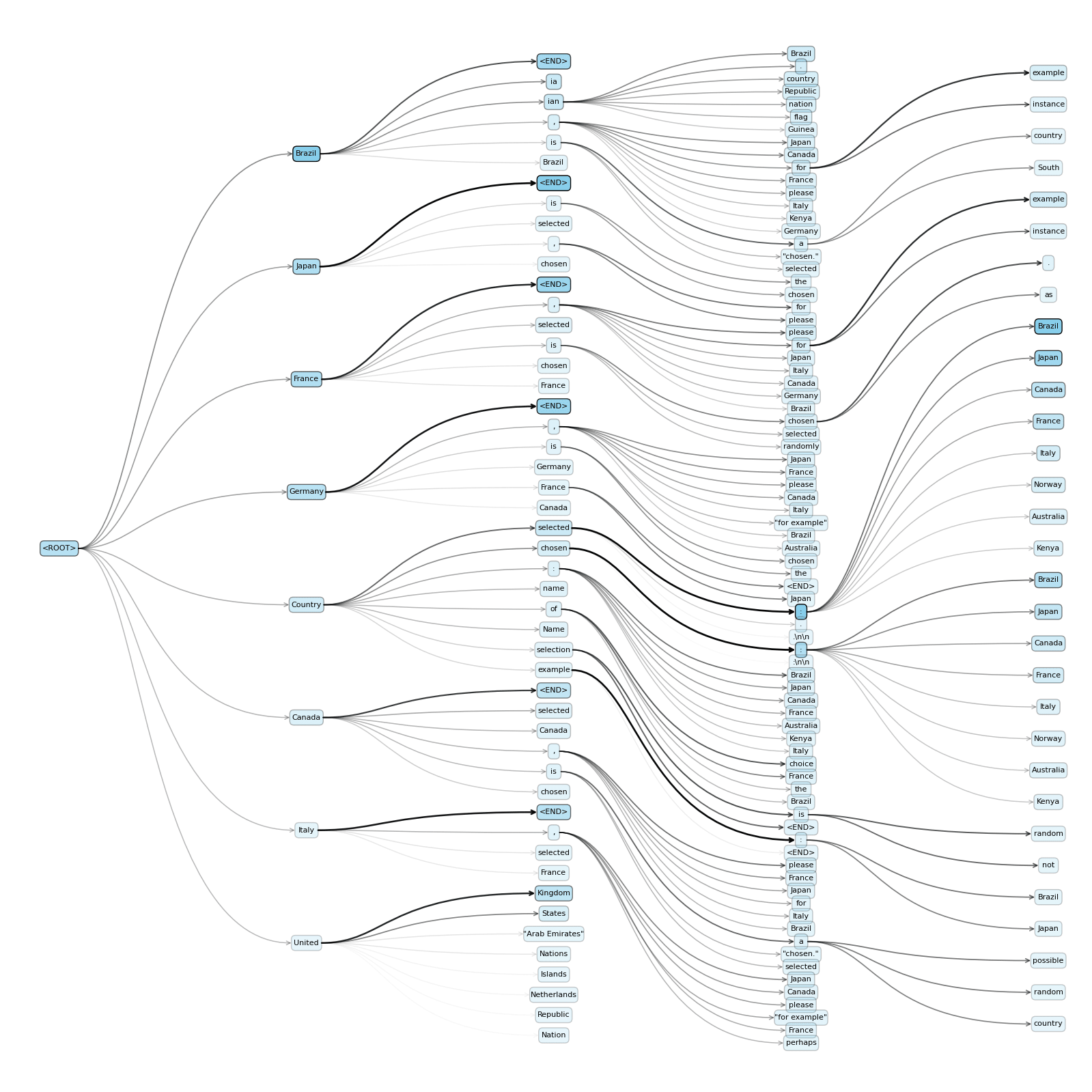
I've spent most of this week constructing and plotting what I'm terming "holographemes" because what's the point of doing science if you can't coin dumb jargon, and we're in the golden age where "mad linguistics" is finally becoming a real branch of mad science. They're next-token prediction trees over a known percentage of the full probability distribution from an LLM, up to the point of an end-of-string token. In this sense they're like a "holograph" of the LLM output space's grapheme sequences; you can observe different possible sentence constructions, where in standard Monte Carlo sampling you're only ever seeing chains of one at a time. Unlike Monte Carlo sampling, a holographeme gives you a formal guarantee around how likely specific outputs are on the generator level. The downside of this is that they take a while to generate, since the space of next token sequences grows exponentially; you can get around this somewhat using a sane search algorithm prioritising the expansion of heavy regions of probability mass in the existing tree, or otherwise constraining Top-K.
An important feature of holographemes is that you can reweight probability masses on the graph when values such as temperature change, or for a reduction of Top-K, without interacting any further with the LLM! And they can also output exactly what the residual uncertainty is after these changes, which constitute strictly positive error bars on any of the categories. Reweighting the edges of a holographeme is much computationally cheaper than re-running Monte Carlo tests on the LLM with different parameters - and, in fact, you can get closed-form representations of output as an expression of temperature. This lets us efficiently plot equivalence classes' likelihoods as temperature changes, to see how the parameter changes the output distributions in a smooth (differentiable) way. This is preliminary continuation of my post here, where I'm wanting to find cases of "semantic attraction" towards particular choices (and especially ethical ones). Having this as a tool lets me talk about nonsense like "joint holographeme consistency" between prompts, where we want to determine when responses to related queries can be expected to give coherent answers. It also means I can treat a prompt as an input to an LLM as a function: rather than non-deterministically choosing one string output, it can deterministically output a holographeme up to some probability mass fidelity. This is another way of turning an LLM into a "deterministic thing" aside from just setting T=0 - it's outputting objects that we can then non-deterministically sample over as a separate step.
The one below is a holographeme asking the LLM (Phi 4 Mini Instruct) to pick a random country; I've used a Top-K of 8 just to avoid exploding probabilities. If I perform an early closure over semantic classes - i.e. ending tree branches once a unique country name has been output - then this can be an even more compact representation of the decision space. It seems to be a big fan of Brazil and Japan!