Should you have personal relationships with your colleagues?
Everyone must decide for himself what is professional and appropriate here. A test might be to imagine yourself delivering a tough performance review to your friend.
It's possible for managers to be friends with their employees; I've seen it. But it's only possible if the economy allows it. Namely, if there's low unemployment and people know they can always find another equally good job, or there's enough safety net that they can afford to go without.
If the economy isn't as pleasant, and people depend on jobs for survival, then the manager-employee relationship is a power relationship. It's not possible for a power relationship to be friendship. Contrary to the quote, it's not a matter of what the manager decides. At most, the manager can make-believe that "I'm friends with this employee even though I can give them a tough performance review". The employee themselves will never feel that way.
That said, I don't think performance reviews specifically are a bad thing. The power imbalance is the bad thing, but assuming it exists, I'd rather work for a company with performance reviews than one with total manager discretion whom to fire when. Performance reviews are a kind of smoothing filter: they at least give the employee some months of warning, "you're about to get pushed out and you should think what to do next". It's still a bit of pretense, because (let's be real) a manager can always arrange for an employee to get poor reviews and get pushed out, given time. But this pretense and smoothing-out is still valuable, in a world where bills come every month.
Use random spot-checks
This is really, really hard to internalize. The default is to pay uniformly less attention to everything, e.g. switch to skimming every PR rather than randomly reviewing a few in detail. But that default means you lose a valuable feedback loop, while spot checking even 10% sustains it.
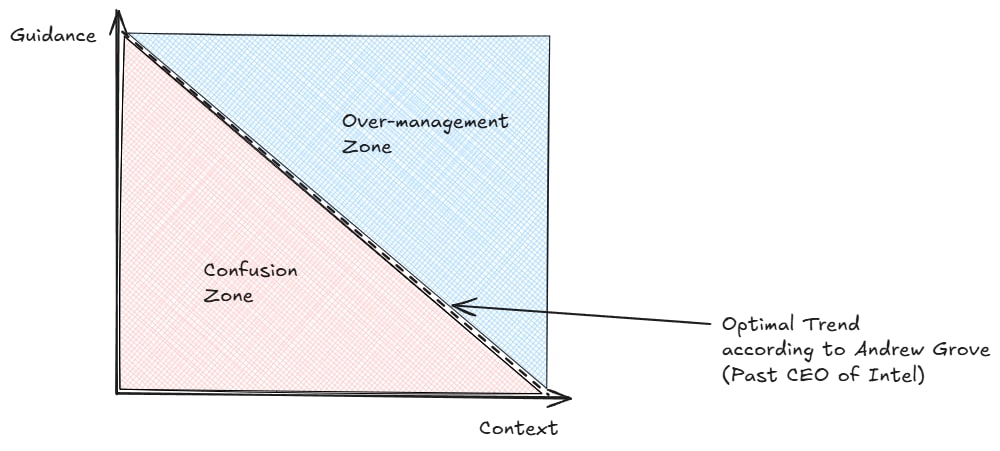
I liked this book too and I just wanted to share a graphic that was implied in the book between guidance and expertise. It's a pretty obvious idea but for me it was just one of those things you don't think about. The lower context someone has the more guidance they need and vice versa (the trend is not necessarily linear though):
I gifted a physical copy of this book to my brother but hadn’t read all of it. Fortunately, I may have absorbed some tacit knowledge on management from my father. Based on these quotes I don’t think that I will be surprised by the rest of the chapters.

Some months ago I read the classic management book High Output Management and made a note of quotes that rang particularly true to me. I normally dislike this genre (management books), and disagree with some popular ones (I sympathize with this review of Scaling People, for example), but found High Output Management pretty reasonable. It's also interesting to see the extent to which its recommendations continue to be followed in successful organizations to this date (the book was published in 1983, but is still popular and recommend amongst tech managers). This post is a list of my copied quotes (headings mine).
Delegate activities that are familiar to you
Should you have personal relationships with your colleagues?
Use random spot-checks
On performance reviews
Assess substance, not potential
Surprises
Criticize high achievers
On interviewing
Measuring problem-solving ability
Tricks bad