This is a special post for quick takes by jacquesthibs. Only they can create top-level comments. Comments here also appear on the Quick Takes page and All Posts page.
Comment Permalink
Al companies recognize which user is a Mathematician?
EDIT: After thinking about it, I place a >90% probability that this is just mathematicians having no idea that OpenAI is just very generous with Codex resets. Especially since few of them are even on X now.
ChatGPT seems unlimited for me too (even when Codex is rate limited)!
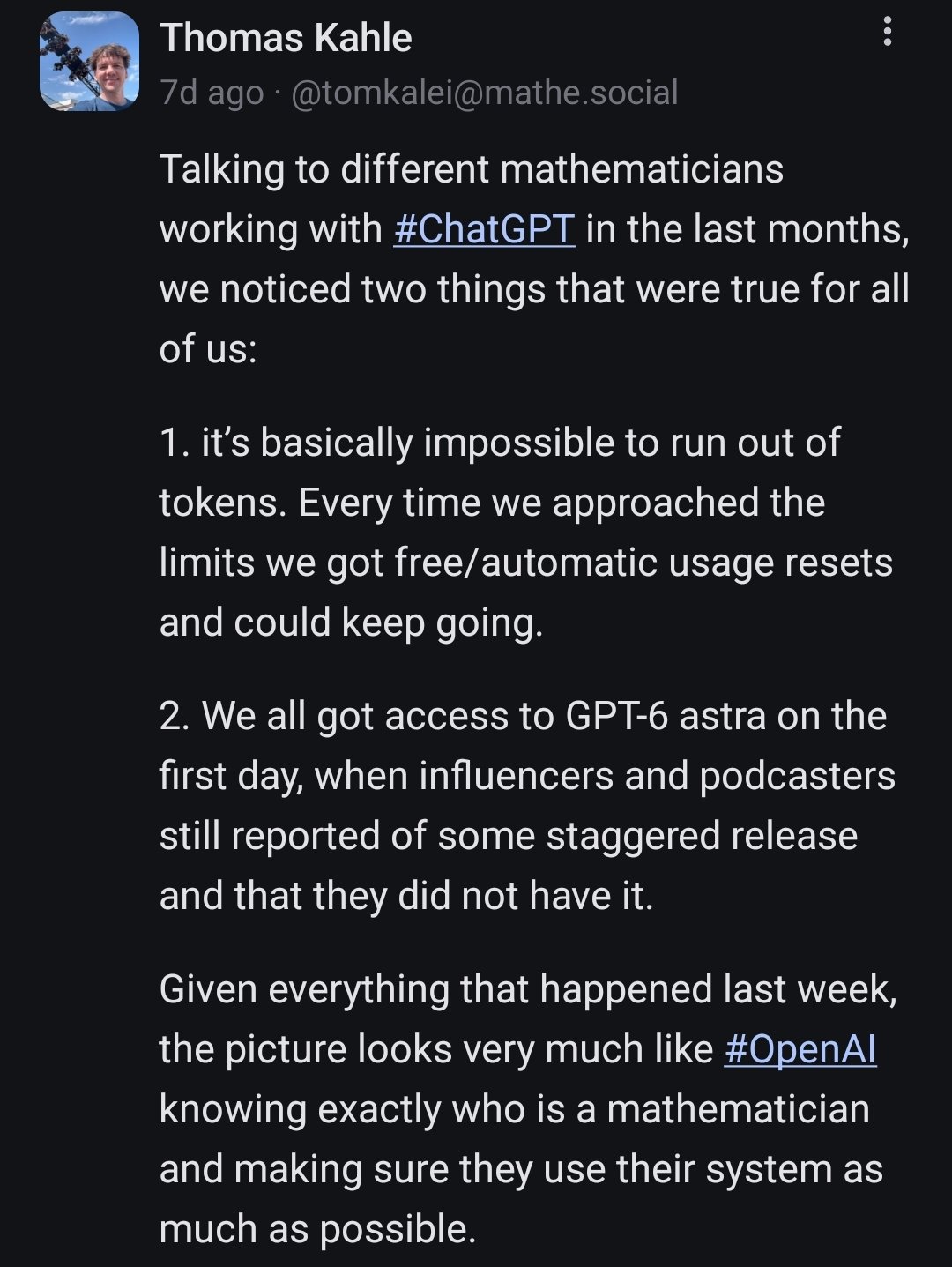
It's obvious the capability was there to identify mathematicians, but treating them as if they are crazy for thinking their work could be used without their consent is becoming questionable.
Unfortunately, we will likely be able to make only reasonable guesses based on imperfect evidence and the character of those involved. They can still say, "Oh, we just really want to support mathematicians and have them use our AIs!"
Overall, this is a fairly important question because if, for example, traces are made accessible to internal systems trying to make progress on math problems (without official direct training), it suggests their internal model capabilities are not as strong as they seem.
Previously, John Schulman stated:
This isn't the most notable aspect of today's news, but on the user data issue, there are different kinds of *training on user data* with very different privacy/IP implications. Sadly, AI cos don't like to disclose what they're doing.
- pretrain on user data, with users' tokens as prediction targets: high regurgitation risk, improper
- use user prompts to distill large models into small ones: low regurg. risk, some companies probably do this
- use user traces to construct RL tasks: low regurg. risk, because RL has low memorization abilities, but can extract customer IP, depending on how it's done. Ranges from benign "use explicit user feedback in reward model training" to invasive "upload user's coding environment and commit history to turn into rl envs"
"De-identification" is weak -- you can identify someone with a small number of bits, and long traces have more than enough. And it doesn't affect IP leakage concerns.
As a follow-up, it's exceedingly unlikely that training on user data contributes much to frontier model gains in areas like math -- those come from scaling up pretraining and RLVR. User data is more likely used to find failure modes or situations that are hard to recreate with hired annotators.
That said, model companies vary in how aggressively they train on user data (and uploading repos isn't hypothetical). I wish there were stronger norms around disclosing how companies train on user data -- with what methods, and to improve what capabilities.
As a response, I shared:
I think if I had no morals and wanted to win at all costs, I would certainly look to train (or at least prompt) on frontier research traces that point the internals much closer to novel solutions that may require non-standard approaches. Getting the ball rolling in the right direction for the swarm likely pays enormously.
And if the number of people who could provide those traces is nearing a handful worldwide? Of course I'd look up their traces or at least give them model access to them. How would they even know?
Though, I guess they would have a reasonable case that the LLM essentially copied previous work if they caught it making the same mistakes (like how Anthropic claimed their C compiler was cleanroom, but it made the same mistakes as Chris Lattner did a while back, which nobody does now): https://modular.com/blog/the-claude-c-compiler-what-it-reveals-about-the-future-of-software
In OpenAI's case, all we have is that the private hypodissipative result apparently suggested a path to unforced Euler (which, afaict, there was some partial evidence of in one 2024 paper, but it wasn't listed as a reference), which could substantially narrow the search space.
Showing 3 of 4 replies (Click to show all) 1
5
I find myself defending OpenAI's innocence-till-proven-guilty disturbingly often, but I think there are possible benign answers here:
1. OpenAI famously gives out tons of free usage resets compared to Anthropic. This was a key part of their strategy for gaining users for Codex from Claude Code. If you're not doing huge amounts of agentic programming or tool use, it would be hard to run out of resets/usage, esp. if you have a high-tier plan with no 5h limits.
2. Astra rollouts could have been targeted at other subsets of users that overlap with "mathematicians". For example, users that are unlikely to use 100% of their limits immediately, or users that typically use only the smartest model.
20
Yes, I agree with this as I noted in my edit.
I think there’s an important conversation to be had wrt the actual use of user data at various AI companies (afaict, Chinese companies have been the ‘worst’ about this), but what I shared is highly likely to be an erroneous example (for NS, I’d consider it a possible very small piece of evidence in a larger assessment of evidence).
12
My odds that openai could not have gound the NS solution are at like 7%, which is a hell of a lot closer to 50 50 that 0.
THAT being said: if in trying to do some other hard task like kill everyone with an engineered supervirus, it succeeds by lying, cheating, and stealing instead of honest scholarship, the universe will unfortunately award it full marks.